
Granule Packaging Systems
Industrial Granule Packaging Machinefor Bulk & Retail Products
Automatic granule filling & sealing solutions from 0.5 g stick packs to 2,000 kg jumbo bags, engineered for food, pharmaceutical, chemical and feed producers.
50+ machine models · Installed in 100+ countries · 30+ years of granule dosing experience
An industrial granule packaging machine for bulk and retail products has to do two very different jobs with the same free-flowing material: fill 10–50 kg sacks for distributors at 300–900 bags per hour, and fill 1–100 g stick packs, sachets or pillow bags for shelf-ready SKUs at up to 720 packs per minute on a 12-lane system. This page is written for procurement managers, plant engineers and equipment distributors comparing granule filling and sealing equipment. It covers dosing technology, format-specific specifications, compliance requirements for food and pharmaceutical contact parts, and the steps from line audit to formal quotation.
Key takeaways
- Multi-lane stick pack and sachet systems run 2–12 lanes at 30–60 cycles per minute per lane, dosing 0.5–100 g per pack with ±1% accuracy.
- VFFS pillow-bag machines paired with 10- or 14-head combination weighers handle 20 g–5 kg retail bags at 40–120 bags per minute.
- Open-mouth bag lines for 10, 20, 25 and 50 kg sacks reach 300–900 bags per hour with ±0.1–0.2% net-weight accuracy.
- Standard lead time is 35–60 working days for catalogue models and 90–120 days for integrated turnkey lines; minimum order quantity is 1 unit.
- Product-contact parts in SUS304 or 316L stainless steel and FDA-compliant seals are standard; CE, ISO 9001 and GMP documentation is supplied for export markets.
Granule Filling & Sealing Machines for Bulk and Retail Formats
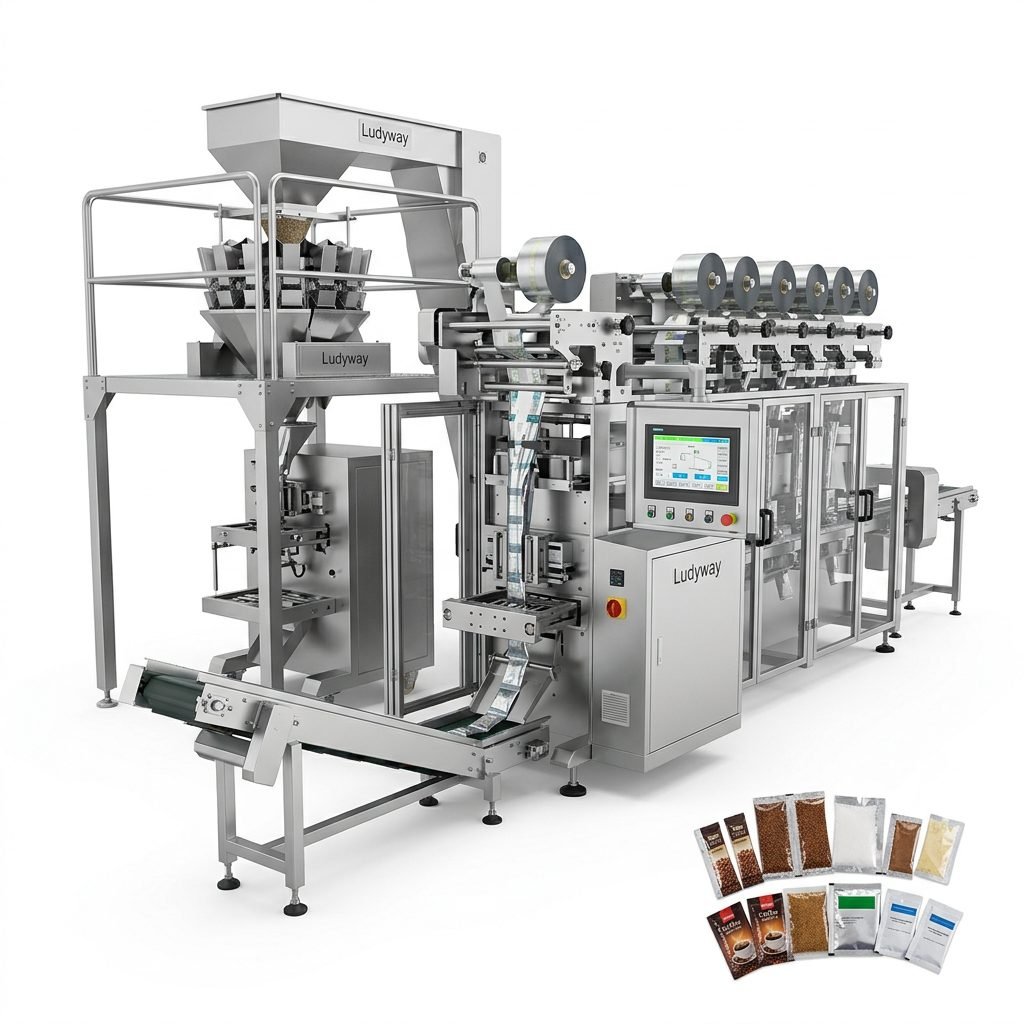
Automated Granule Packaging Line
Turnkey Line, Food & Pharma
Quote on request
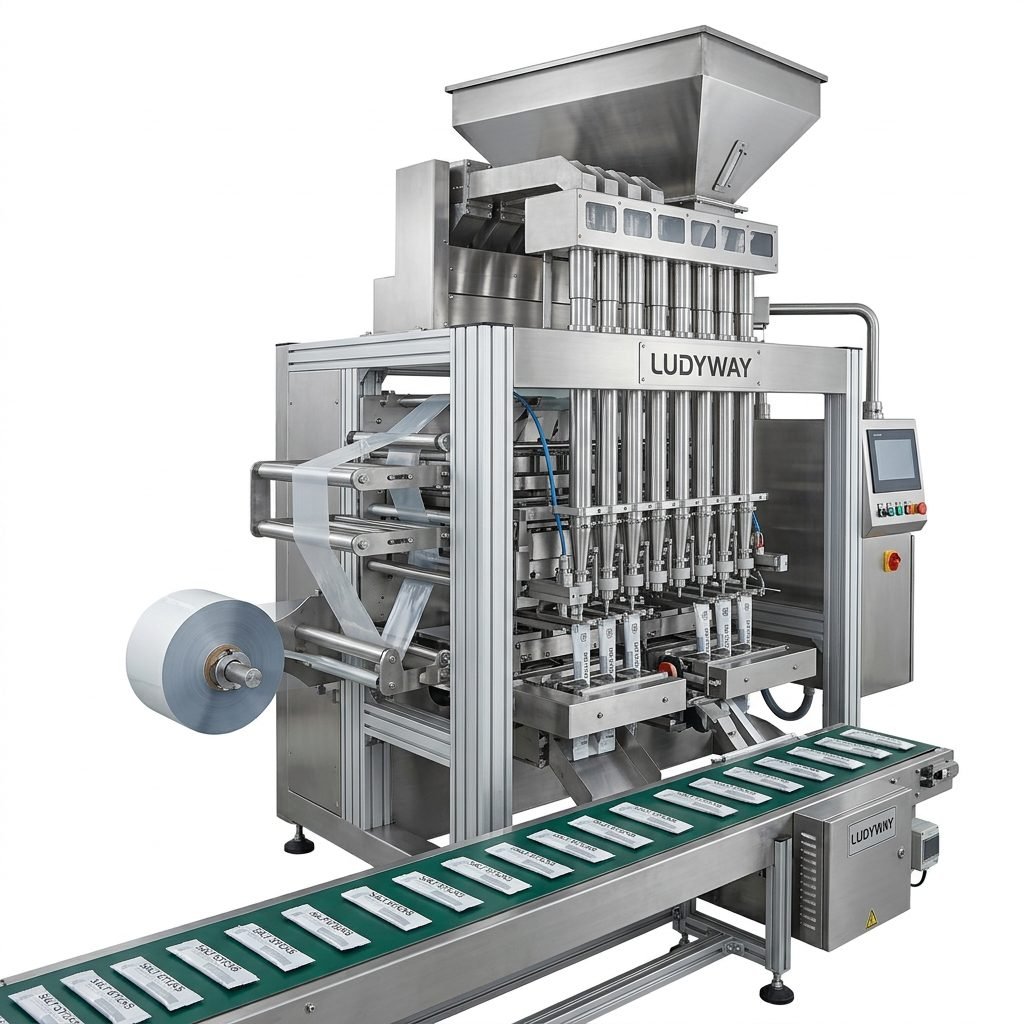
Granule Stick Pack Machine
Multi-Lane, Retail Portion Packs
Quote on request
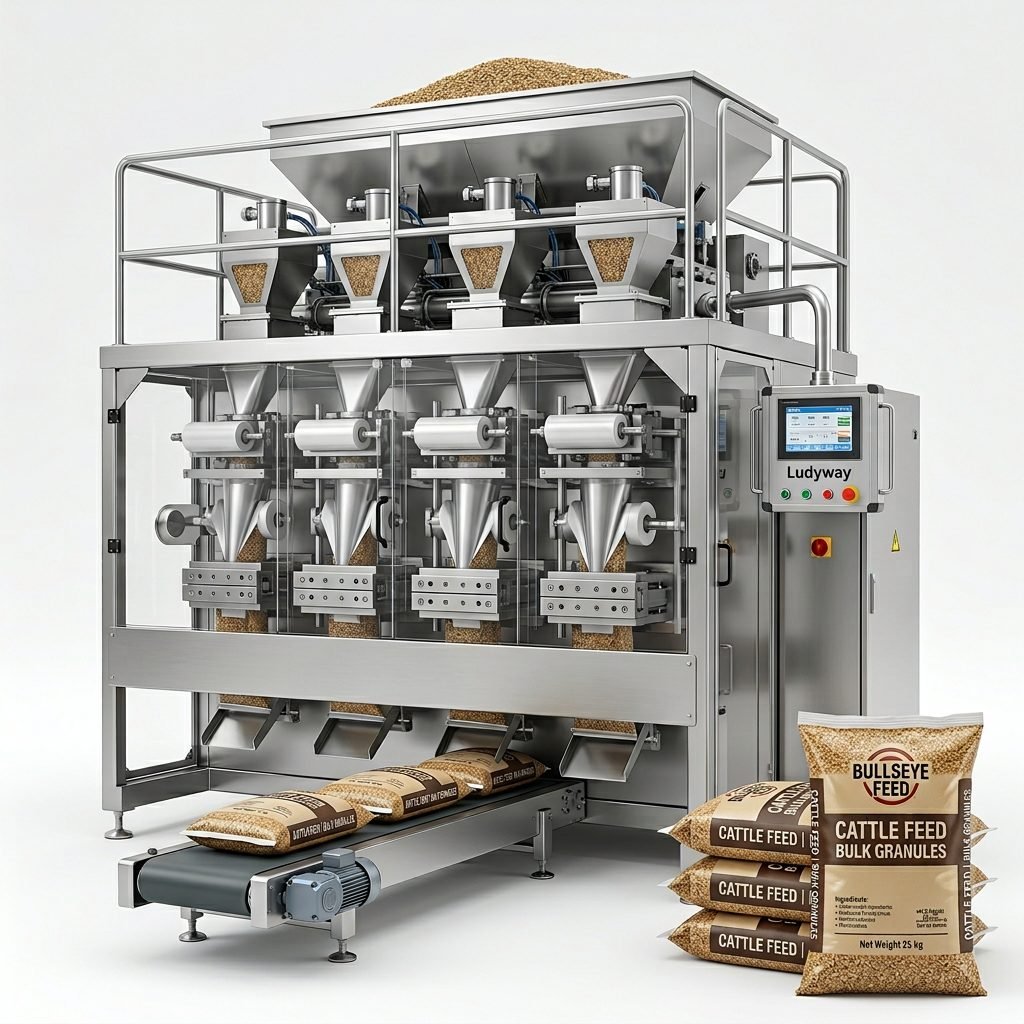
Bulk Granule Bagging System
Feed & Agri, 10–50 kg Bags
Quote on request
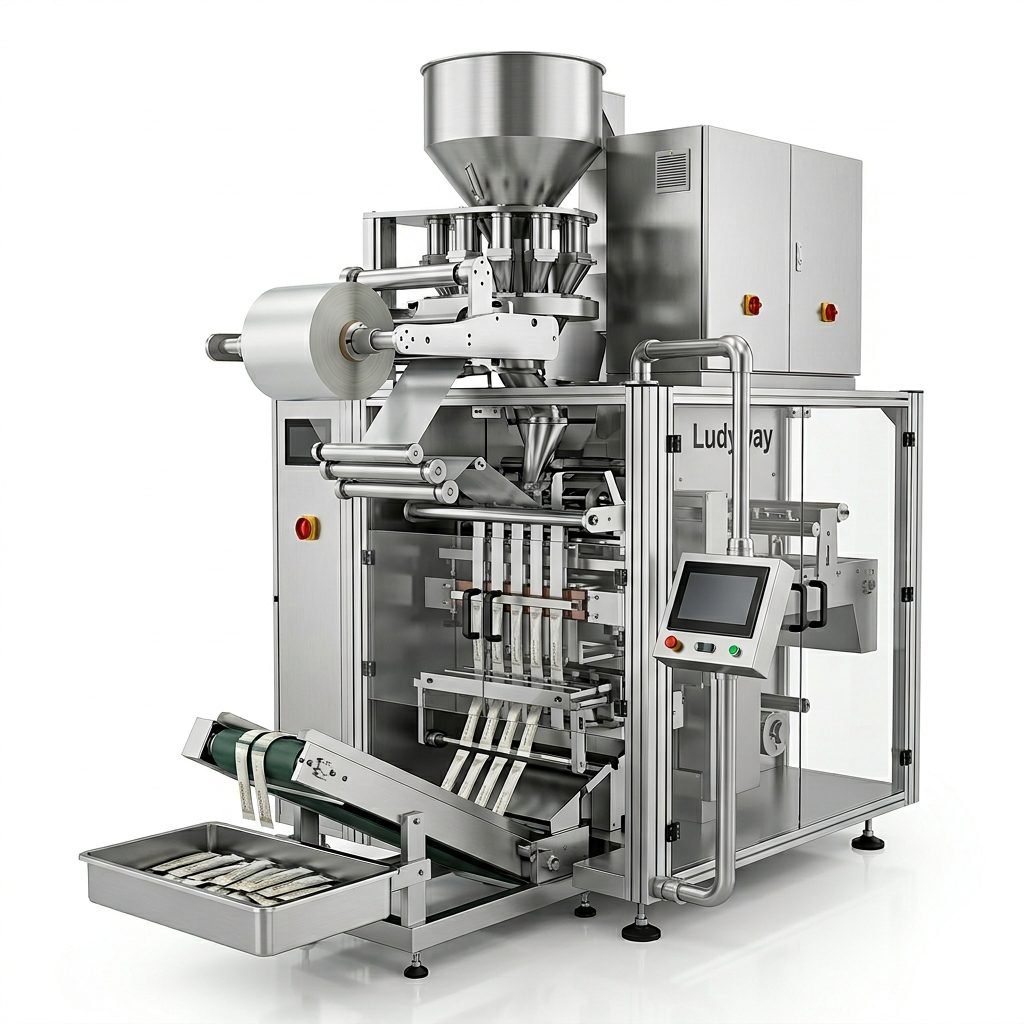
Starch Granule Packaging System
Multi-Lane, Food Ingredients
Quote on request
View all granule packaging machines →
Bulk vs. Retail Granule Packaging: Two Jobs, One Engineering Logic
Granules are easy to dose compared with fine powders, but the two commercial formats pull equipment design in opposite directions. Bulk packaging prioritises throughput in kilograms per hour, bag integrity for pallet stacking and weighing accuracy that protects margin on every tonne. Retail packaging prioritises packs per minute, seal appearance, portion accuracy and fast changeovers between SKUs. Buying the wrong architecture for the job is the most common and most expensive sourcing mistake.
Bulk granule packaging (10 kg – 2,000 kg)
Open-mouth and valve bag lines use gross or net weighers to fill 10–50 kg PE, woven PP or multi-wall paper sacks, followed by heat sealing or sewing, conveying and palletising. Jumbo bag (FIBC) stations fill 500–2,000 kg with a platform scale and dust-tight spout.
Typical buyers: fertilizer and feed mills, sugar and salt refineries, rice and grain processors, chemical granule producers. Key metric: bags per hour and net-weight deviation per tonne.
Retail granule packaging (0.5 g – 5 kg)
Multi-lane stick pack and sachet machines form 3- or 4-side-seal packs from a single film reel across 2–12 lanes, while VFFS machines with combination weighers produce pillow, gusset or quad-seal bags. Premade pouch machines add zipper doypacks for premium shelf presence.
Typical buyers: coffee, sugar, seasoning and cereal brands, nutraceutical and pharmaceutical granule producers, pet treat manufacturers, co-packers. Key metric: packs per minute, seal quality and changeover time.
How an Automatic Granule Filling and Sealing Machine Works
Whatever the pack size, every automatic granule packaging line follows the same five-stage sequence. Understanding each stage helps you specify the right options, because most performance problems (give-away, leaking seals, product in the seal area) trace back to a single stage that was under-specified at purchase.
01
Feeding
Vibratory feeder, screw conveyor or Z-type bucket elevator lifts granules into a buffer hopper with high/low level sensors to keep the dosing head full.
02
Dosing
Volumetric cup, auger, linear weigher or multi-head weigher meters the target weight; servo control adjusts in real time from checkweigher feedback.
03
Forming & filling
Film is drawn over forming tubes (stick/sachet/VFFS) or bags are placed by a bag applicator (bulk); product drops through anti-static chutes into the open pack.
04
Sealing & cutting
Heated jaws at 120–180 °C or ultrasonic sealers close the pack; servo-driven cutters, tear notches and inkjet or thermal transfer coding run inline.
05
Inspection & end of line
Dynamic checkweigher and metal detector reject off-spec packs before case packing, carton sealing and robotic palletising.
Choosing the right dosing system for your granule
The dosing head is the component that decides accuracy, speed and how much product you give away over a year. Free-flowing, uniform granules such as sugar, salt or rice run fastest on volumetric cups; irregular or fragile pieces such as nuts, dried fruit or kibble need a multi-head weigher; bulk sacks rely on net weighers for legal-for-trade accuracy. A high-precision dosing system can be specified separately when integrating into an existing bagger.
| Dosing system | Best for | Fill range | Typical accuracy |
|---|---|---|---|
| Volumetric cup filler | Uniform free-flowing granules: sugar, salt, seeds, rice, desiccant | 1–500 ml | ±1–2% |
| Multi-head combination weigher | Irregular or fragile pieces: nuts, dried fruit, cereal, pet kibble, candy | 10–5,000 g | ±0.5–1 g |
| Linear / net weigher | Bulk sacks: fertilizer, feed pellets, resin, grain | 5–50 kg | ±0.1–0.2% |
| Auger filler | Granules with fines or slight stickiness: herbal granules, drink mixes, electrolytes | 1–5,000 g | ±0.5–1% |
Technical Specifications Buyers Should Compare
Request these parameters on every quotation so that machines from different suppliers can be compared on the same basis. Output figures should always be stated for your product and your pack weight, not as a theoretical maximum on an empty machine.
| Parameter | Multi-lane stick / sachet | VFFS pillow bag | Open-mouth bag 10–50 kg | Jumbo bag (FIBC) |
|---|---|---|---|---|
| Fill range per pack | 0.5–100 g | 20 g–5 kg | 10–50 kg | 500–2,000 kg |
| Output | 2–12 lanes, 30–60 cpm per lane | 40–120 bags/min | 300–900 bags/h | 20–40 bags/h |
| Dosing | Volumetric cup or auger | 10/14-head weigher | Net or gross weigher | Platform scale, loss-in-weight |
| Packaging material | Laminated or mono-PE film 60–120 µm | Laminated, mono-PE or paper-based film | PE, woven PP, multi-wall paper | Woven PP FIBC with PE liner |
| Power & air | 4–8 kW, 380 V 3-phase, 0.6 MPa | 5–7 kW, 380 V 3-phase | 6–12 kW incl. conveyors | 4–8 kW |
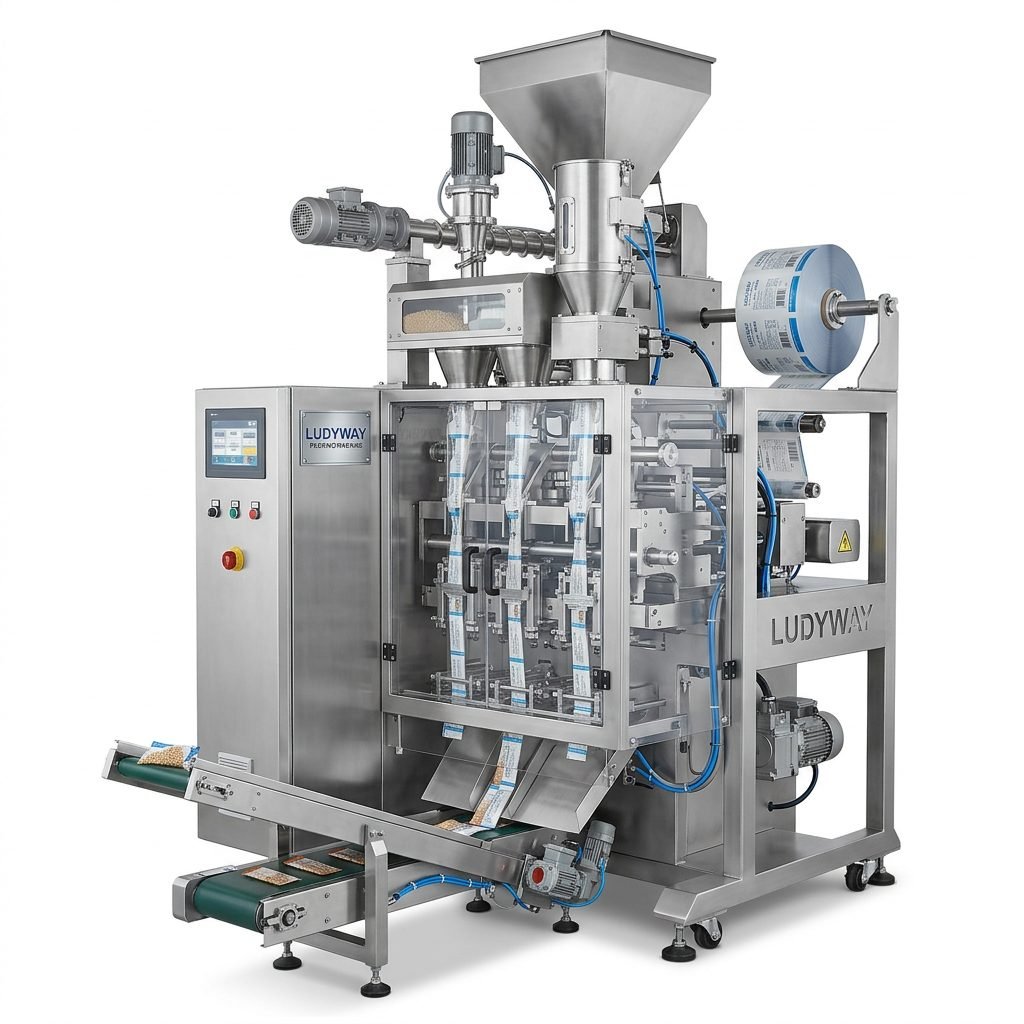
Multi-lane system producing retail portion packs of granular product from a single film reel.
Retail formats: what drives output and cost per pack
On a multi-lane machine, output scales with lane count, so an 8-lane unit at 45 cycles per minute delivers 360 stick packs per minute from one operator. Lane count is fixed by the film web width (up to 1,000 mm), so decide your maximum stick or sachet width before ordering. Servo film pulling, photo-eye registration and PID-controlled sealing jaws are the three options that most reduce film waste and reject rates.
For bags above 100 g, a VFFS machine with a 10- or 14-head weigher is more economical than adding lanes. Ludyway’s multi-lane stick pack and sachet machine can be configured with volumetric cups for free-flowing granules or augers for granules with fines, and changes between recipes from a stored HMI profile.
Bulk formats: weighing accuracy is the business case
On a 25 kg line running 600 bags per hour, a 0.2% improvement in net-weight accuracy saves roughly 30 kg of product per hour of give-away. That is why bulk granule baggers are specified by weigher class first and speed second. Dual-speed (coarse/fine) feed gates, load-cell weigh hoppers and automatic tare compensation are standard on quality equipment.
A complete 25 kg bag packaging line typically includes a bucket elevator, surge hopper, net weigher, bag clamp, heat sealer or sewing head, flattening conveyor, metal detector and palletiser. Dust collection and explosion-rated electrics should be specified for fertilizer, resin or feed applications.

Automated granule packaging line integrating feeding, weighing, bagging and conveying.
Applications Across Industries
Granule packaging equipment is one of the most cross-industry categories in packaging machinery. The same core architecture is adapted through material selection, hygiene design, dust control and dosing choice for each sector below.
Food & beverage
Sugar, salt, instant coffee, breakfast cereal, rice, nuts, dried fruit, seasoning granules and drink mixes in 1–5 g sticks, 100 g–5 kg retail bags and 25–50 kg industrial sacks.
Pharma & nutraceutical
Herbal granules, oral rehydration salts, probiotic and electrolyte granules, effervescent granules in GMP-grade sachets with 316L contact parts, nitrogen flushing and batch coding.
Chemical & agriculture
Compound fertilizer, pesticide granules, water-treatment media, resin pellets and seeds, packed in dust-tight sachets or 10–50 kg valve and open-mouth bags with corrosion-resistant construction.
Feed & pet
Dry kibble, freeze-dried treats, feed pellets, premix and aquaculture feed from 20 g trial packs to 20 kg bags, with gentle multi-head weighing to protect fragile pieces.
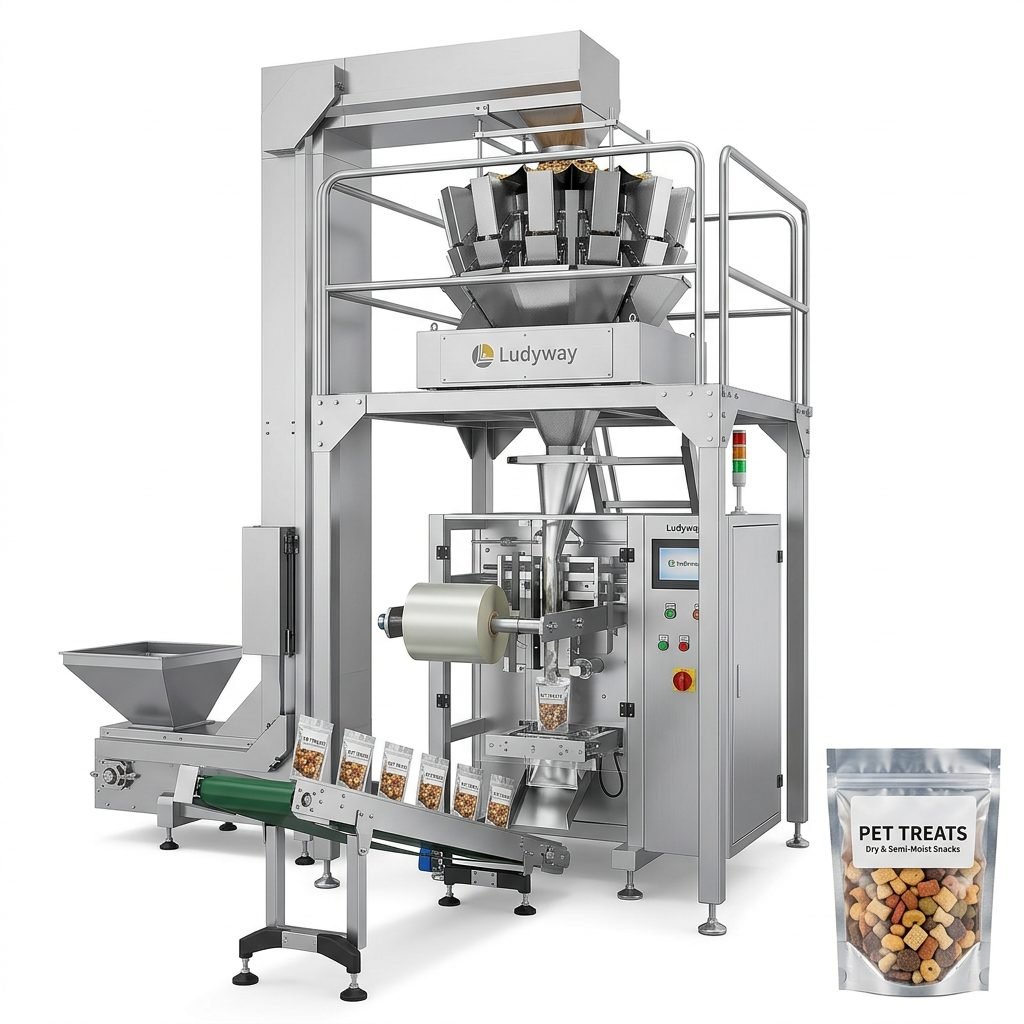
Pet treat and kibble granules packed on an automated multi-lane line with inline inspection.
Compliance, Materials and Certifications
For food and pharmaceutical granules, every surface that touches product should be SUS304 stainless steel at minimum, with 316L specified for acidic, saline or pharmaceutical-grade materials. Seals, belts and film-contact rollers should be made from materials compliant with FDA food-contact regulations; the FDA guidance on packaging and food contact substances is the reference most US importers request in the technical file.
Machines exported to Europe carry CE marking with a Declaration of Conformity covering machinery safety, low voltage and EMC requirements, and are built under an ISO 9001 quality system. Brands selling into the EU should also check that sealing jaws are validated for recyclable mono-material films, which the EU Packaging and Packaging Waste Regulation is accelerating across retail formats.
Industry benchmarks for safety and performance are maintained by PMMI, the Association for Packaging and Processing Technologies, whose standards and PACK EXPO events are where most buyers verify supplier claims in person.
Documentation checklist to request with every quotation
- CE Declaration of Conformity and ISO 9001 certificate copies
- Material certificates for 304/316L contact parts and FDA-compliant seals
- GMP design statement: tool-free disassembly, IP65 cabinets, washdown-rated motors
- Electrical schematics with brand list (PLC, servo, HMI, sensors, pneumatics)
- FAT protocol with your product and film, including weight-accuracy and seal-strength tests
- Spare parts list with 12-month and 24-month consumption forecasts
From Line Audit to Commissioning: How Procurement Works
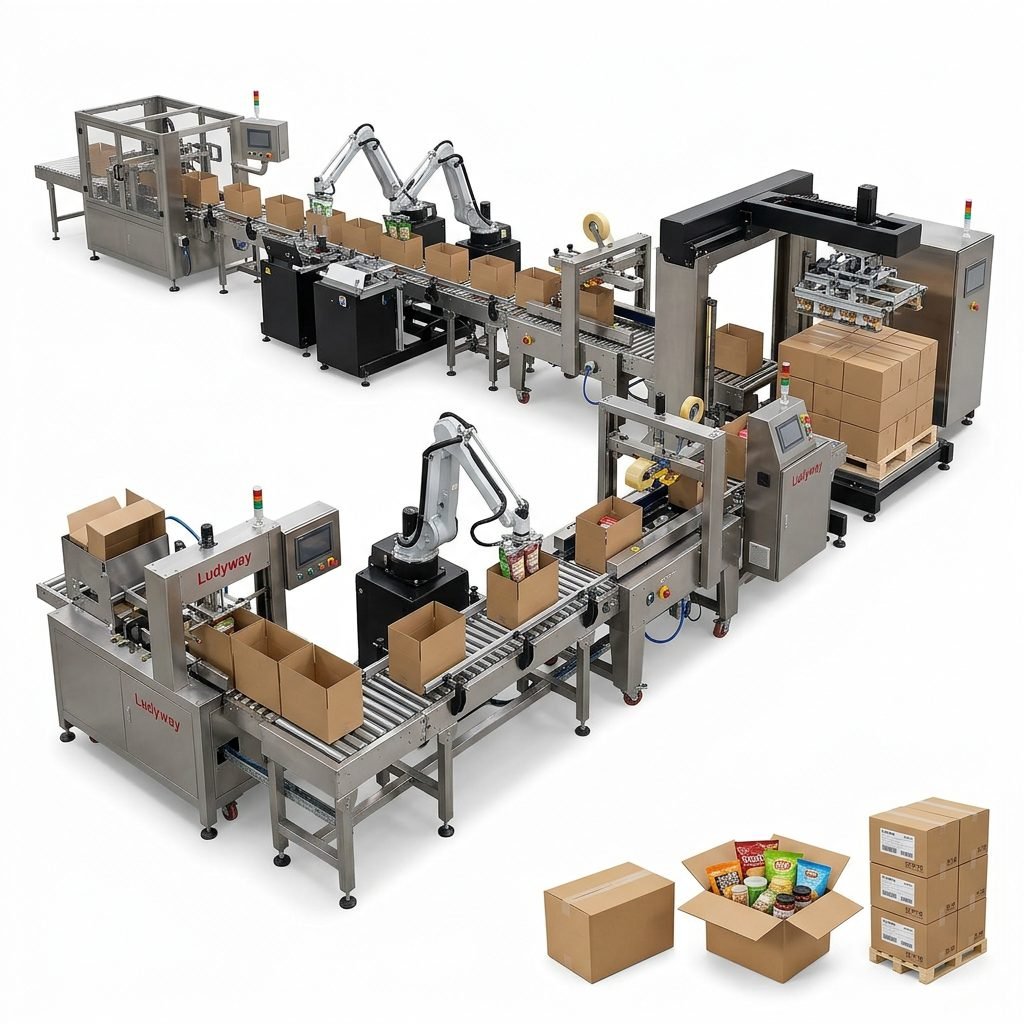
End-of-line case packing and palletising completes a turnkey granule packaging project.
1Product sample and target formats. Send 500 g–2 kg of granules plus pack sizes and hourly output targets; free fill tests confirm the dosing head and accuracy.
2Line proposal and layout. A 2D layout, equipment list and utility requirements are issued within 3–5 working days of receiving the sample results.
3Formal quotation. Quoted FOB Guangzhou/Shenzhen or CIF your port, MOQ 1 unit, with typical terms of a 30% deposit and balance before factory acceptance test.
4Manufacturing and FAT. 35–60 working days for standard models, 90–120 days for turnkey lines; FAT runs your film and product, attended on site or by live video.
5Shipping, installation and support. Engineers travel for installation and operator training; 12-month warranty, remote diagnostics and a starter spare-parts kit are included.
Why Source Granule Packaging Equipment from Ludyway
Ludyway is one of the largest packaging machine manufacturers in China, founded in 1993 and based in Nanlang Town, Zhongshan, Guangdong. The company designs and builds more than 50 intelligent packaging machine models for granule, powder, liquid and pouch applications in a 20,000 m² facility, and supplies both single machines and complete turnkey lines to customers in over 100 countries. Granule dosing has been a core competence for three decades, from 1 g sugar sticks to 50 kg fertilizer sacks.
30+
Years of industry experience
130+
Professional packaging experts
200+
Manufacturing equipment units
100+
Countries and regions served
“Specify the dosing head for your granule, the sealing system for your film and the frame for your hygiene zone, in that order. Speed is the last number to negotiate, not the first.”
Ludyway application engineering guidance for granule line projects
Options frequently added to granule projects include a nitrogen flushing system for oxygen-sensitive coffee or probiotic granules, a high-precision checkweigher for closed-loop weight correction, and dust collection for fertilizer, resin and feed lines.
Frequently Asked Questions
What granule sizes and flow properties can these machines handle?
Standard configurations handle free-flowing granules from about 0.2 mm to 15 mm. Hygroscopic or slightly sticky granules such as herbal extracts or electrolyte mixes should be run on an auger filler with a heated, dehumidified hopper; fragile pieces such as freeze-dried fruit or coated cereal need a multi-head weigher with low drop heights.
Can one machine pack both bulk sacks and retail sticks?
No single machine covers 1 g to 25 kg efficiently, because the dosing and sealing principles differ. The practical solution is a shared feeding system, typically a bucket elevator and surge hopper, that supplies a multi-lane stick pack machine for retail SKUs and an open-mouth bagger for bulk from the same product stream. Ludyway designs these combined layouts as a single turnkey project.
What are the minimum order quantity and lead time?
The MOQ is 1 machine. Catalogue models ship in 35–60 working days after deposit and drawing approval; integrated lines with conveyors, checkweighers, case packers and palletisers take 90–120 days including factory acceptance testing.
How long does a format changeover take?
Recipe changes within the same film width take 5–10 minutes from the HMI, which stores up to 100 recipes. Changing forming tubes for a new stick or sachet width takes 20–40 minutes with tool-free clamps. On bulk baggers, switching between 10 kg and 25 kg bags is a stored recipe plus a bag-clamp height adjustment.
What after-sales support is included for overseas buyers?
Every machine includes a 12-month warranty, on-site installation and operator training, English manuals and schematics, remote diagnostics through the PLC, and a starter spare-parts kit. Wear parts such as sealing jaws, cutting blades, film rollers and heating elements are stocked for next-day dispatch.
Get a Granule Packaging Line Proposal for Your Product
Send your granule sample, target pack sizes and hourly output, and our engineers will return a layout, specification sheet and formal quotation within 3–5 working days. Request the full catalogue of 50+ models or book a factory visit in Zhongshan.
