
Sugar Packaging Solutions
Sugar Packaging Machine for Industrial & Commercial ProductionAutomatic Sugar Packing Solutions for Sticks, Sachets, Bags and Bulk Sacks
50+ packaging machine models · Customers in 100+ countries · 30+ years of packaging engineering
A sugar packaging machine for industrial and commercial production has to do three things at once: dose granulated, brown or powdered sugar accurately, seal it at speed, and keep a hygroscopic product dry from hopper to carton. This page is written for sugar refiners, food processors, co-packers, foodservice suppliers and distributors specifying equipment for 3–10 g stick packs, 5–50 g sachets, 500 g–5 kg retail bags and 10–50 kg bulk sacks. You will find format comparisons, dosing options, technical specifications, compliance notes and exactly what a supplier needs to issue an accurate quotation.
Key takeaways
- Multi-lane stick pack machines run 4–16 lanes and reach 1,000+ sticks per minute on 5 g granulated sugar.
- Volumetric cup fillers hold ±1–2% on free-flowing granulated sugar; auger fillers are required for powdered and icing sugar below 0.2 mm particle size.
- Standard sugar sticks are 17–45 mm wide and 80–150 mm long; sachets run 50–120 mm wide on 3- or 4-side seal formats.
- Sugar dust is combustible: dust extraction, sealed electrical zones and grounding should be written into the specification, referencing NFPA 652 or ATEX where applicable.
- Typical lead time is 30–45 days for a standard machine and 60–90 days for an integrated line with checkweigher, cartoner and palletizer.
Sugar Stick Pack & Sachet Packaging Machines
Four of the most requested configurations for granulated, brown and powdered sugar. Each model is built on the same multi-lane platform and configured to your pack size, output and film.
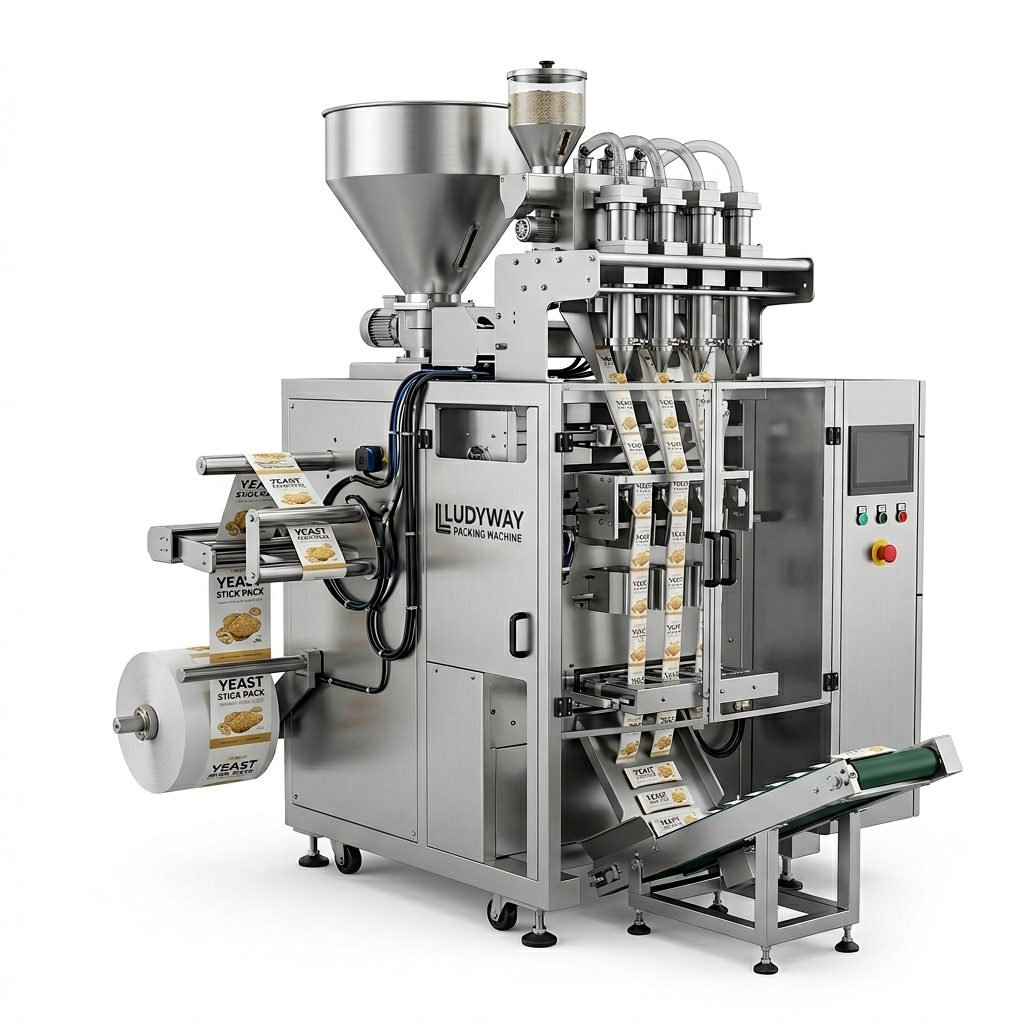
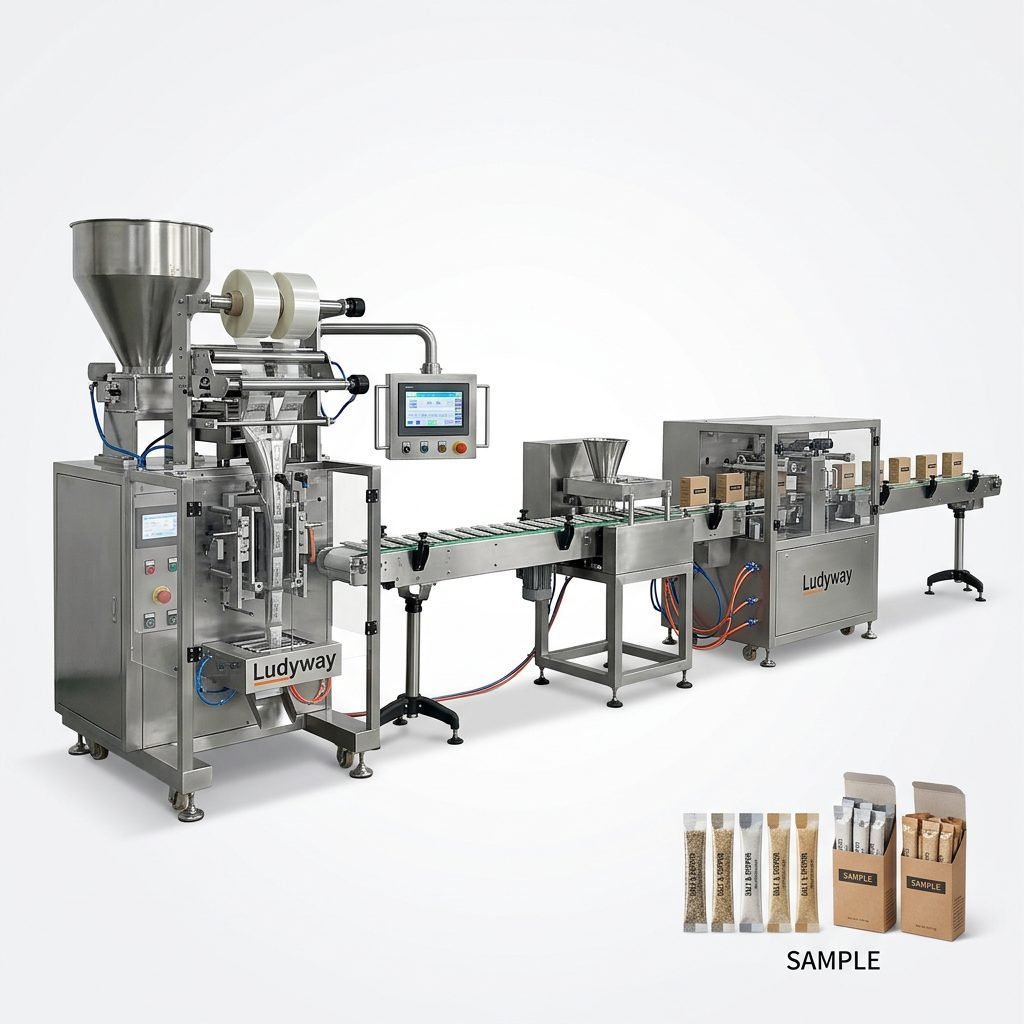
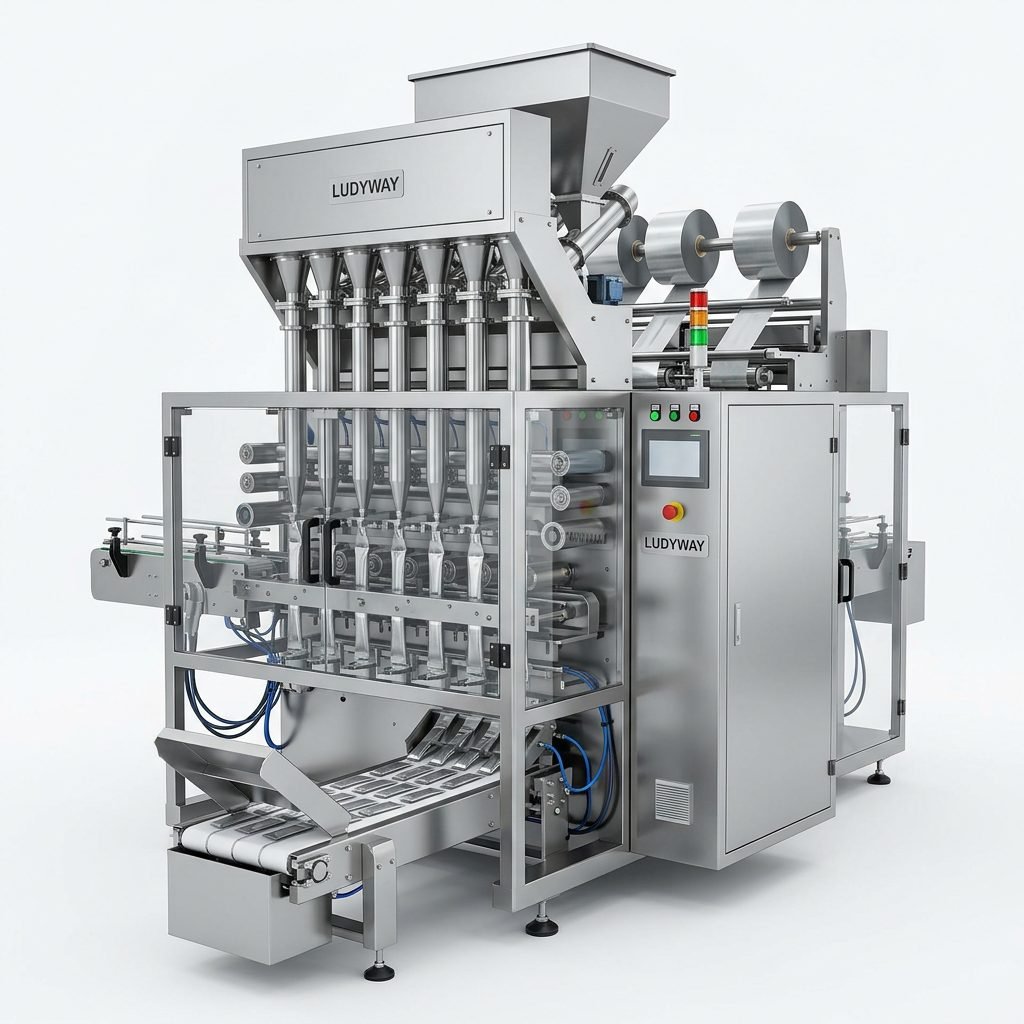
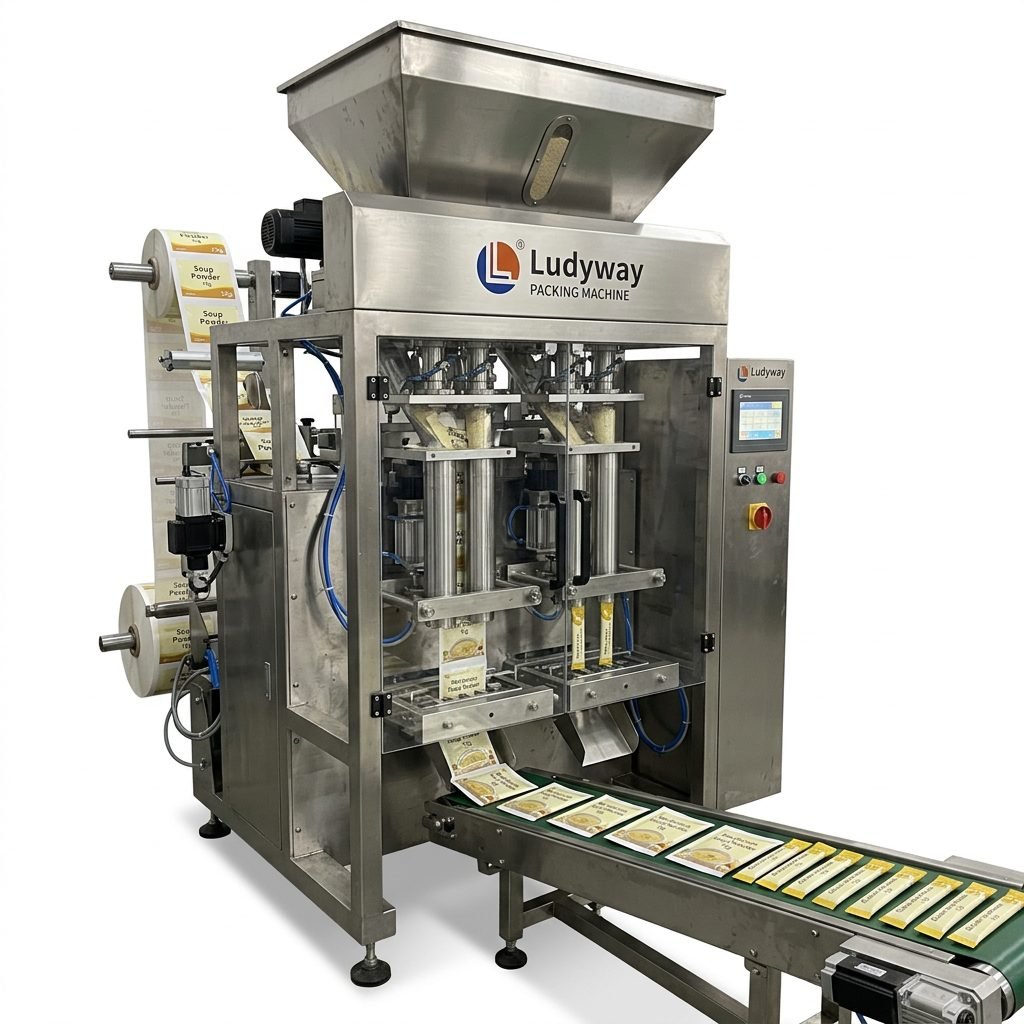
View all sugar & sweetener packaging machine models →
Packaging Formats for Sugar: From 3 g Sticks to 50 kg Sacks
The right sugar packaging machine depends first on the format you sell. Single-serve sticks and sachets dominate foodservice and hospitality, pillow bags serve supermarket shelves, and open-mouth or valve bags move sugar between refineries, bakeries and beverage plants. Most industrial producers operate at least two of these formats, which is why line layouts are planned around shared feeding, inspection and palletizing equipment.
The table below summarises the working ranges buyers typically specify. Speeds assume free-flowing white granulated sugar at 0.5–0.7 mm grain size; brown and powdered sugar run 10–25% slower because of bridging and dust control.
| Format | Typical fill weight | Pack dimensions | Typical output | Best suited to |
|---|---|---|---|---|
| Stick pack (3-side seal) | 3–10 g | 17–45 mm wide, 80–150 mm long | 600–1,600 sticks/min on 8–16 lanes | Hotels, cafés, airlines, retail dispenser boxes |
| Flat sachet (4-side seal) | 5–50 g | 50–120 mm wide | 400–1,200 sachets/min multi-lane | Foodservice, institutional catering, promotions |
| Pillow / gusset bag (VFFS) | 500 g–5 kg | 150–400 mm film width | 30–80 bags/min | Supermarket and wholesale retail |
| Open-mouth / valve bag | 10–50 kg | Woven PP or multi-wall paper | 300–1,200 bags/hour | Bakeries, beverage plants, refinery dispatch |
| Jumbo bag (FIBC) | 500–1,500 kg | 90 × 90 cm base typical | 10–30 bags/hour | Bulk export and inter-plant transfer |
For 10–50 kg formats see the 25 kg bag packaging lines and valve bag filling systems; the rest of this page concentrates on single-serve stick and sachet machines, which represent the majority of enquiries from commercial and industrial sugar packers.
How a Multi-Lane Sugar Stick Pack Machine Works
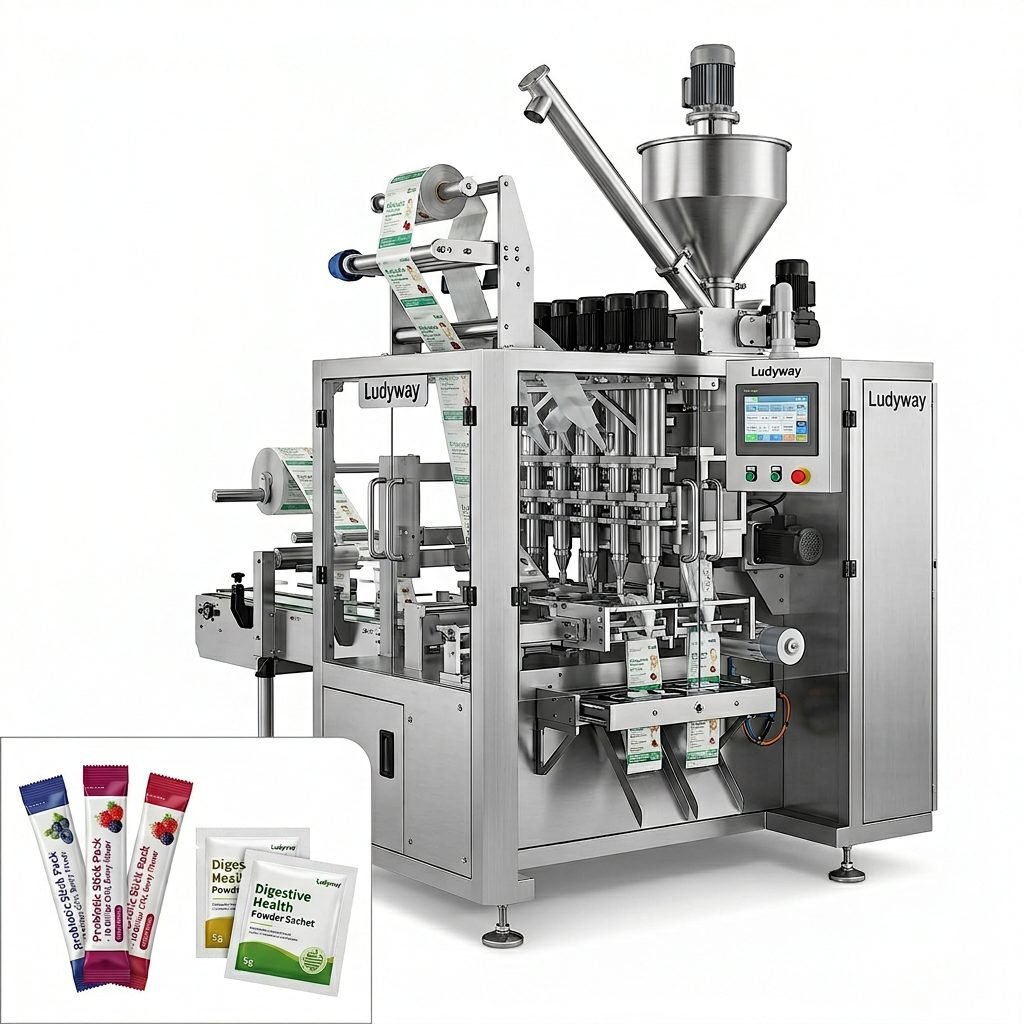
Multi-lane vertical form-fill-seal platform: one film roll is slit into parallel lanes, each forming, filling and sealing its own stick.
A multi-lane stick pack machine is a vertical form-fill-seal (VFFS) system that slits a single wide film roll into 4–16 narrow webs and runs them in parallel. Every lane has its own forming tube, dosing station and sealing jaws, so output scales with lane count rather than with cycle speed, keeping film tension and seal quality stable even at 1,000+ sticks per minute.
Film unwind and slitting. Servo-driven unwind with edge guiding and a rotary slitter; splice tables allow roll changes with under 5 minutes of downtime.
Tube forming. Each web wraps around a forming collar and tube sized to the stick width; tube sets are swapped tool-free when changing between 17 mm and 45 mm formats.
Dosing. A volumetric cup plate or auger set meters the sugar into each tube on every cycle; the dosing head sits directly above the tubes to minimise free-fall and dust.
Sealing. Heated vertical jaws make the back seal; horizontal jaws close the bottom of one stick and the top of the next in the same stroke, with PID-controlled temperature per zone.
Cutting, output and inspection. Sticks are cut, counted and discharged by lane onto a take-away conveyor feeding a checkweigher, cartoner or bulk collection bin.
Dosing Technology for Granulated, Brown and Powdered Sugar
Sugar is not one product from a dosing point of view. Grain size, moisture content and molasses coating change how the material flows, which is why the filler type should be specified per sugar grade rather than per machine.
Granulated and caster sugar: volumetric cup filler
White granulated sugar at 0.3–0.7 mm is free-flowing and has a stable bulk density of roughly 0.8–0.9 g/cm³, so a volumetric cup filler delivers ±1–2% accuracy at the highest speeds with no moving parts in the product stream. Telescopic cups adjust the fill volume from the HMI; fixed cup plates are supplied for dedicated 4 g, 5 g or 8 g formats.
Brown and raw sugar: agitated hopper and anti-bridging design
Brown sugar carries 2–4% moisture and a molasses film, so it compacts and bridges. A brown sugar sachet packaging system is configured with a hopper agitator, polished or coated cups, larger discharge openings and slower cup rotation to protect weight accuracy.
Powdered and icing sugar: servo auger filler
Below 0.2 mm, sugar aerates and dusts heavily; a cup filler loses accuracy and coats the seal area. A servo auger with a sealed hopper, nitrogen-free dust shroud and anti-static film handling is standard on a powdered sugar packaging machine, and the same head handles icing mixes with 3% corn starch. The platform also runs sugar substitutes such as erythritol, xylitol and stevia blends after a cup or auger change.
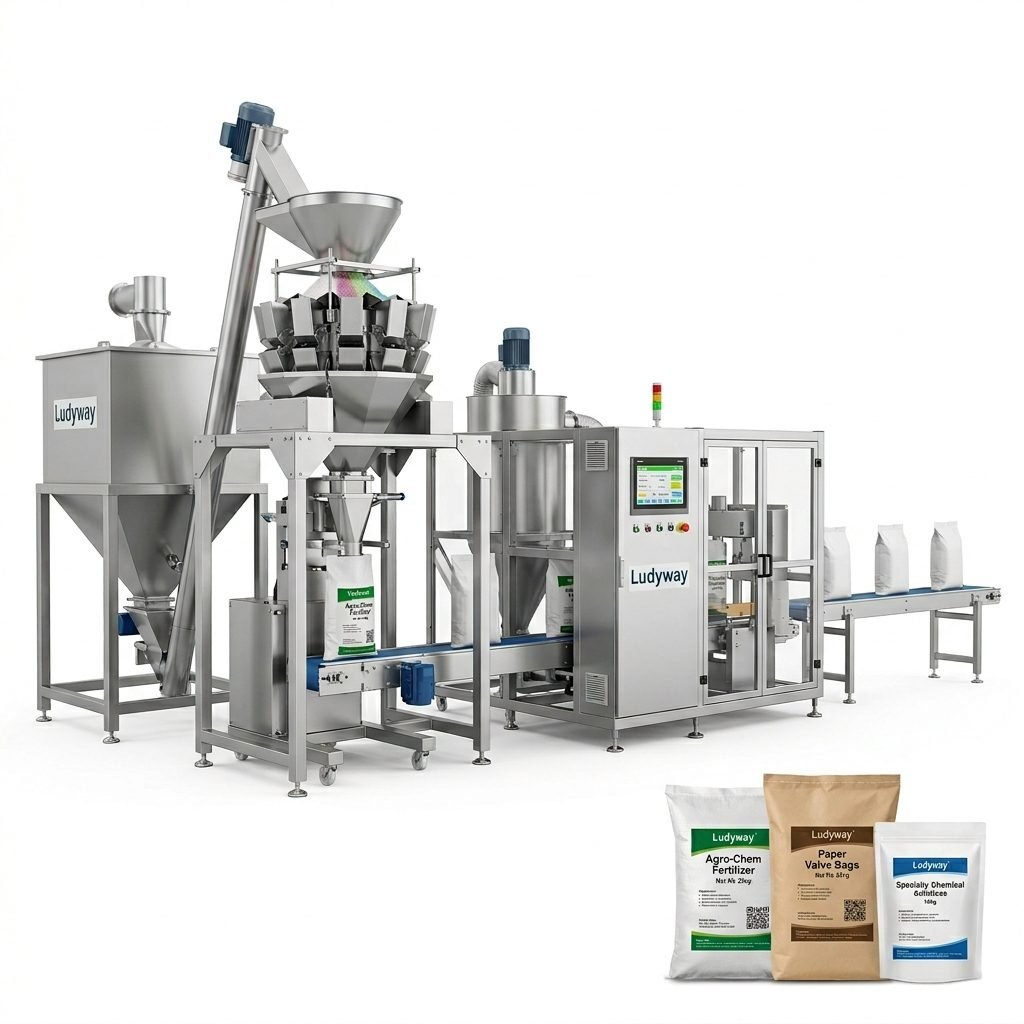
Dosing stations are selected by sugar grade: cup fillers for granulated grades, agitated hoppers for brown sugar, servo augers for powdered sugar.
Technical Specifications of a Sugar Packaging Machine
The two columns below correspond to the configurations most commonly quoted for commercial packers and for industrial refineries or large co-packers. Figures are typical working ranges; the final data sheet is issued against your pack drawing and product sample.
| Parameter | Commercial (4–6 lanes) | Industrial (8–16 lanes) | Notes |
|---|---|---|---|
| Output (5 g granulated) | 240–480 sticks/min | 800–1,600 sticks/min | Based on 40–100 cycles/min per lane |
| Fill range | 1–20 g | 1–50 g | Cup or auger sets per weight band |
| Dosing accuracy | ±1–2% | ±1–2% | Verified at FAT on customer sugar |
| Stick width / length | 17–45 mm / 80–150 mm | 17–45 mm / 80–180 mm | Length set on HMI; width by tube set |
| Film | OPP/PE, PET/PE, paper/PE, 40–90 µm | Same, plus recyclable mono-PE | Max roll Ø 400–450 mm |
| Product-contact parts | SUS304 | SUS304 / SUS316L option | Food-grade seals and belts |
| Power | 380 V, 50/60 Hz, approx. 5 kW | 380 V, 50/60 Hz, approx. 8–15 kW | 220 V / 415 V on request |
| Compressed air | 0.6 MPa, 0.3 m³/min | 0.6 MPa, 0.6 m³/min | Dry, oil-free supply |
| Control | PLC, 7–10 in. HMI, servo film pull | PLC, HMI, servo, recipe memory, MES-ready | Multi-language interface |
Optional modules include date coders, nitrogen-free dust shrouds, lane-by-lane weight sampling, easy-open notch or tear-line units, and automatic film splicing. Download the model data sheet for the high-speed multi-lane sugar stick machine or request a layout drawing for your floor space.
Hygiene, Food-Contact Materials and Safety Compliance
Food-contact materials
Product-contact surfaces are SUS304 or SUS316L stainless steel with food-grade polymer wear parts. Documentation is available to support compliance with the FDA food-contact substance requirements and EU Regulation 1935/2004; machines are CE-marked and built under an ISO 9001 quality system.
Hygienic and dry-clean design
Sugar lines are dry-cleaned, so the frame uses sloped surfaces, open stand-off construction and tool-free removal of cups, augers, hoppers and forming tubes. A full format and cleaning changeover is typically completed in 20–40 minutes by one operator. IP65 electrical enclosures protect controls from sugar dust and wash-down of adjacent areas.
Combustible dust control
Sugar dust is a recognised combustible dust (Kst class St 1). Specifications for industrial plants should include a dust collection system at the dosing head, bonded and grounded film paths, and electrical design to NFPA 652 or ATEX zone classification where the site requires it.
Commercial vs Industrial Sugar Production: Sizing the Right Machine
Over-specifying lane count ties up capital and floor space; under-specifying forces a second machine within two years. Use annual stick volume as the anchor and work back to lanes, shifts and changeover frequency.
Commercial production
Co-packers, hotel and catering suppliers, regional food brands, private-label sugar sticks
- 4–6 lanes, 240–480 sticks/min, one or two shifts
- Annual volume roughly 40–120 million sticks
- Frequent changeovers between customer brands and 4 g / 5 g / 8 g weights
- Semi-automatic collation into dispenser boxes or bulk bags of 1,000–2,000 sticks
- Compact footprint, typically under 3 m × 2 m including take-away conveyor
Industrial production
Sugar refineries, national brands, QSR and airline supply contracts, export packers
- 8–16 lanes per machine, 800–1,600 sticks/min, often 2–4 machines in parallel
- Annual volume 300 million to 2 billion+ sticks across three shifts
- Dedicated formats with long runs; changeovers planned weekly, not daily
- Integrated checkweighing, cartoning, case packing and robotic palletizing
- Silo or big-bag feeding with closed pneumatic or screw conveying
Rule of thumb: divide your committed annual stick volume by 250 working days, then by 18 productive hours and 60 minutes, and add 25% headroom for growth and downtime. The result is the sticks-per-minute figure your machine must sustain, not its peak rating.
From Stand-Alone Machine to Complete Sugar Packaging Line
Industrial buyers increasingly purchase the full line from one supplier so that interfaces, controls and spare parts are standardised. A typical turnkey sugar stick line is built from six blocks, each of which Ludyway designs and supplies in-house.
- Feeding: screw conveyor or vacuum feeder from silo, big bag or tote, with level sensors that keep the machine hopper between 30% and 80% full for consistent cup density.
- Primary packaging: one or more multi-lane stick or sachet machines with shared HMI recipes.
- Inspection: a high-precision checkweigher and metal detector with automatic rejection, logging weights per lane for statistical control.
- Secondary packaging: counting and cartoning into 50-, 100- or 500-stick boxes, or bulk bagging into 1,000–2,000 stick polybags.
- End of line: an automatic case packer for stick packs, carton sealer, labeler and coder.
- Palletizing: robotic or conventional palletizer with stretch wrapping for dispatch.
Line control is unified on one PLC network so that a stop downstream automatically pauses upstream dosing, preventing overfilled buffers and sugar spillage. Ask for the custom turnkey packaging line brief if you are planning a new hall or a brownfield upgrade.
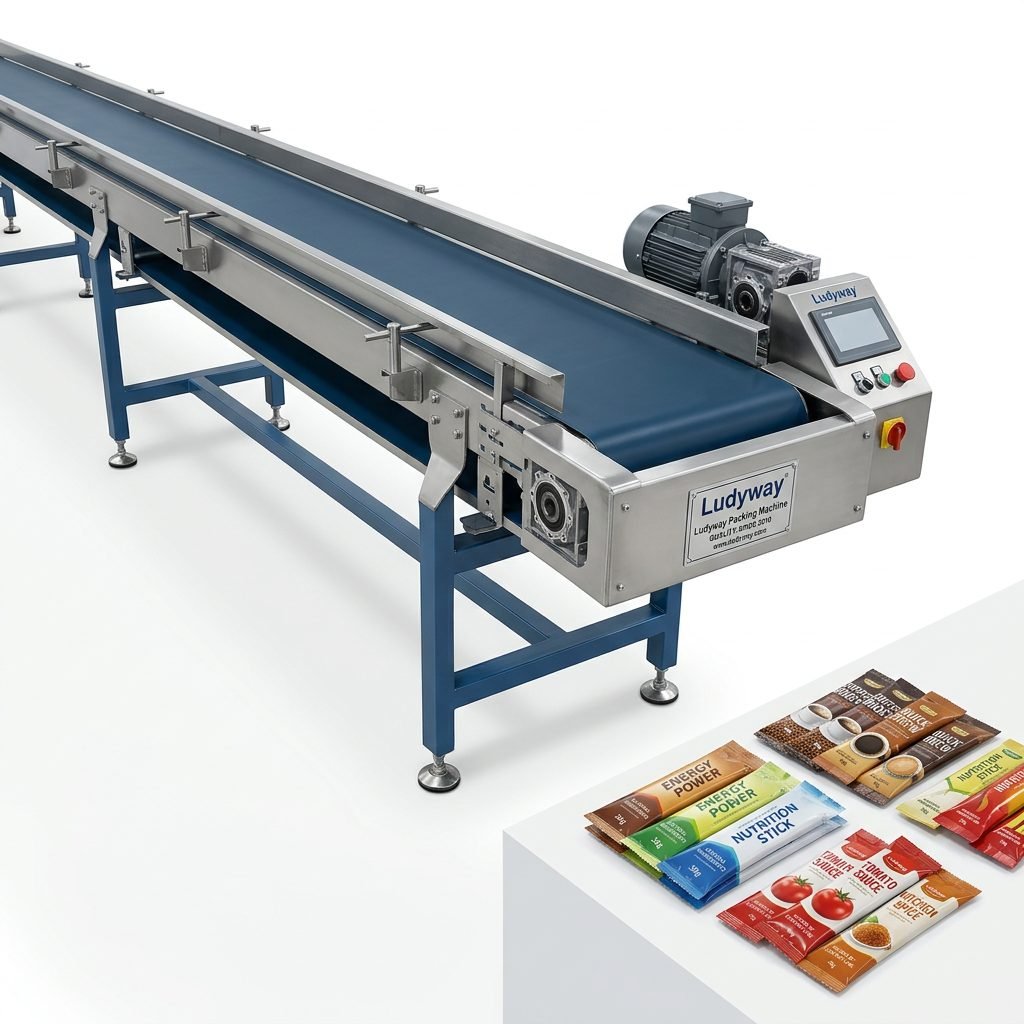
Conveying and material handling link the stick pack machine to inspection, cartoning and palletizing in a single controlled line.
Why Source Your Sugar Packaging Machine from Ludyway
30+
Years building packaging machinery since 1993
20,000 m²
Manufacturing facility in Zhongshan, Guangdong
50+
Intelligent packaging machine models
130+
Packaging engineers and technical specialists
Ludyway is one of the largest packaging machine manufacturers in China, specialising in multi-lane stick pack, sachet and fully automated packaging systems for the food, pharmaceutical and health industries. Founded in 1993 and operating a 20,000 m² plant with more than 200 manufacturing equipment units, the company supplies granule, powder, liquid and pouch packaging solutions to customers in over 100 countries, with annual revenue passing RMB 500 million in 2025 and an export target above RMB 1 billion for 2026, as reported in this industry growth update.
For sugar packers this translates into machines that have already run granulated, brown, powdered and sweetener products in dozens of markets, a factory acceptance test on your own sugar before shipment, and international service teams for installation and operator training. Market context for capacity planning is available in the PMMI 2026 State of the Industry report, which tracks packaging machinery demand across food segments.
Procurement Guide: Specifications, MOQ, Lead Time and Quotation
Capital equipment is quoted against a technical brief, not a catalogue price. The process below is what buyers should expect from enquiry to commissioning.
Step 1
Share product and pack data
Sugar grade and grain size, target fill weight, stick or sachet dimensions, required output, film structure, voltage and available floor space.
Step 2
Receive proposal and layout
Model selection, lane count, dosing type, utilities, 2D layout and a formal quotation within 2–3 working days of a complete brief.
Step 3
Sample test and FAT
Send 5–10 kg of sugar and film samples; filled samples and a video or on-site factory acceptance test confirm weight accuracy and seal integrity.
Step 4
Delivery and commissioning
Export packing, shipment, installation supervision, operator training and 12-month warranty with recommended spare parts kit.
Commercial terms at a glance
- Minimum order: 1 machine; multi-unit and line orders receive project pricing
- Lead time: 30–45 days for standard stick or sachet machines, 60–90 days for integrated lines
- Quotation basis: FOB or CIF per Incoterms 2020, issued as a proforma invoice with validity period
- Payment: deposit with order, balance before shipment after FAT approval
- After-sales: 12-month warranty, remote diagnostics, spare parts stock and on-site service
Include these in your RFQ
- Sugar type, grain size and moisture content (a lab sheet if available)
- Fill weight and tolerance you must declare on pack
- Stick or sachet dimensions with artwork repeat length
- Target output per hour and number of shifts
- Film specification; see the Flexible Packaging Association resources for laminate options
- Downstream requirements: counting, cartoning, case packing, palletizing
Frequently Asked Questions
What output can a sugar stick pack machine achieve on 5 g sticks?
A 6-lane machine typically delivers 300–480 sticks per minute; a 12-lane machine 900–1,200; a 16-lane machine up to 1,600. Real-world efficiency of 85–90% should be applied when calculating shift output.
Can one machine run both granulated sugar and powdered sugar?
Yes, if it is ordered with interchangeable dosing heads. Granulated sugar runs on a cup filler and powdered sugar on a servo auger; swapping heads takes 30–45 minutes. Plants running both grades daily usually dedicate one machine to each.
Which films are suitable for sugar sticks and sachets?
Paper/PE laminates of 60–80 g/m² are the hospitality standard, OPP/PE and PET/PE at 50–70 µm give better moisture barrier, and recyclable mono-PE structures are increasingly specified for retail. All must be heat-sealable and dimensionally stable for lane slitting.
How accurate is the dosing, and how is it verified?
Volumetric cup fillers hold ±1–2% on granulated sugar, equivalent to ±0.05–0.1 g on a 5 g stick. Accuracy is verified during the factory acceptance test with your sugar sample and confirmed in production by a downstream checkweigher.
What is the lead time and is installation included?
Standard machines ship in 30–45 days; integrated lines in 60–90 days. Installation supervision, commissioning and operator training are quoted as a line item and can be delivered on site or remotely depending on the destination.
Request a Quotation for Your Sugar Packaging Machine
Send your sugar grade, pack size and target output and Ludyway engineers will return a model recommendation, layout drawing and formal quotation. Sample testing on your own product and film is available before you order.
Email info@ludyway.comWhatsApp +86 131 2959 2456
Ask for the sugar and sweetener machine catalogue, request filled samples, or schedule a factory visit in Nanlang Town, Zhongshan, Guangdong.
