
Coffee Packaging Equipment
Coffee Powder Packaging Machine for Coffee ManufacturersAutomatic Filling & Sealing Solutions for Instant, Ground and 3-in-1 Coffee
50+ intelligent packaging machine models · Installed in 100+ countries and regions · 30+ years of manufacturing since 1993
A coffee powder packaging machine for coffee manufacturers has to do three things at once: dose fine, dusty and hygroscopic coffee to within ±0.1 g, seal it against oxygen and moisture, and keep pace with roasting or spray-drying output. This page is written for coffee producers, co-packers and plant engineers evaluating automatic filling and sealing equipment for instant coffee, ground coffee, 3-in-1 mixes and drip bags. You will find typical specifications (2–14 lanes, 0.5–1,000 g fills, up to 840 sticks per minute), certification requirements, food-contact standards, lead times, and how to request a quotation or a free material test.
Key takeaways
- Multi-lane stick pack and sachet machines run 2–14 lanes and reach 400–840 coffee sticks per minute, compared with 30–80 bags/min on a single-lane VFFS unit.
- Servo auger fillers hold ±0.1 g on 1.8–3 g instant coffee sticks and ±1% on 25–50 g ground coffee sachets.
- Nitrogen flushing cuts residual oxygen below 2%, extending ground coffee shelf life from roughly 3 months to 12 months in high-barrier film.
- Standard lead time is 30–45 days for catalog models and 60–90 days for turnkey lines; MOQ is 1 set, quoted EXW, FOB or CIF.
- All product-contact parts are SUS304 or SUS316L stainless steel, and machines ship with CE and ISO 9001 documentation plus a 12-month warranty.
Coffee Powder Filling & Sealing Machines
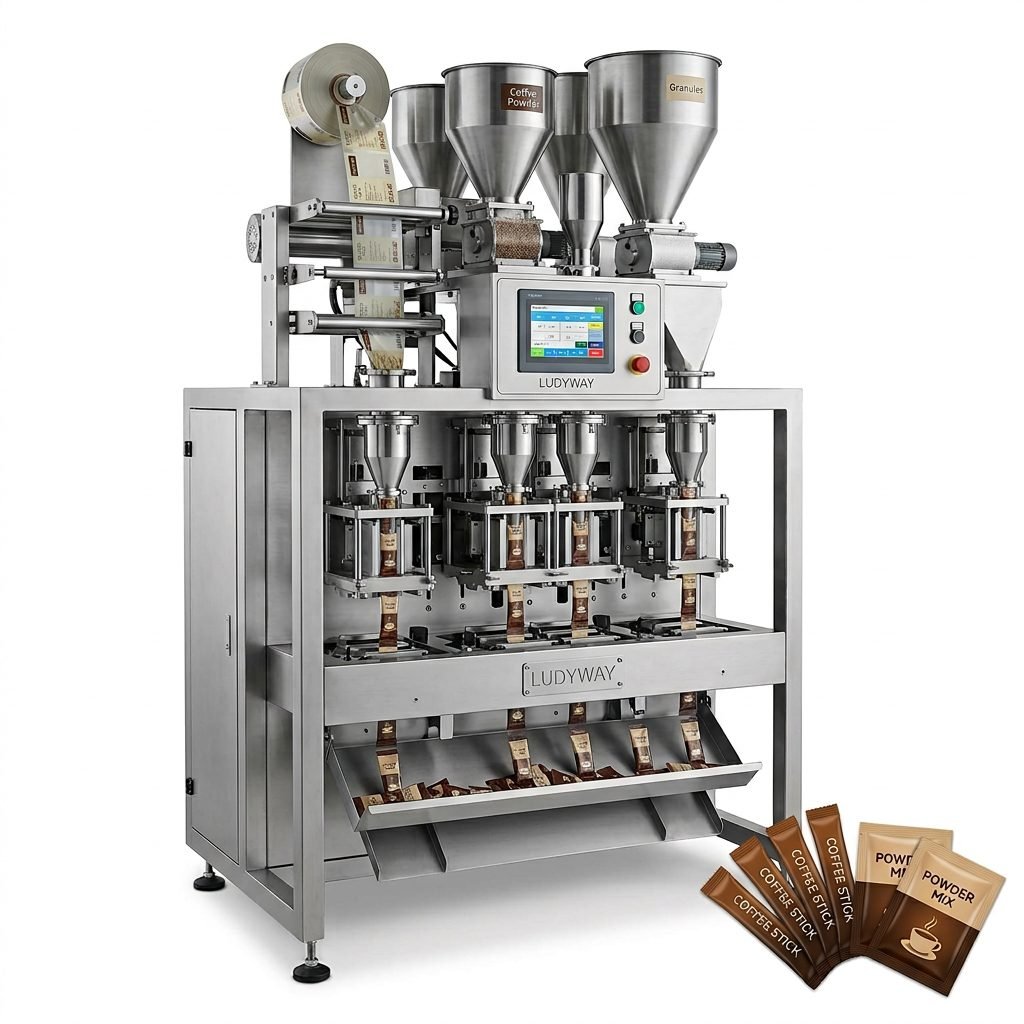
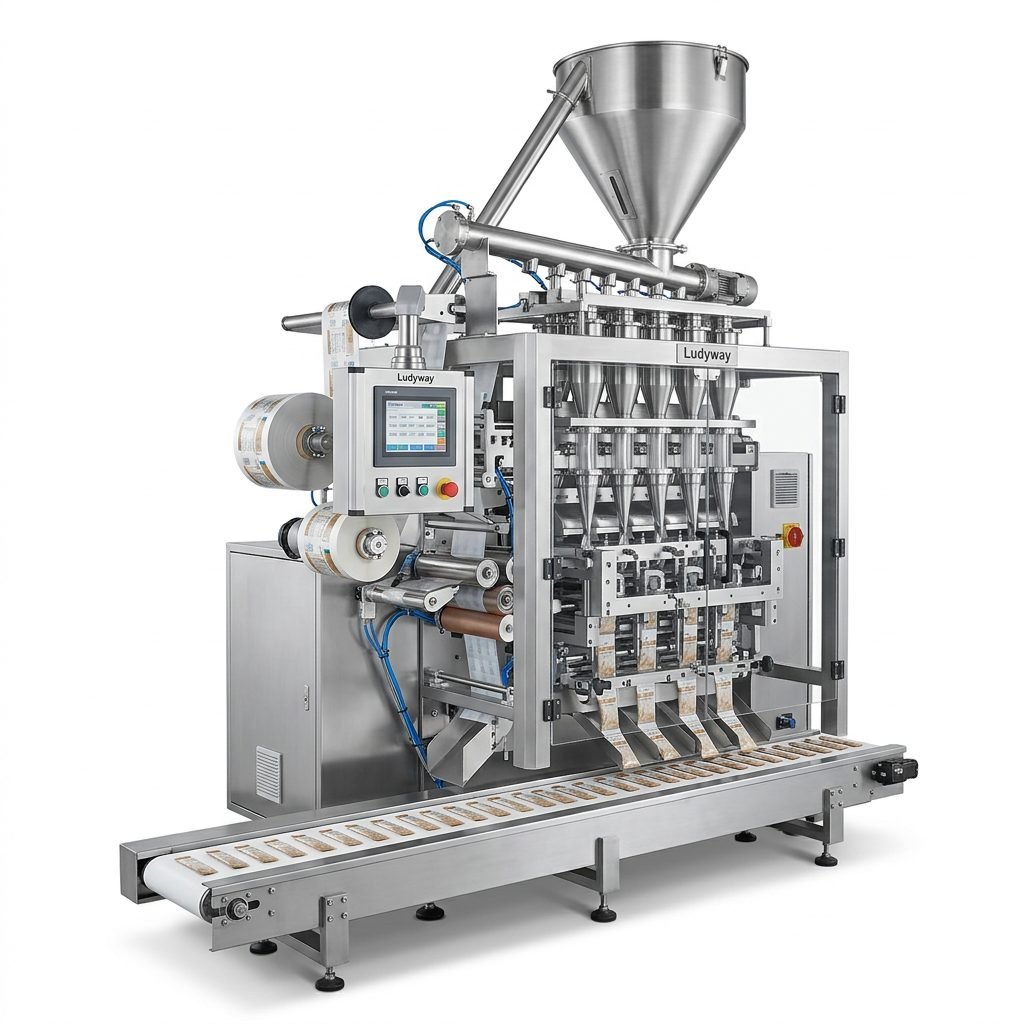
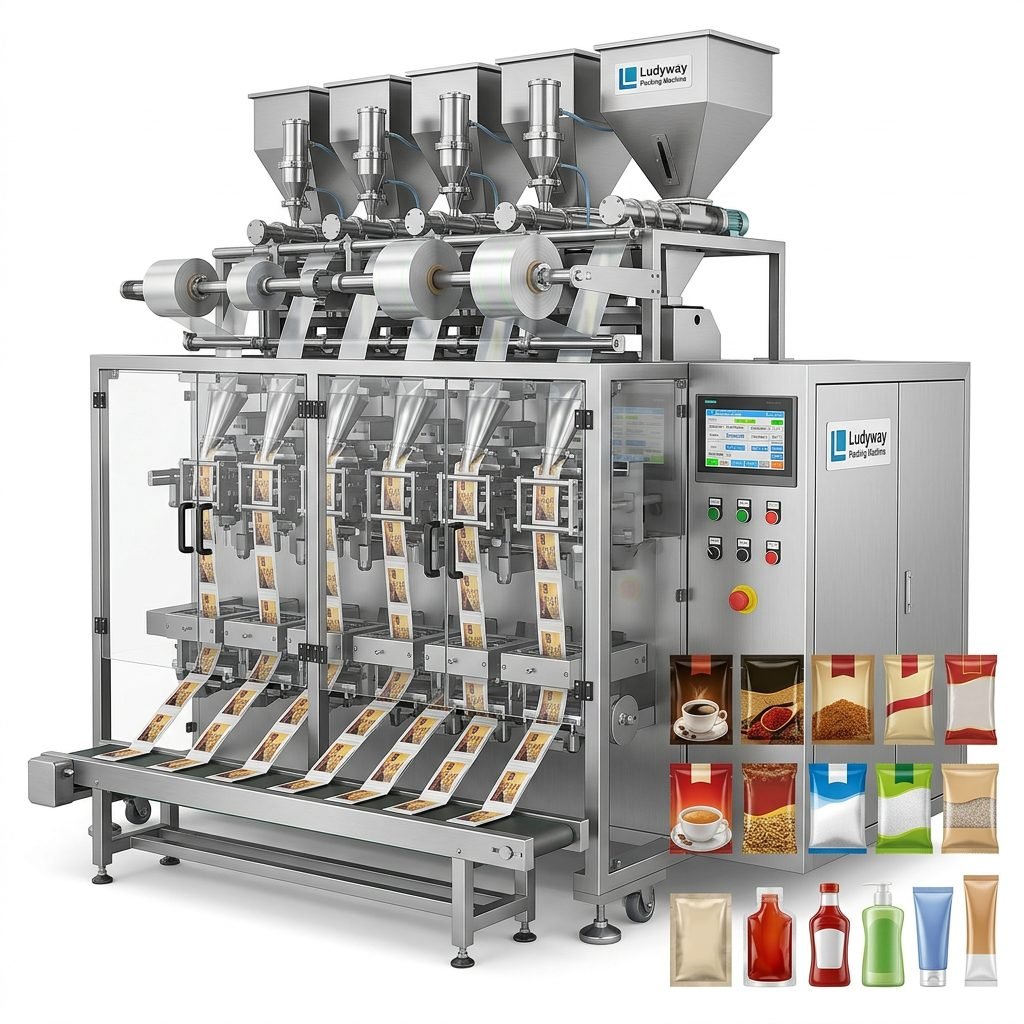
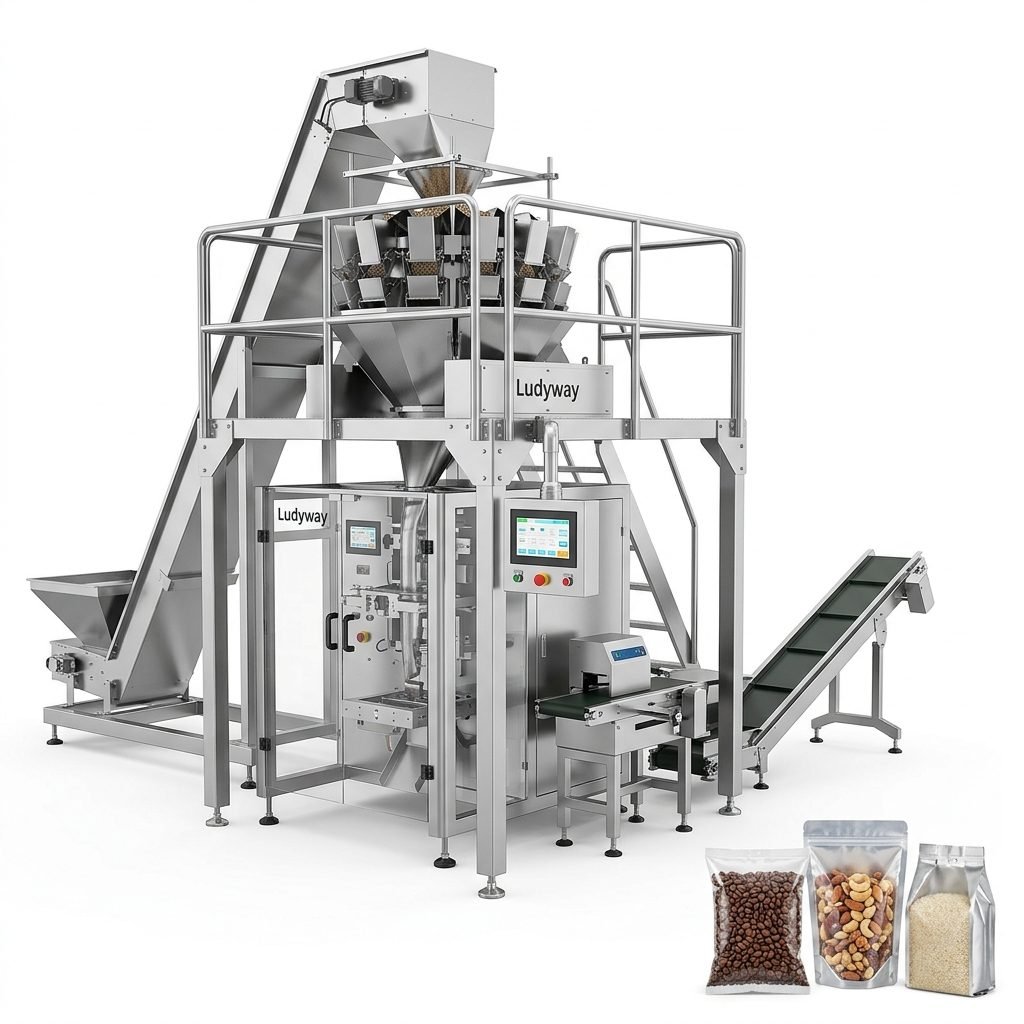
View all coffee packaging machines →
Which Coffee Products This Equipment Handles
Coffee is not one powder. Spray-dried instant coffee is light and free-flowing, agglomerated and freeze-dried granules are fragile and bridge easily, fine ground roast coffee is oily and dusty, and 3-in-1 mixes carry sugar and creamer that cake in humid plants. The right coffee powder packaging machine for coffee manufacturers is matched first to the material, then to the pack format and finally to the speed target. The table below summarises how the main coffee categories are typically specified.
| Coffee product | Typical fill weight | Pack format | Recommended dosing | Barrier requirement |
|---|---|---|---|---|
| Instant / freeze-dried coffee | 1.8–3 g | Stick pack 17–25 mm wide | Servo auger or volumetric cup | PET/AL/PE, moisture-proof |
| 3-in-1 / coffee mix | 12–25 g | Stick 25–35 mm or 3-side sachet | Servo auger with agitator | PET/AL/PE, dehumidified room |
| Ground roast coffee | 7–50 g sachet; 250–1,000 g bag | 4-side sachet or VFFS pillow/gusset | Auger plus nitrogen flush | High-barrier film, degassing valve on bags |
| Drip bag coffee | 8–12 g | Inner filter + outer envelope | Auger, dual-film system | Nitrogen flush, residual O₂ <2% |
| Liquid coffee concentrate | 15–30 ml | Stick pack or 4-side sachet | Piston or pump filler | PET/AL/PE, hot-fill compatible |
For roast and ground producers who need both retail sachets and 250–500 g bags, a dedicated ground coffee packaging machine is normally paired with a VFFS unit, while single-serve brands move straight to multi-lane stick packs or a drip coffee stick pack machine with dual-film forming.
How an Automatic Coffee Powder Filling and Sealing Machine Works
Whether the machine forms a 20 mm stick or a 120 mm four-side sachet, the cycle follows the same five stages. Understanding each stage helps you evaluate where accuracy, speed and hygiene are won or lost.
1
Film unwind & forming
A single roll up to 800 mm wide is slit into lanes and shaped around forming tubes; photo-eye registration keeps print within ±1 mm.
2
Dosing
Independent servo augers meter each lane; an agitator keeps 3-in-1 mixes from bridging and a vacuum feeder refills the hopper automatically.
3
Filling & gas flushing
Product drops through dust-controlled funnels while nitrogen is injected into the pack to displace oxygen before the top seal closes.
4
Sealing & cutting
PID-controlled heat jaws seal at 120–180 °C depending on film; knives or serrated cutters separate sticks with tear notches.
5
Output & inspection
Finished packs exit on a collecting conveyor to a checkweigher, metal detector and counting or cartoning station.
Technical Specifications by Machine Type
The parameters below are representative ranges for Ludyway coffee powder packaging machines. Exact figures depend on coffee bulk density, film structure and pack geometry, so treat them as the starting point for a quotation rather than a fixed data sheet.
| Parameter | Multi-lane stick pack | Multi-lane sachet (3/4-side) | Single-lane VFFS bag |
|---|---|---|---|
| Lanes | 2–14 | 2–12 | 1 |
| Output | 30–60 cycles/min per lane, up to 840 sticks/min | Up to 720 sachets/min | 30–80 bags/min |
| Fill range | 0.5–30 g | 1–100 g | 50–1,000 g |
| Pack size | W 17–40 mm × L 50–180 mm | W 50–120 mm × L 60–180 mm | W 80–300 mm × L 100–400 mm |
| Max film roll width | 800 mm | 900 mm | 650 mm |
| Accuracy | ±0.1 g (≤5 g) / ±1% | ±1% | ±0.5–1% |
| Utilities | 380 V 3-phase 50/60 Hz, 6–12 kW; air 0.6 MPa | 380 V 3-phase, 5–10 kW; air 0.6 MPa | 220/380 V, 3–5 kW; air 0.6 MPa |
Dosing Technology: Choosing the Right Filler for Coffee
Dosing is where most of the cost and most of the giveaway live. For a plant filling 500,000 sticks a day, a 0.1 g overfill on a 2 g stick represents 50 kg of instant coffee lost every day, which is why coffee manufacturers increasingly specify servo-driven augers with lane-by-lane calibration.
Servo auger filler
The default for instant, 3-in-1 and ground coffee. Screw pitch and hopper agitation are selected per bulk density (typically 0.25–0.45 g/ml), and the servo profile is stored per recipe on the HMI.
Best for: 1–100 g, dusty or cohesive powders · Accuracy: ±0.1 g or ±1%
Volumetric cup filler
Simple, fast and low-maintenance for free-flowing agglomerated or freeze-dried granules where density is stable. Adjustable telescopic cups set the volume; it is less suitable when the product settles or varies batch to batch.
Best for: 2–50 g granules · Accuracy: ±1.5–2%
Multihead weigher
Used on VFFS bags for whole beans or coarse granules where weight, not volume, is the legal declaration. 10- or 14-head weighers deliver 60–120 weighments per minute into pillow or quad-seal bags.
Best for: 100–1,000 g beans and coarse grinds · Accuracy: ±0.5 g
Protecting Coffee Freshness: Nitrogen, Barrier Film and Seal Integrity

Multi-lane sachet machine with PID-controlled sealing jaws and optional nitrogen injection.
Nitrogen flushing and residual oxygen
Roast coffee stales through oxidation of volatile aromatics. Injecting food-grade nitrogen into each lane just before the top seal brings residual oxygen below 2%, which in a PET/AL/PE laminate typically extends shelf life from about 3 months to 12 months. Ludyway integrates a nitrogen flushing packaging system with flow meters per lane so consumption can be audited.
Film structures that run well
Stick packs usually use PET 12 µm / AL 7 µm / PE 50–60 µm or a metallised PET alternative for lower cost. Mono-material PE or PP laminates for recyclability are increasingly requested in the EU and run on the same machine with a 10–20 °C lower seal temperature.
Seal quality you can prove
Jaw temperature, pressure and dwell time are logged per batch, and dust-extraction hoods around the fill tubes keep coffee fines out of the seal area, which is the number one cause of channel leaks on coffee lines.
Downstream Automation for Coffee Packaging Lines
A multi-lane machine producing 600 sticks a minute will overwhelm manual packing within an hour. Most coffee manufacturers therefore specify the primary machine together with a collecting conveyor, a high-precision checkweigher with automatic reject, a metal detector, and a counting unit that groups 10, 20 or 30 sticks for cartoning.
For retail boxes and display cartons, an automatic carton packer receives counted sticks, erects the carton, loads and glues it at 20–40 cartons per minute. Date coding, labeling, case packing and palletizing complete a turnkey line that runs with 2–3 operators instead of 10–12.
Line integration is handled by one engineering team, which matters when the OEE target is 85% or higher: a single PLC architecture, shared HMI recipes and one spare-parts list.
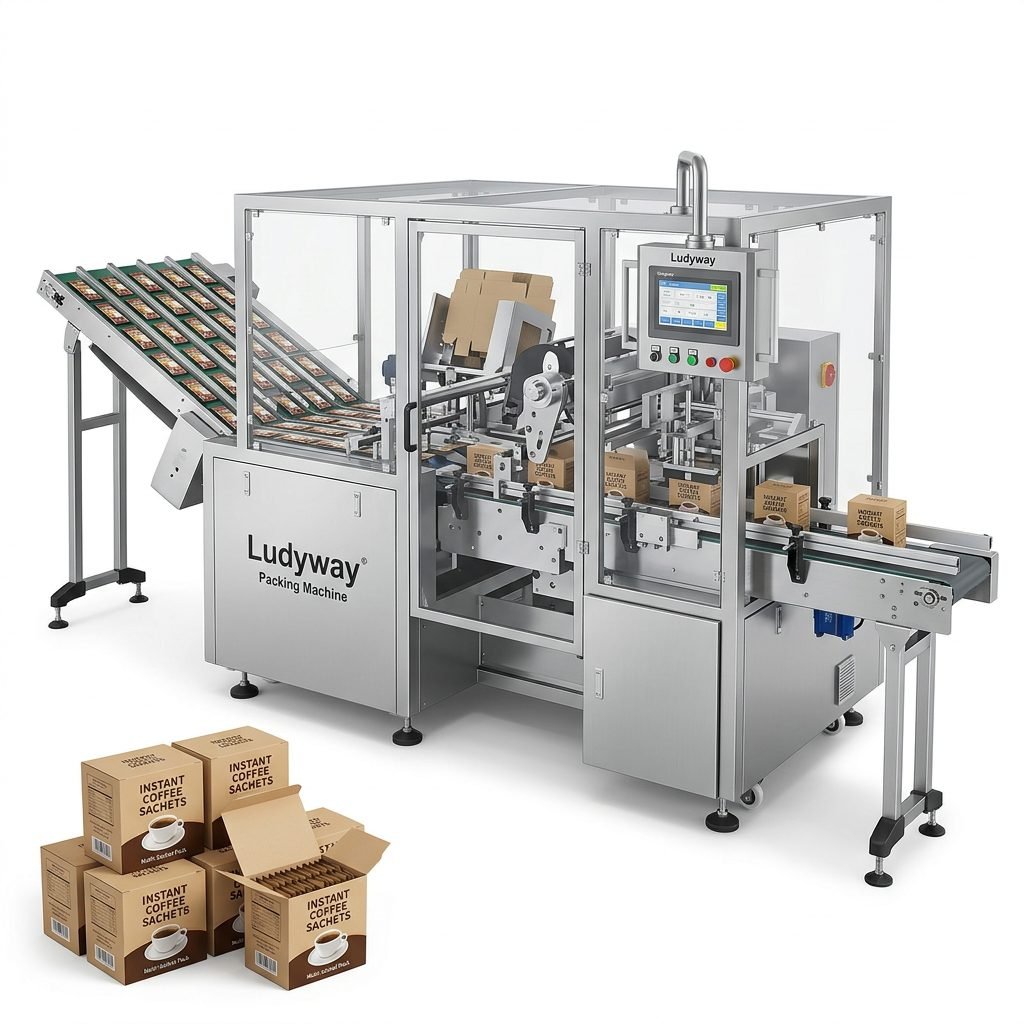
Automatic carton packer receiving counted coffee sticks from a multi-lane machine.
Certifications, Hygiene and Compliance
Coffee is a food product sold in nearly every regulated market, so the packaging machine must satisfy both machinery safety law and food-contact rules in the destination country. Ludyway coffee powder packaging machines are built to the following baseline, with market-specific additions on request.
Machinery safety
CE marking with interlocked guards and emergency stops; the EU Machinery Regulation (EU) 2023/1230 applies to new machines from January 2027 and is already reflected in current builds. ISO 9001 quality system at the Zhongshan factory.
Food-contact materials
All contact parts in SUS304 (SUS316L optional), food-grade seals and tool-less removal for washdown. Material declarations support compliance with FDA food-contact substance rules and EU Regulation 1935/2004.
Electrical & dust control
IP65 control cabinets, Siemens or Schneider PLCs, and integrated dust collection to keep coffee fines below workplace exposure limits and away from sealing jaws.
According to the PMMI 2026 State of the Industry report, single-serve and portion-pack formats remain among the fastest-growing drivers of flexible packaging machinery demand, which is consistent with what coffee manufacturers are asking for: more lanes, faster changeovers and recyclable film compatibility.
Why Coffee Manufacturers Choose Ludyway
30+
Years of industry experience
20,000 m²
Modern production facility
130+
Packaging engineers and specialists
100+
Countries and regions served
Ludyway is one of the largest packaging machine manufacturers in China, specializing in advanced packaging equipment and turnkey production solutions for the food, pharmaceutical and health industries. Founded in 1993 in Nanlang Town, Zhongshan, Guangdong, the company operates a 20,000 m² facility with more than 200 manufacturing equipment units and offers over 50 intelligent packaging machine models, including multi-lane stick pack, sachet and fully automated line systems. Annual revenue passed RMB 500 million in 2025, and the company is targeting RMB 1 billion in export revenue in 2026, which for buyers translates into established spare-parts logistics and service coverage across its main markets.
Procurement Guide: MOQ, Lead Time and How to Get a Quotation
Commercial terms at a glance
- MOQ: 1 set; multi-machine lines and OEM configurations welcome.
- Lead time: 30–45 days for standard stick pack and sachet models, 60–90 days for turnkey lines with cartoning and palletizing.
- Quotation basis: EXW Zhongshan, FOB Shenzhen/Guangzhou or CIF your port; pricing is project-specific and provided after a technical review.
- Payment: typically 30% deposit, balance before shipment after Factory Acceptance Test (FAT) video or on-site witness.
- Warranty and support: 12 months on parts, remote diagnostics, overseas installation and operator training available.
A quotation is only as good as the data behind it. Sending 2–5 kg of your actual coffee for a filling trial removes the two biggest risks in a packaging project: dosing accuracy and seal contamination.
What to include in your enquiry
01 Coffee type and bulk density (instant, 3-in-1, ground, freeze-dried, drip bag).
02 Target fill weight, pack dimensions and a photo or sample of the current pack.
03 Required output per hour or per shift, and number of SKUs to change between.
04 Film structure you plan to use and whether nitrogen flushing is required.
05 Plant voltage, destination country and any downstream equipment to integrate.
Frequently Asked Questions
Which coffee powder packaging machine should I choose for instant coffee sticks versus ground coffee bags?
Instant coffee and 3-in-1 sticks of 1.8–25 g are best run on a multi-lane stick pack machine with servo augers, where 6–14 lanes deliver 400–840 sticks per minute. Ground coffee in 250–1,000 g retail bags belongs on a VFFS bagger with auger or multihead weigher and a degassing-valve applicator. Many plants run both, fed from the same vacuum conveyor.
How accurate is auger filling for coffee powder?
With a servo auger and a correctly selected screw, accuracy is ±0.1 g for fills under 5 g and ±1% above that. Lane-by-lane auto-calibration against an inline checkweigher keeps drift under control as bulk density changes through the shift.
Can one machine run both black instant coffee and 3-in-1 mix?
Yes. Recipes are stored on the HMI, and changing auger screws and forming tubes takes 15–30 minutes. If the stick width also changes, a second forming set is quoted as a format part so changeover stays under one hour.
Can you test our coffee before we commit to an order?
Yes. Send 2–5 kg of product and a roll or sample of your film to the Zhongshan factory. Engineers run filling and sealing trials, record weight data and send a video report, usually within 7–10 working days of receipt.
What installation and after-sales support is available overseas?
Machines are pre-commissioned and FAT-tested before shipment. Ludyway engineers can travel for installation and operator training, and the PLC supports remote access for diagnostics. A recommended spare-parts kit for 12 months of operation is included in every quotation.
Request a Quotation, Sample Test or Catalog
Tell us your coffee type, target fill weight and output, and our engineering team will return a configured proposal with specifications, lead time and EXW/FOB/CIF pricing. Material trials and the full 50-model catalog are available on request.
