
Rice Bagging Equipment
Rice Packaging Machine Manufacturer for Bulk & Retail Packaging
Automatic rice bagging solutions from 25 g sachets to 1,500 kg jumbo bags
30+ years of packaging engineering · 50+ intelligent machine models · Customers in 100+ countries and regions
Choosing a rice packaging machine manufacturer for bulk and retail packaging comes down to three questions: which pack sizes you run, how accurately you must weigh, and how much downstream automation your plant can absorb. This page is written for rice mills, grain processors, contract packers and equipment distributors. It covers machine formats from 25 g sachets and 1–5 kg retail bags to 25 kg and 50 kg open-mouth sacks and 1,500 kg FIBCs, with output ranges, weighing tolerances, food-contact and metrology requirements, lead times, and the information Ludyway needs to prepare a line proposal.
Key takeaways
- Retail VFFS rice baggers typically run 1–5 kg pillow or gusseted bags at 20–60 bags/min; multi-lane stick pack and sachet machines pack 25–500 g portions at 300–600 sachets/min on 8–12 lanes.
- Bulk open-mouth bagging lines handle 10/20/25/50 kg sacks at 300–900 bags/hour; jumbo-bag (FIBC) stations fill 500–1,500 kg at 15–30 bags/hour.
- Dual-speed net weighers for 25–50 kg sacks hold ±0.1–0.2%; 10–14 head combination weighers for 1–5 kg retail bags typically reach ±0.5–2 g.
- Product-contact parts are built in SUS304 stainless steel (SUS316L optional); machines carry CE marking and are built under an ISO 9001 quality system.
- Minimum order is 1 set; standalone machines ship in roughly 35–60 days and turnkey lines in 60–120 days after drawing approval.
Rice Bagging Machines & Lines for Every Pack Size
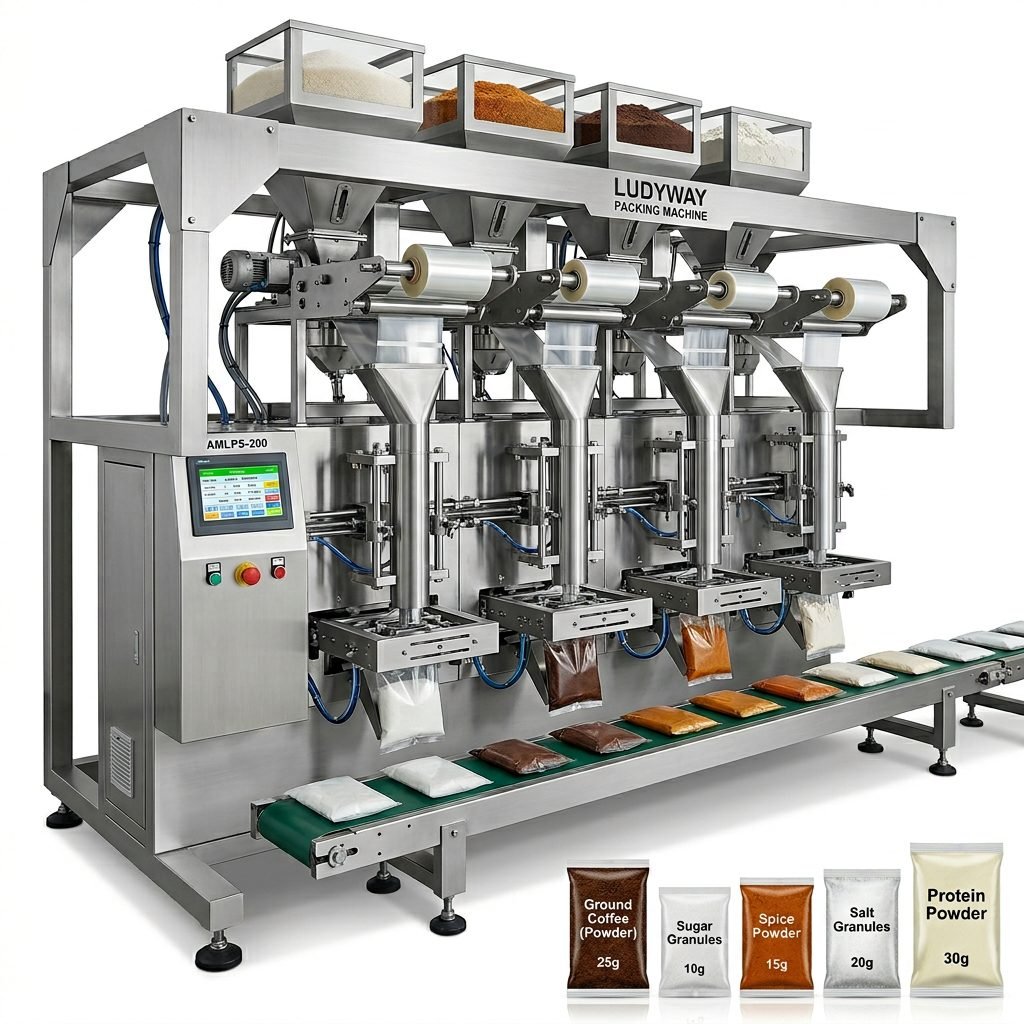
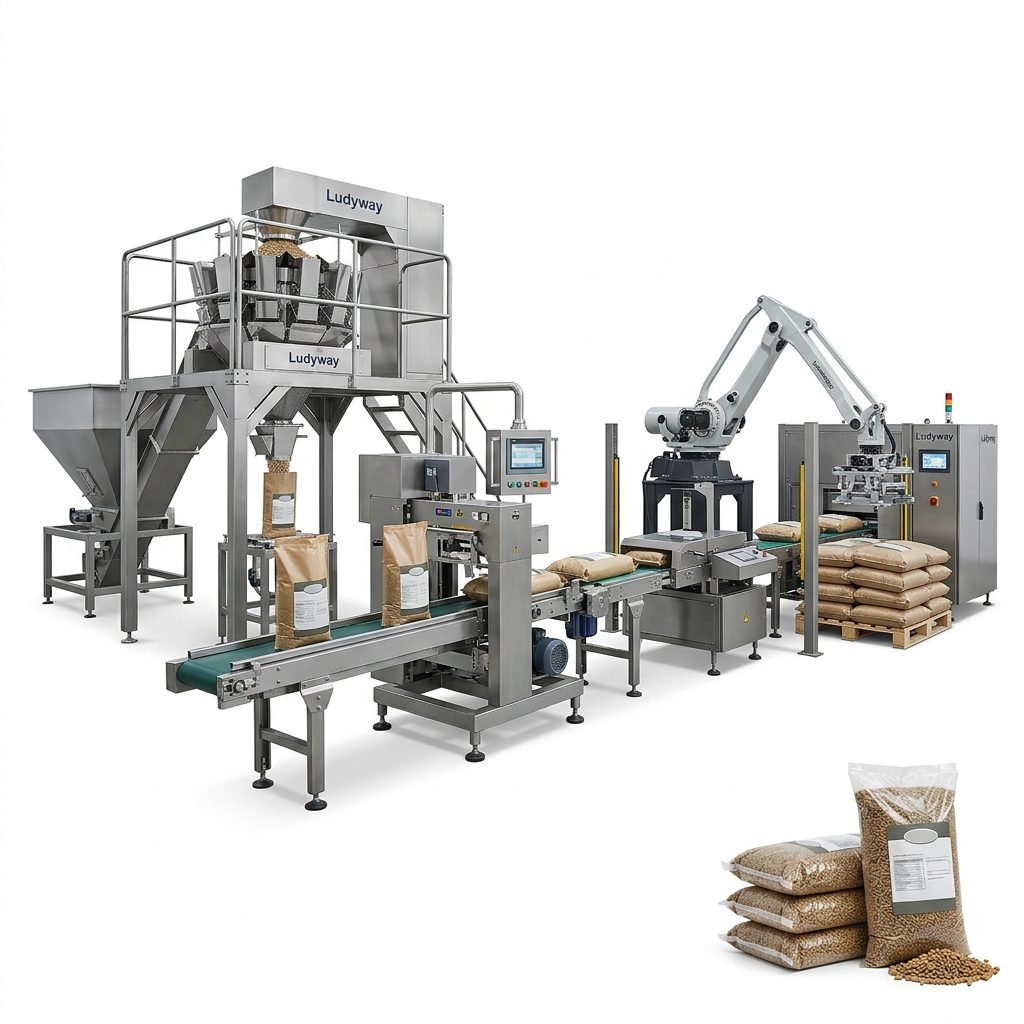
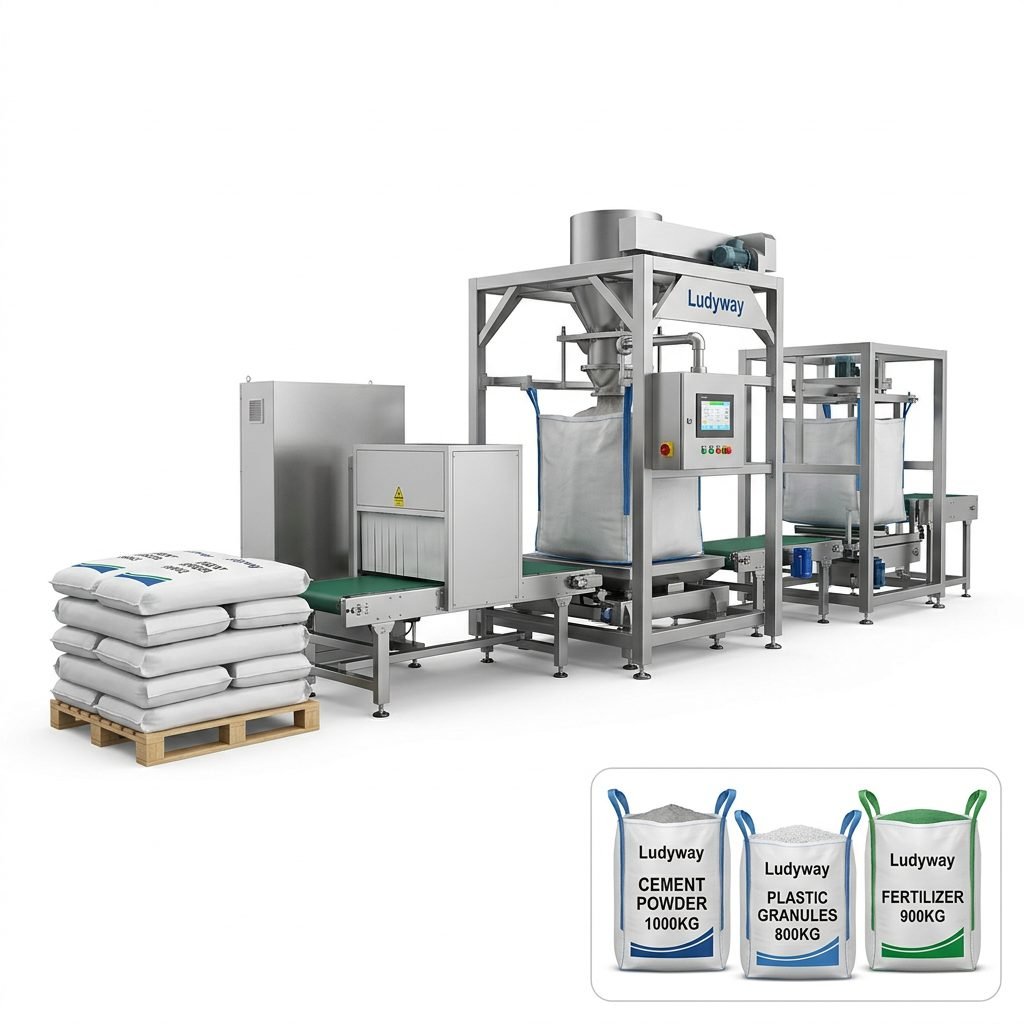
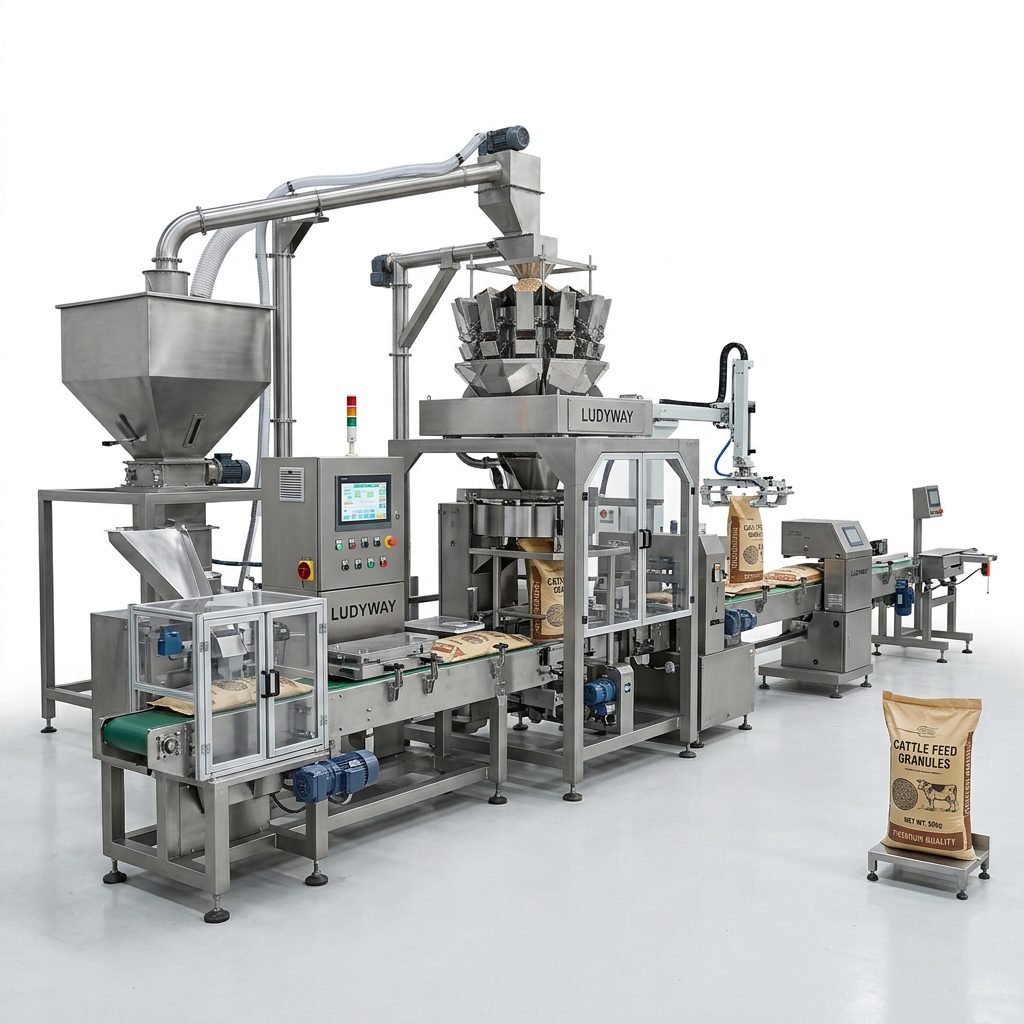
View all granule & bulk packaging lines →
Bulk vs. Retail Rice Packaging: Choosing the Right Machine Format
Rice reaches the market through two very different channels. Wholesale, food-service, export and institutional buyers move product in 10 kg to 50 kg woven polypropylene (PP) or paper sacks, and increasingly in 500–1,500 kg flexible intermediate bulk containers (FIBCs). Retail and e-commerce channels sell 500 g to 5 kg laminated film bags, vacuum brick packs and single-serve portions for instant rice and meal kits. The machine architecture for each is different, and a credible manufacturer should be able to quote both from the same engineering team so that weighing, coding and palletizing standards stay consistent across your plant.
Retail rice packaging (25 g – 5 kg)
- Vertical form-fill-seal (VFFS) baggers with 10–14 head combination weighers for pillow, gusseted and quad-seal bags.
- Vacuum brick packing for 1–5 kg premium rice: compact, stackable bricks and shelf life extended to 12–18 months.
- Multi-lane stick pack and sachet machines for 25–500 g instant rice, rice flour and seasoning portions, including fully automated instant rice packaging lines.
- Premade pouch (doypack) fillers with zipper closures for organic and premium ranges.
Bulk rice bagging (10 kg – 1,500 kg)
- Open-mouth bagging lines combining a dual-speed net weigher, bag placer, filling spout and sewing or heat-seal closer.
- Rates of 300–900 bags/hour depending on bag weight and whether bag placing is manual, semi-automatic or robotic.
- Jumbo-bag (FIBC) filling stations with platform load cells, inflatable spout seal and dust extraction.
- Integrated checkweighing, metal detection, inkjet coding, case packing and robotic palletizing for export-ready pallets.
How an Automatic Rice Bagging Line Works
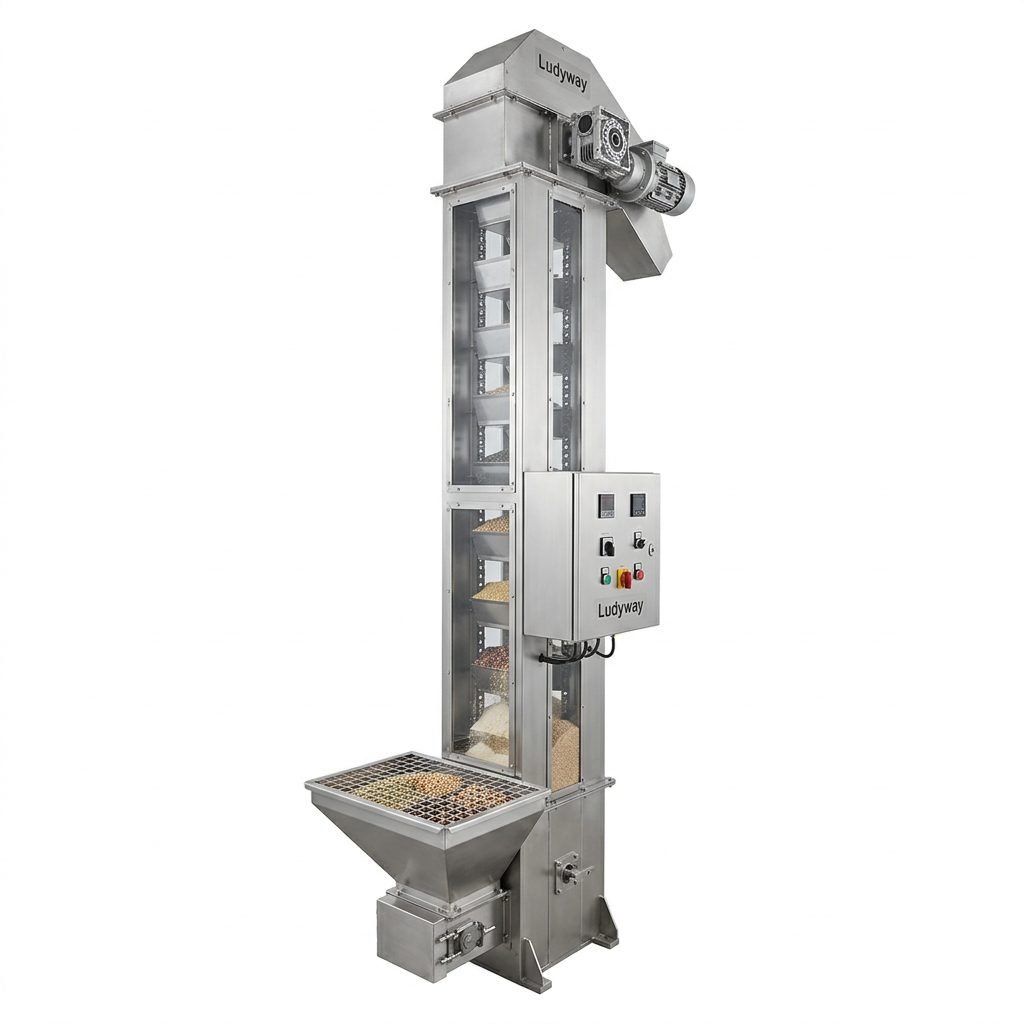
Bucket elevators move rice gently to the weigher hopper, protecting head-rice yield.
An automatic rice bagging line is a chain of material handling, dosing, bag forming or bag placing, closing and inspection. Rice is a free-flowing granule, which makes it easier to dose than flour, but it generates dust, broken kernels and static, and it abrades contact surfaces over time. Good line design moves product gently, favouring bucket elevators over long screw runs, and keeps every drop height short so breakage stays low.
On the retail side, roll film is formed into a tube, filled from a combination weigher and sealed in a single VFFS cycle. On the bulk side, a pre-made sack is clamped onto a spout, filled by a coarse/fine net weigher, released onto a conveyor and closed by sewing or heat sealing. Both variants can share the same surge hopper, metal detection and palletizing infrastructure.
Typical utilities are 380 V/50 Hz or 480 V/60 Hz three-phase power and 0.6–0.8 MPa compressed air; Ludyway configures electrical panels to the voltage and component brands specified in your RFQ.
01
Infeed & conditioning
Silo discharge, vibratory feeder or Z-type bucket elevator fills a surge hopper with level sensors.
02
Weighing
Combination weigher for retail bags or dual-speed net weigher for sacks, with in-flight compensation.
03
Forming or placing
VFFS forms bags from roll stock; bulk lines use automatic placers for open-mouth sacks.
04
Filling & closing
Heat sealing with optional vacuum or nitrogen flush; sewing, hot-air or heat-seal closers for sacks.
05
Inspection & end of line
Checkweigher, metal detector, coding, case packing or palletizing and stretch wrapping.
Technical Specifications for Rice Packaging Machines
The ranges below are indicative for medium- and long-grain milled rice at 13–14% moisture and a bulk density of roughly 0.75–0.85 g/cm³. Parboiled rice, broken rice and rice flour change flow behaviour and are tested on sample before a final specification is issued.
| Packaging format | Weight range | Typical output | Weighing / dosing | Bag or film type |
|---|---|---|---|---|
| Stick pack / sachet | 25–500 g | 300–600 sachets/min (8–12 lanes) | Volumetric cup or auger per lane | Heat-sealable laminate roll film |
| VFFS retail bag | 500 g – 5 kg | 20–60 bags/min | 10–14 head combination weigher, ±0.5–2 g | PET/PE, BOPP/PE, paper-based laminates |
| Vacuum brick pack | 1–5 kg | 8–20 bags/min | Combination weigher + vacuum chamber | High-barrier PA/PE film |
| Open-mouth sack | 10–50 kg | 300–900 bags/hour | Dual-speed net weigher, ±0.1–0.2% | Woven PP, multiwall paper, PE-lined |
| Jumbo bag / FIBC | 500–1,500 kg | 15–30 bags/hour | Platform load cells, gross or net weighing | 1–4 loop FIBC with liner |
Weighing Accuracy and Dosing Systems for Rice
Weighing is where a rice packaging machine earns or loses money. On a 25 kg sack, an average overfill of only 50 g (0.2%) gives away two tonnes of rice for every 1,000 tonnes packed. Our quotations therefore name the weighing technology and its tolerance rather than a generic accuracy figure.
Combination weighers for 1–5 kg bags
Ten or fourteen weigh heads compute the best combination for each target weight, delivering ±0.5–2 g at 40–60 weighments per minute. Stainless hoppers with dimpled surfaces reduce sticking of polished grains.
Net weighers for 10–50 kg sacks
A coarse gate fills roughly 90% of the target quickly, a fine gate tops up the balance, and the controller compensates for in-flight product. Expect ±0.1–0.2% repeatability with 20–40 kg loads at 300–900 bags/hour.
Volumetric and auger dosing for portions
Multi-lane sachet machines use adjustable volumetric cups for whole-grain rice (around ±1%) and servo augers for rice flour and seasoning blends.
Legal metrology
For prepacked goods, specify OIML R 61 compliant gravimetric fillers and OIML R 51 checkweighers; buyers in the EU reference the Measuring Instruments Directive, while US packers follow NTEP and NIST Handbook 133 sampling.
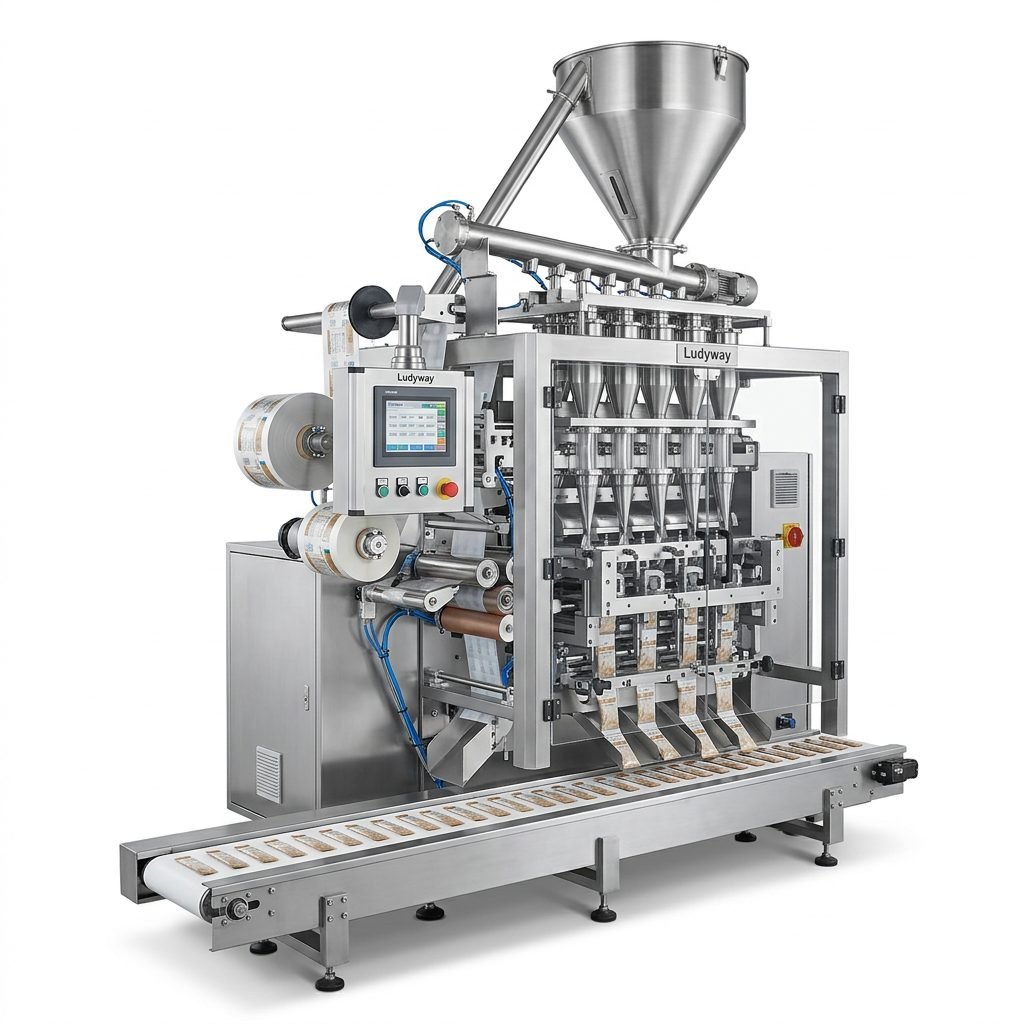
Multi-lane sachet system for 25–500 g instant rice and rice flour portions.
Certifications, Food-Contact Compliance and Weighing Standards
A rice bagging machine is a food-contact appliance first and a piece of automation second. Specify materials, surface finish and cleanability before you specify speed.
Procurement teams buying from an overseas rice packaging machine manufacturer should ask for documentary evidence on four fronts. Ludyway supplies the following as standard with a formal quotation:
- Food-contact materials. Product-contact parts in SUS304 (SUS316L on request), food-grade belts and seals, and material declarations aligned with FDA food-contact substance rules and EU Regulation (EC) No 1935/2004.
- Machine safety and export documentation. CE marking with technical file, interlocked guarding, emergency stops and electrical components from Siemens, Schneider or Omron; UL-listed panels can be specified for North America.
- Quality system and packaging standards. Manufacturing under ISO 9001, with design references drawn from the ISO packaging and distribution standards (ICS 55).
- Sustainability readiness. Sealing jaws and film tracking tuned for mono-material PE and paper-based laminates, which matter under the EU Packaging and Packaging Waste Regulation.
- Industry benchmarking. Output and automation targets cross-checked against the PMMI 2026 State of the Industry report so your line is sized for current market practice rather than legacy assumptions.
Rice-Specific Engineering Details That Protect Yield and Shelf Life
Generic granule packaging machines can bag rice, but a few details separate an acceptable installation from one that pays back quickly. These are the points our engineers review on every rice project.
Dust, fines and broken kernels
Extraction hoods at the weigher discharge and filling spout keep bran dust off seal areas, which is the most common cause of leaking retail bags. Short drop heights and lined chutes limit kernel breakage, and a dedicated dust collection system keeps the packing hall within workplace exposure limits.
Vacuum brick packs and nitrogen flushing
Premium 1–5 kg rice is increasingly sold as a vacuum brick. An industrial vacuum packaging machine with high-barrier PA/PE film, or a VFFS bagger with a nitrogen flushing system holding residual oxygen below 1–2%, slows oxidation and suppresses stored-grain insects without chemical treatment.
Moisture and hermetic sealing
Rice is milled and packed at 13–14% moisture. Seal integrity testing (vacuum decay or dye penetration) on every format change and seal strength of at least 20 N/15 mm for retail films are written into our acceptance criteria.
Film and sack compatibility
Send film or sack samples with your RFQ. Woven PP sacks are closed by sewing with crepe tape, PE-lined sacks by hot-air or heat sealing; retail laminates of 60–120 µm run best with servo-driven jaws and PID-controlled sealing temperature.
End-of-Line Automation: Checkweighing, Case Packing and Palletizing
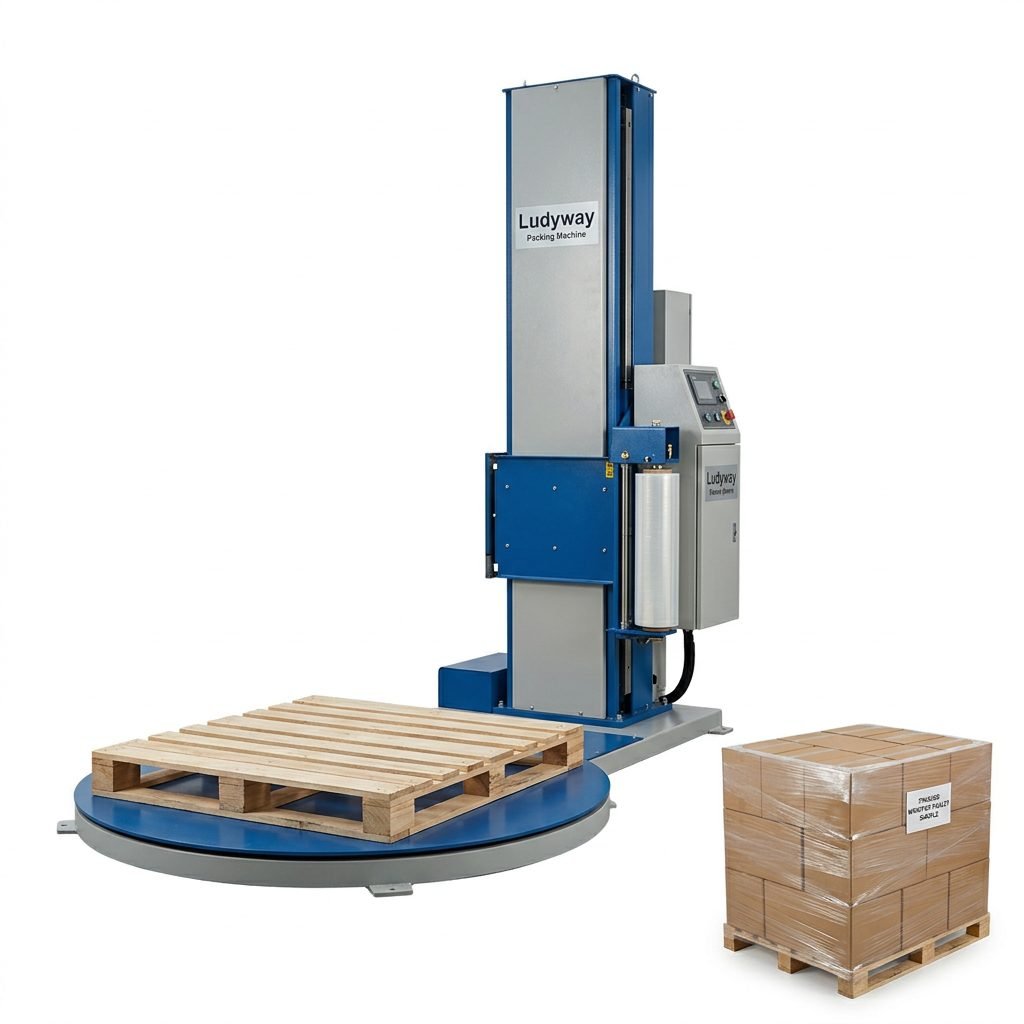
Pallet stretch wrapping completes an export-ready rice bagging line.
Bagging speed is only useful if the downstream equipment keeps pace. A 25 kg line at 600 bags/hour produces 15 tonnes per hour, which no manual palletizing crew can sustain across a shift. Ludyway designs the end of line as part of the same project so that conveyors, buffers and reject stations are matched to the bagger.
- A high-precision checkweigher and metal detector on every bag, with data logging for legal-metrology audits.
- Inkjet or thermal transfer coding of lot, best-before and GS1 barcodes.
- Case packers for 1–5 kg retail bags; bag flatteners and robotic palletizing at 600–1,200 sacks/hour for bulk.
- Stretch wrapping or hooding for container loading and long sea voyages.
Where floor space is tight, a combined checkweigh-and-reject module and a low-level palletizer can fit a 25 kg line into roughly 25 m of length.
Supply Capability, MOQ, Lead Time and How to Get a Quotation
130+
packaging engineers and specialists
20,000 ㎡
production facility in Zhongshan
200+
manufacturing equipment units
100+
countries and regions served
Commercial terms
- MOQ: 1 set for standalone machines; turnkey lines quoted per project.
- Lead time: 35–60 days for standard baggers and sachet machines, 60–120 days for integrated lines, counted from drawing approval and deposit.
- Payment: typically 30% deposit and 70% before shipment by T/T, or irrevocable L/C at sight for larger projects.
- Incoterms: FOB Shenzhen/Guangzhou, CIF or DAP to major ports; wooden export packing and fumigation included.
- Acceptance: factory acceptance test (FAT) with your rice and packaging material, witnessed on site or by live video.
- After-sales: 12-month warranty, spare-parts kit, remote diagnostics via HMI, and on-site installation and operator training on request.
What to include in your RFQ
- Rice type (long/short grain, parboiled, broken, rice flour), moisture and bulk density if known.
- Target pack sizes and required bags or sachets per hour for each size.
- Packaging material: film structure and thickness, or sack type and dimensions, ideally with physical samples.
- Plant voltage and frequency, compressed air availability, and a layout sketch with available floor space.
- Desired automation level: manual bag placing, semi-automatic, or fully automatic with palletizing.
- Destination market, so certification and labelling requirements can be built into the proposal.
With this information a layout drawing and itemised quotation are normally returned within 7–10 working days.
Why Source Rice Packaging Equipment from Ludyway
Ludyway is one of the largest packaging machine manufacturers in China, specializing in advanced packaging equipment and turnkey production solutions for the food, pharmaceutical and health industries. Founded in 1993 and based in Nanlang Town, Zhongshan, Guangdong, the company draws on more than 30 years of experience in granule, powder, liquid and pouch packaging, a 20,000 ㎡ manufacturing facility, 200+ production equipment units and a 130-strong engineering and technical team. The portfolio covers more than 50 intelligent machine models, from multi-lane stick pack and sachet systems to fully automated bagging and palletizing lines, serving customers in over 100 countries and regions.
For rice processors this scale matters in practical ways: weighers, baggers, conveyors, inspection and palletizing come from one supplier with one warranty and one control architecture; FAT is run on your grain and your film; and spare parts are stocked for the long service life of a bagging line. Ludyway’s export growth, documented in an industry report on its global expansion, reflects repeat orders from food manufacturers who started with a single machine and later standardised entire plants.
Buyers are welcome to visit the factory in Zhongshan to see machines running, or to meet the team at international packaging exhibitions where current rice, grain and granule packaging systems are demonstrated.
Frequently Asked Questions
Can one rice packaging line handle both bulk sacks and retail bags?
Not on the same filling head, because a 25 kg net weigher and a 1 kg combination weigher are different machines. However, both can be fed from one surge hopper and share metal detection, coding, conveying and palletizing. Many mills install a bulk line first and add a retail VFFS or sachet machine on a parallel leg within 12–24 months.
What weighing accuracy should I specify for 25 kg and 50 kg rice sacks?
Ask for a dual-speed net weigher with ±0.1–0.2% repeatability at rated speed and request the FAT protocol that proves it, using at least 30 consecutive bags on a certified reference scale. For legal-for-trade packing, specify OIML R 61 compliance and a downstream checkweigher with data logging.
What is the minimum order and typical delivery time?
The minimum order is one machine. Standard rice baggers and multi-lane sachet machines ship in roughly 35–60 days after drawing approval; turnkey lines with palletizing take 60–120 days. Sea freight to most ports adds 20–45 days, so plan around 4–6 months from purchase order to commissioning for a full line.
Do you test my rice and packaging material before shipment?
Yes. Customers send 50–200 kg of rice and sample film or sacks. The machine is set up and run in the factory, and a recorded or live-video FAT is delivered with weight, seal and output data before the balance payment and shipment.
How do I get a quotation and layout proposal?
Send the RFQ details listed above by email or WhatsApp. An engineer will confirm pack sizes and throughput, propose a layout drawing and return an itemised quotation, typically within 7–10 working days.
Request a Rice Packaging Line Proposal
Tell us your pack sizes, bags per hour and packaging material, and Ludyway’s engineering team will prepare a layout drawing, itemised quotation and FAT plan for your bulk or retail rice bagging project. Samples can be tested in our Zhongshan factory and the full product catalogue is available on request.
