
Salt Packaging Equipment
Salt Packaging Machine for Fine & Coarse SaltAutomatic Salt Packing Solutions for Pouches & Bags
4–12 lane stick pack & sachet systems · Formats from 0.5 g single-serve to 50 kg bags · SUS316L salt-contact parts as standard option
A salt packaging machine for fine and coarse salt products has to manage three things most granule packers never face: a highly corrosive chloride, a product that cakes once room humidity climbs above roughly 75% RH, and crystal sizes ranging from 0.2 mm flour salt to 6 mm rock salt. This page is written for salt refiners, co-packers, food-plant engineers and equipment buyers comparing automatic salt packing solutions for sachets, stick packs, pillow pouches and 1–50 kg bags, with the dosing, material and compliance specifications needed to request an accurate quotation.
Key takeaways
- Fine table salt (0.3–0.8 mm) is dosed most economically by volumetric cup or auger fillers at ±0.5–1% accuracy; coarse salt above 2 mm needs a linear or multi-head weigher to keep crystals out of the seal zone.
- Multi-lane stick pack and sachet machines run 4–12 lanes at 30–60 cycles per lane per minute, producing 240–600+ single-serve packs of 0.5–10 g every minute.
- Salt-contact parts should be specified in SUS316L rather than SUS304: chloride pitting on 304 hoppers and cups typically appears within 6–12 months in a salt plant.
- Pillow pouches of 100 g–2 kg run on VFFS machines at 30–80 bags/min; 10–50 kg open-mouth bagging lines reach 300–900 bags/hour.
- Standard lead time is 35–60 days after drawing approval, with CE marking, ISO 9001 manufacturing and FDA 21 CFR / EU 1935/2004 food-contact documentation supplied with the machine.
Salt Packaging Machines for Sachets, Stick Packs & Bags
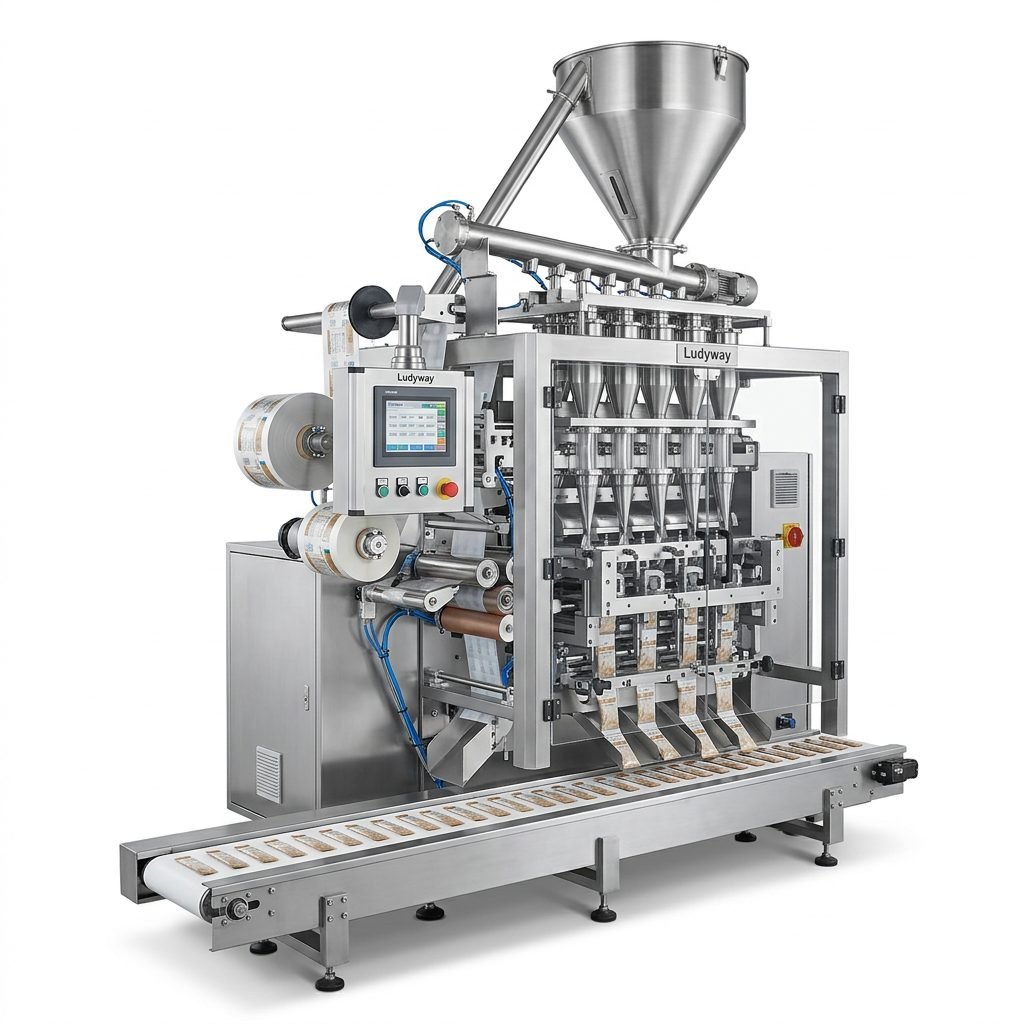
Salt Sachet Packaging Machine
Multi-Lane Sachet, Fine & Iodized Salt
Quote on request
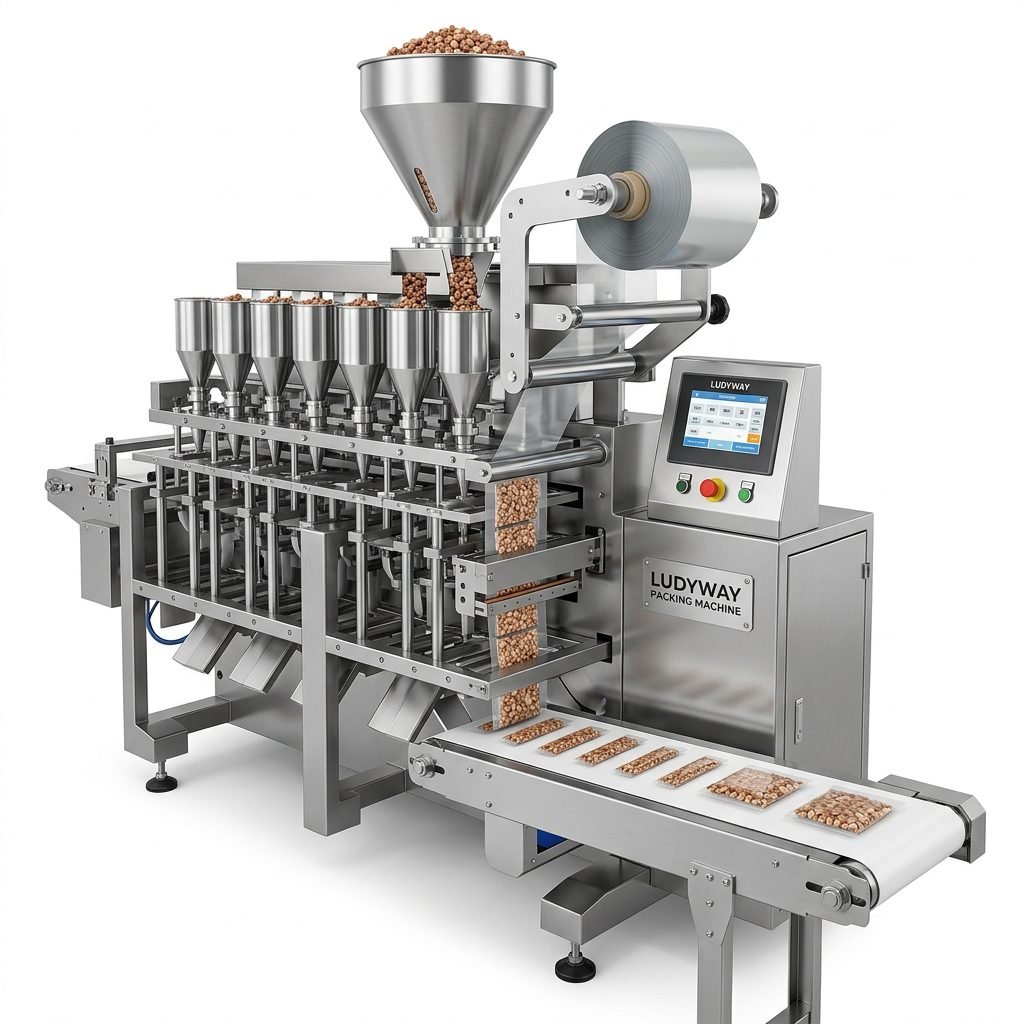
Salt Stick Pack Machine
Multi-Lane Stick Pack, 0.5–5 g Portions
Quote on request
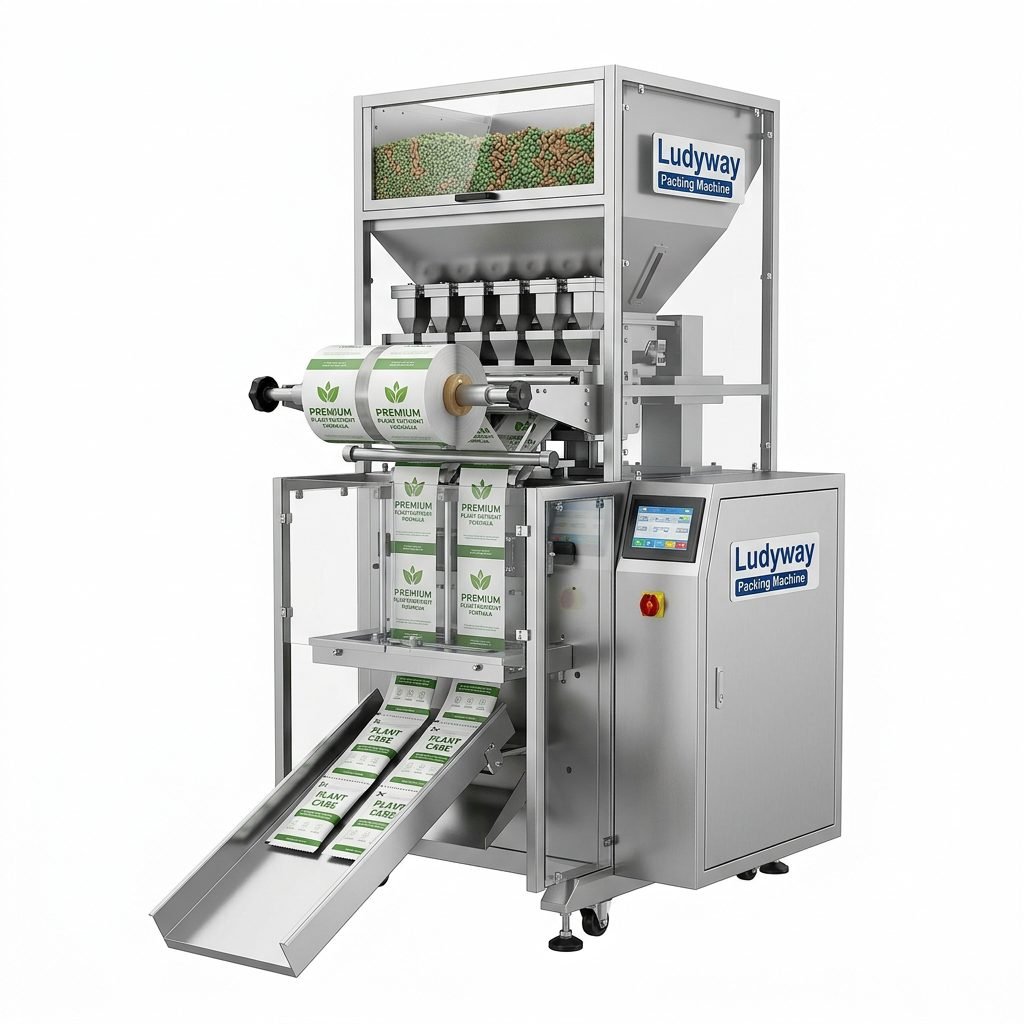
Sea Salt Granule Packer
Sachet & Pouch, Coarse Sea Salt
Quote on request
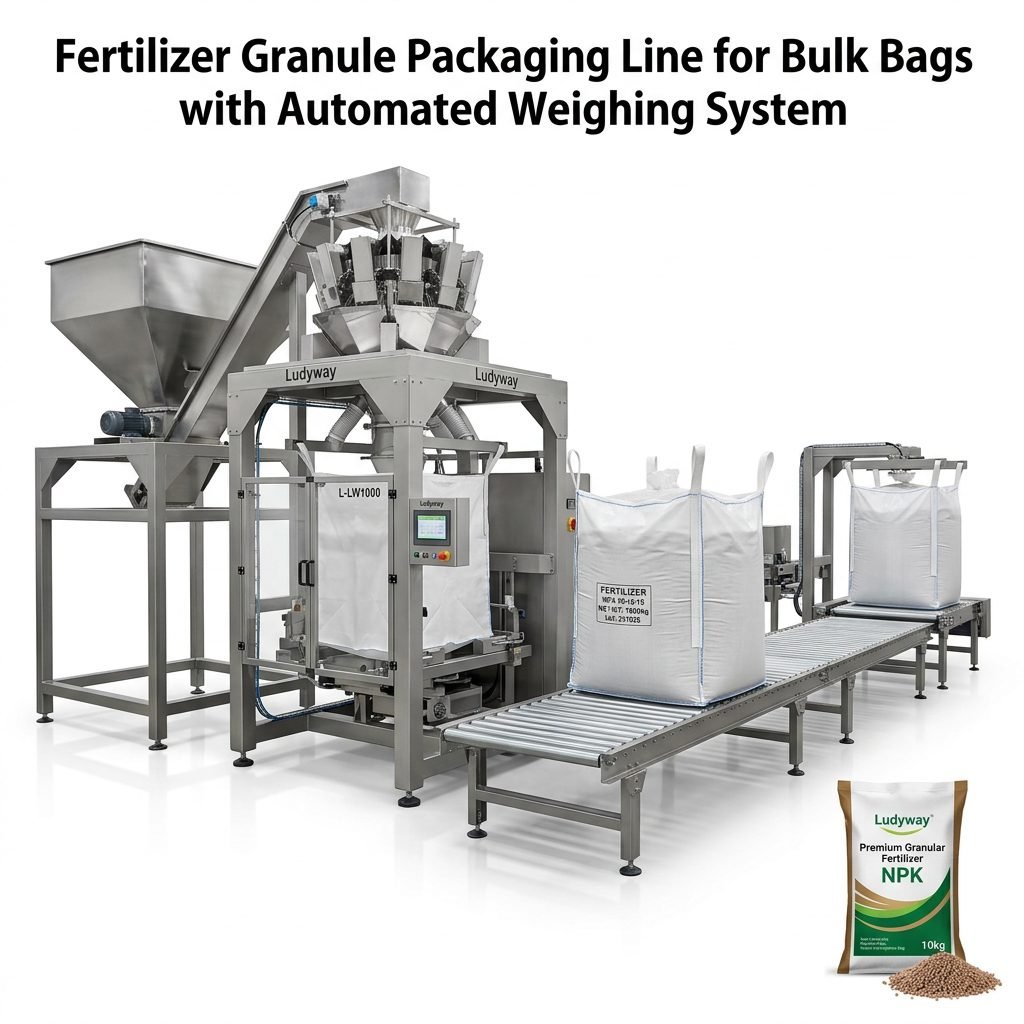
Rock Salt Bagging Equipment
Bulk Bags, 10–50 kg Rock Salt
Quote on request
Why Salt Needs a Dedicated Packaging Machine, Not a Generic Granule Packer
Sodium chloride is one of the most aggressive food products a packaging line can run. Salt dust settles on every horizontal surface, draws moisture from the air and forms a brine film that attacks carbon steel, aluminium and even SUS304 stainless. A general-purpose granule packer that works perfectly on sugar or rice will show rust streaks on the forming tube, seized cup-filler shafts and corroded sensor housings within the first year of salt duty.
Salt is also hygroscopic above its deliquescence point of about 75% RH, which means fine salt bridges in the hopper and coarse salt forms lumps that jam gates and distort fill weights. Add the abrasiveness of crystalline rock salt, the light sensitivity of potassium iodate in iodized salt, and the free-flowing anti-caking agents (E535/E536 or silicon dioxide) that create fine dust, and the case for a purpose-built salt packaging machine becomes clear.
SUS316L
Recommended grade for hoppers, cups, augers and forming tubes in chloride-contact service; 304 is acceptable only for frame and guards.
≤ 55% RH
Target humidity in the packing room to keep fine salt free-flowing and avoid moisture pick-up before the pack is sealed.
0.2–6 mm
Crystal size range handled by one machine platform when the dosing module is switched between cup filler and weigher.
Fine Salt vs Coarse Salt: Dosing, Flow and Seal Integrity
The single most important specification on your inquiry is the particle size distribution of the salt you pack. It determines the dosing technology, the film thickness, the sealing jaw design and ultimately the speed you can expect. The comparison below reflects typical refined table salt on one side and sea salt, kosher salt or crushed rock salt on the other.
Fine & Powdered Salt (0.2–0.8 mm)
- Bulk density: 1.1–1.3 g/cm³, consistent batch to batch, which makes volumetric cup dosing accurate to ±0.5–1%.
- Dosing: adjustable volumetric cup for 0.5–500 g; servo auger for flour salt and salt–spice blends below 0.3 mm.
- Main risk: airborne dust contaminating the seal and settling on electrical components; requires dust extraction at the filling point.
- Film: 50–70 µm PE or paper/PE for sachets; PET/PE or BOPP/PE laminate for retail pouches with print.
- Typical formats: 0.5–1 g single-serve sachets and stick packs, 100 g–1 kg pillow pouches, 500 g–1 kg paper bags.
Coarse, Sea & Rock Salt (1–6 mm)
- Bulk density: 1.0–1.2 g/cm³ but variable with crystal shape and moisture, so weighing replaces volumetric dosing above about 50 g.
- Dosing: 2- or 4-head linear weigher for 50 g–2 kg; 10- or 14-head multi-head weigher where speeds above 60 bags/min are required.
- Main risk: a single 4 mm crystal trapped in the cross seal produces a leaker; vibration settling and jaw brushes or air knives are specified.
- Film: 70–90 µm PE or PA/PE puncture-resistant laminates; woven PP or multi-wall paper for 10–50 kg bags.
- Typical formats: 250 g–2 kg gusseted pouches, stand-up pouches with zipper, 10–25 kg open-mouth bags, 500–1,200 kg FIBC.
Automatic Salt Packing Machine Types by Package Format
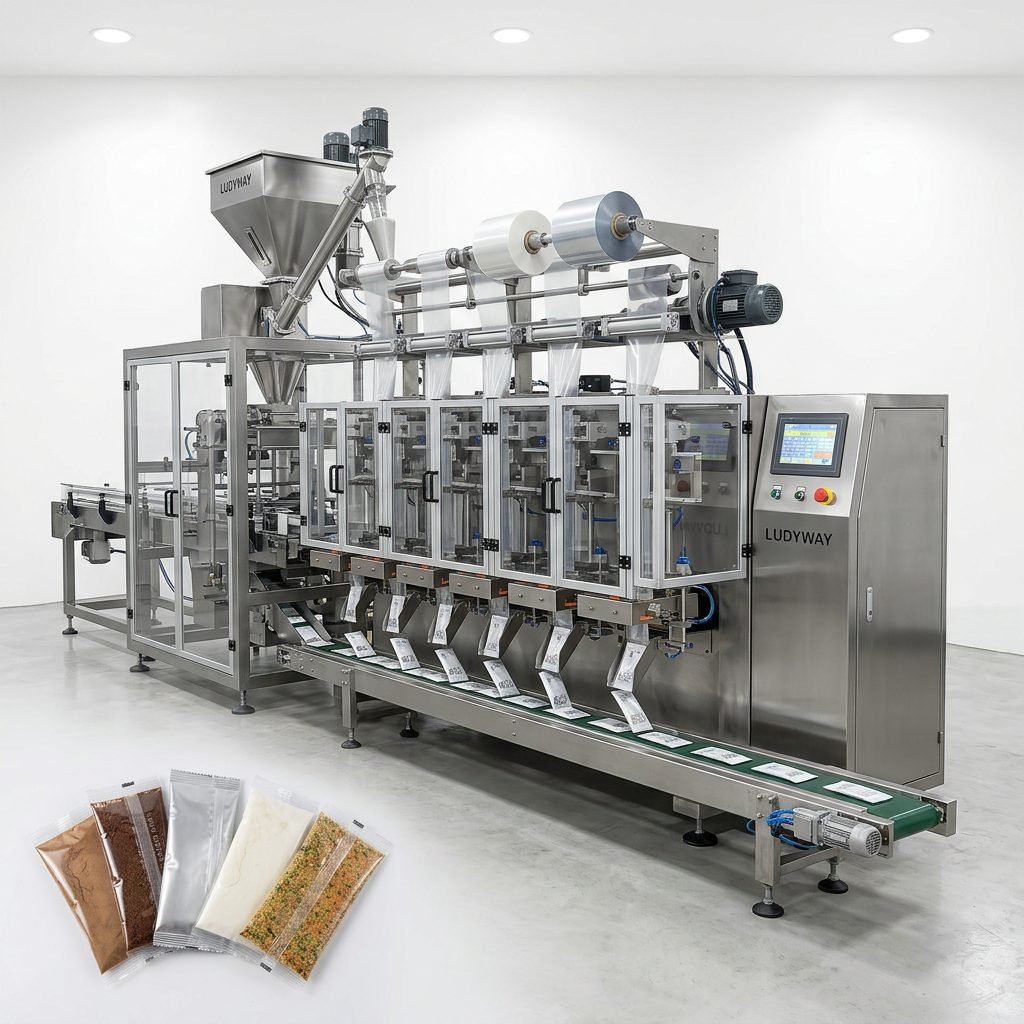
Multi-lane sachet line configured for 0.5–10 g single-serve salt portions.
Single-Serve Sachets and Stick Packs (0.5–10 g)
Restaurant, airline and food-service salt is packed on multi-lane vertical form-fill-seal machines with 4, 6, 8, 10 or 12 lanes. Each lane carries its own volumetric cup or auger, so a 10-lane machine at 45 cycles/min delivers 450 four-side-seal sachets per minute from a single 600–800 mm film reel.
Stick packs use the same platform with three-side seals and a narrower 20–30 mm width, which is popular for pink Himalayan salt, flavoured finishing salts and salt–pepper duo portions. Iodized salt runs on an opaque PET/AL/PE or paper laminate to protect iodate from light. A related configuration handles oral rehydration salt sachets where dose accuracy is pharma-grade.
Options include date coding, easy-tear notches, lane-by-lane fill verification and a brine-resistant dust hood over the filling station.
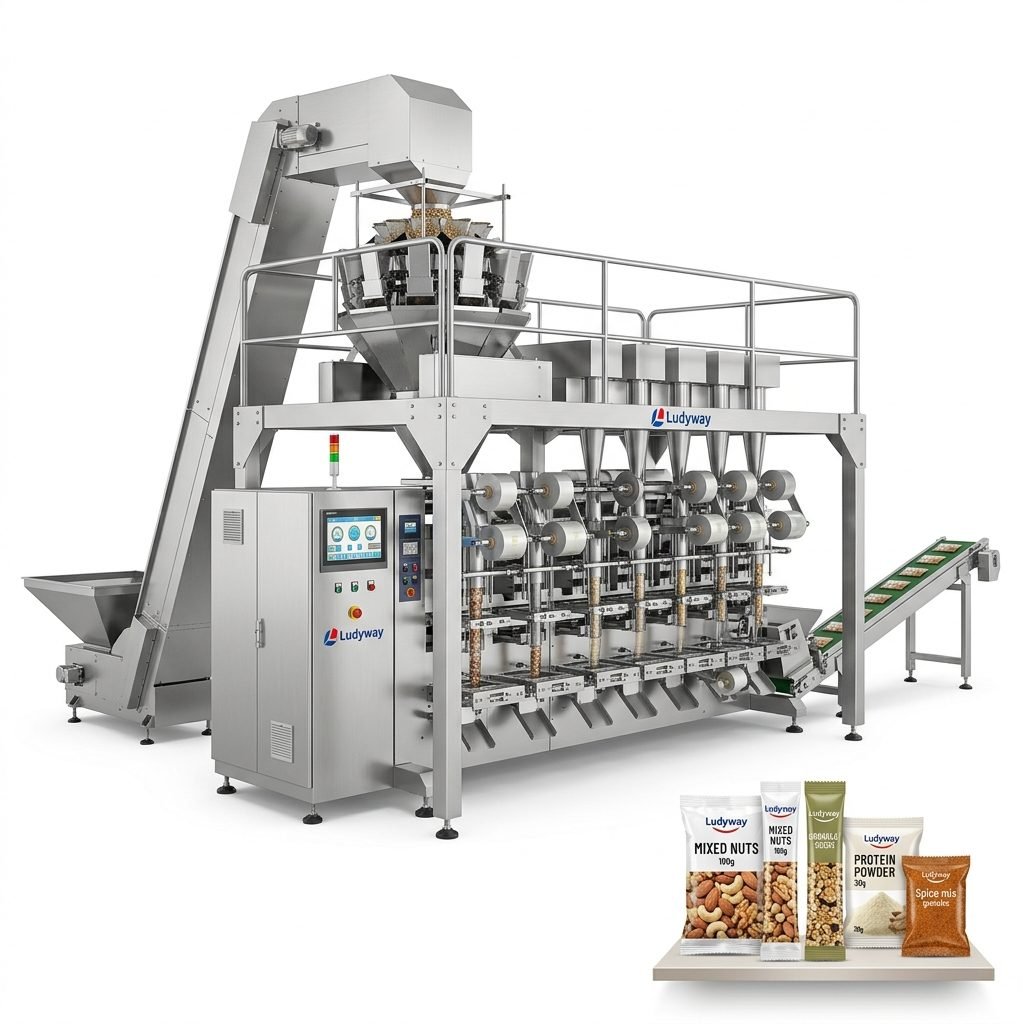
Granule packaging line with weigher feed for 250 g–2 kg retail salt pouches.
Pillow, Gusseted and Stand-Up Pouches (100 g–2 kg)
Retail table salt, sea salt and kosher salt are packed on a single-lane VFFS machine fed by a bucket elevator or inclined screw conveyor. For fine salt, a 16- or 24-cup rotary volumetric filler keeps the machine at 60–80 bags/min; for coarse crystals a linear or multi-head weigher runs 30–60 bags/min with ±1–2 g accuracy on a 1 kg pack.
The automated salt granule packaging system adds a vibratory settling tray before the sealing jaws, a product-sweep brush on the cross-seal and servo film pull to avoid the slip that salt dust causes on friction-driven belts.
Stand-up pouches with zipper, quad-seal bags and pre-made pouch fillers are available where shelf presence matters more than absolute speed.
Open-Mouth Bags and Bulk Bags (10–1,200 kg)
Industrial salt, water-softener salt and de-icing salt are weighed by a net-weight scale and dropped into woven PP, multi-wall paper or PE heavy-duty bags, then sewn or heat-sealed and conveyed to a palletizer. A 25 kg bag packaging line typically reaches 300–600 bags/hour with gross-weight accuracy of ±0.1–0.2%, while FIBC stations fill 500–1,200 kg big bags at 20–40 bags/hour.
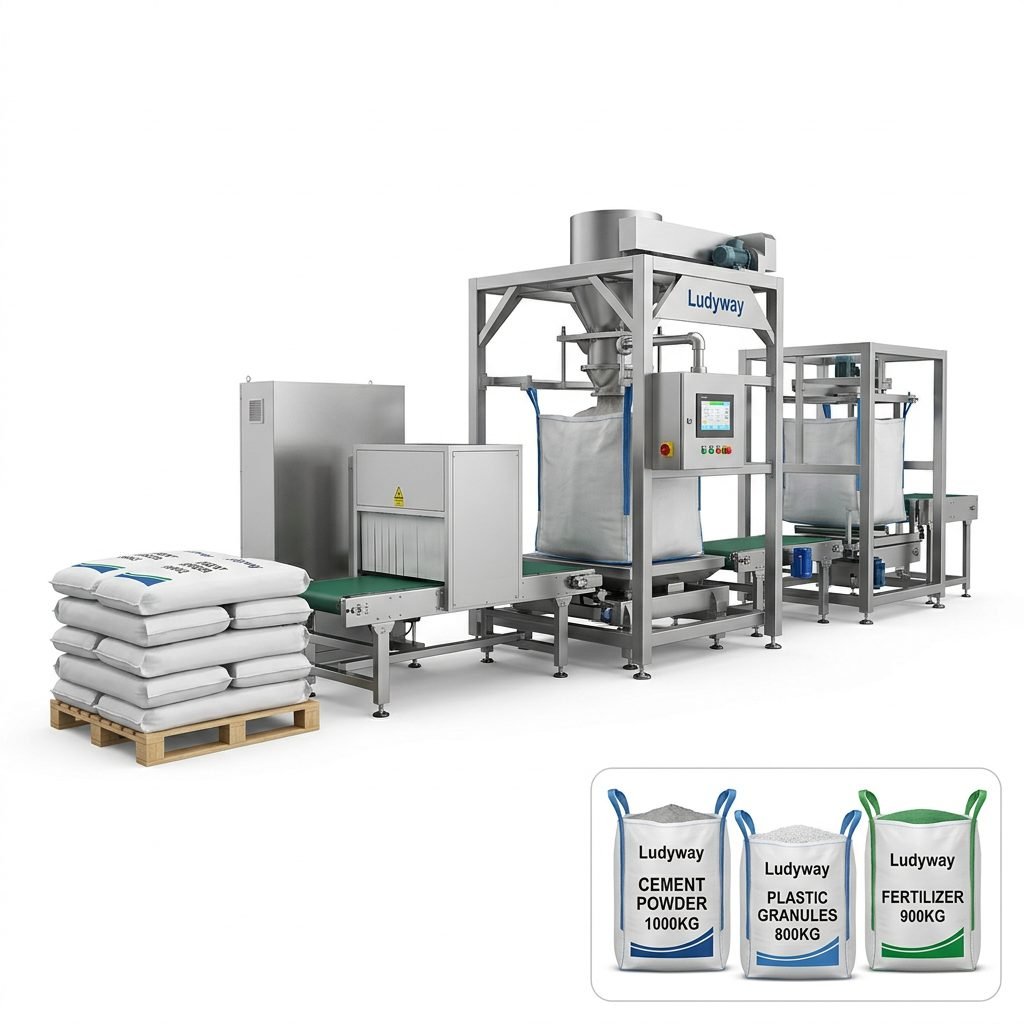
Big bag filling station for industrial and de-icing salt, 500–1,200 kg per FIBC.
Salt Packaging Machine Specifications at a Glance
The values below are representative ranges for standard configurations. Final figures depend on crystal size, moisture content, film structure and the level of automation you specify around the primary packer.
| Parameter | Multi-Lane Sachet / Stick | VFFS Pouch | Open-Mouth Bag | Bulk Bag (FIBC) |
|---|---|---|---|---|
| Fill range | 0.5–10 g | 100 g–2 kg | 10–50 kg | 500–1,200 kg |
| Output | 240–600+ packs/min | 30–80 bags/min | 300–900 bags/hour | 20–40 bags/hour |
| Dosing | Volumetric cup / servo auger per lane | Rotary cup, linear or multi-head weigher | Net-weight scale, gravity or belt feed | Gross-weight platform scale |
| Accuracy | ±0.5–1% (fine salt) | ±1–2 g at 1 kg | ±0.1–0.2% | ±0.1% |
| Packaging material | Paper/PE, PET/PE, PET/AL/PE, 50–70 µm | PE, PET/PE, PA/PE, BOPP/PE, 60–90 µm | Woven PP, multi-wall paper, PE | Woven PP FIBC with PE liner |
| Contact parts | SUS316L cups, hopper, forming tubes | SUS316L hopper, tube, weigh buckets | SUS316L scale hopper, PU-lined chutes | SUS316L spout, PU seals |
| Utilities | 380 V/50–60 Hz, 6–10 kW, 0.6 MPa air | 380 V, 4–8 kW, 0.6 MPa air | 380 V, 5–12 kW, 0.6 MPa air | 380 V, 3–6 kW, 0.6 MPa air |
Corrosion Resistance, Hygiene and Food-Contact Compliance
“The cheapest salt packaging machine is rarely the lowest cost of ownership. Every carbon-steel bracket, every 304 cup and every unsealed junction box becomes a maintenance ticket once salt dust meets humid air.”
A salt-ready machine specification starts with the frame: fully welded SUS304 with no enclosed hollow sections where brine can collect, SUS316L or PU-coated surfaces wherever product touches metal, and IP65-rated motors, sensors and HMI. Electrical cabinets are positively pressurised or mounted away from the dusty zone, and pneumatic valves sit in sealed manifolds. Chain drives are replaced with timing belts or direct servo drives, and all bearings are stainless with food-grade grease.
Dust control is part of the machine, not an afterthought. An industrial dust collection system with extraction points at the filler and the forming tube keeps the sealing area clean, extends jaw life and reduces the daily washdown load. Downstream, a dynamic checkweigher rejects underweight pouches and documents compliance with average-weight regulations in export markets.
On documentation, buyers should request CE marking (Machinery Directive 2006/42/EC), ISO 9001 manufacturing certification, and material declarations for all food-contact components in line with FDA 21 CFR and EU Regulation 1935/2004. The FDA guidance on packaging and food contact substances is the reference for US-bound salt, while the Flexible Packaging Association publishes film and laminate resources useful when choosing barrier structures for iodized or flavoured salt.
How to Specify the Right Salt Packaging Machine in Five Steps
STEP 1
Send a 2 kg product sample
Particle size distribution, moisture and anti-caking agent determine cup versus weigher dosing. Samples are run on a test machine and a fill-accuracy report is returned.
STEP 2
Define formats and target output
List every pack size you plan to run in the next 3 years. One VFFS with a quick-change forming set may replace two fixed machines.
STEP 3
Fix the material specification
Confirm SUS316L contact parts, IP65 electrics, dust extraction and washdown level in writing before pricing is compared.
STEP 4
Scope upstream and downstream
Bucket elevator, metal detector, checkweigher, case packer and palletizer should be quoted as one integrated line with a single controls interface.
STEP 5
Agree FAT criteria and spares
Set the acceptance test on your salt and your film, at rated speed for 2 hours, with a 12-month wear-part kit included in the offer.
Supply Capability, Lead Time and How Quotations Work
Ludyway, founded in 1993 in Zhongshan, Guangdong, is one of the largest packaging machine manufacturers in China, operating a 20,000 m² facility with 130+ packaging engineers and more than 50 machine models for granule, powder, liquid and pouch applications. Salt lines ship to customers in over 100 countries, and the company’s export growth toward RMB 1 billion is tracked in this industry report on Ludyway’s global expansion.
Quotations are issued per configuration rather than from a price list: the same multi-lane platform can vary significantly in price depending on lane count, dosing type, material grade and inspection equipment. Send product samples, target formats and output, and a formal offer with layout drawing follows within 3–5 working days.
For wider market context on automation trends and machinery standards, the PMMI Association for Packaging and Processing Technologies publishes annual State of the Industry data covering salt, spice and seasoning packaging segments.
| Commercial Term | Standard Offer |
|---|---|
| Minimum order | 1 machine; turnkey lines quoted as a package |
| Lead time | 35–60 days standard machine; 75–100 days integrated line |
| Acceptance | FAT on customer salt and film, live video or on-site |
| Payment | T/T deposit with balance before shipment; L/C on request |
| Shipping | EXW, FOB Shenzhen/Guangzhou or CIF, plywood case |
| Warranty | 12 months, wear parts excluded; remote support included |
| Documentation | CE, ISO 9001, material certificates, manuals, electrical drawings |
Frequently Asked Questions About Salt Packaging Machines
Can one machine pack both fine table salt and coarse sea salt?
Yes, provided the dosing module is interchangeable. A VFFS machine with a quick-release volumetric cup filler for fine salt and a linear weigher for coarse crystals can switch formats in 30–45 minutes. Multi-lane sachet machines are usually dedicated to fine salt because weighers do not scale economically to 10 or 12 lanes.
Is SUS316L really necessary or is SUS304 enough?
For frames, guards and conveyors SUS304 is adequate. For any part that touches salt or sits in the dust zone, 316L’s molybdenum content gives significantly better resistance to chloride pitting. The cost difference on a typical machine is a small fraction of the total and is recovered in the first avoided overhaul.
What fill accuracy should I expect on a 1 g salt sachet?
With free-flowing fine salt at stable humidity, volumetric cup dosing holds ±0.5–1%, i.e. roughly ±5–10 mg on a 1 g portion. Accuracy drops if the salt absorbs moisture before filling, which is why a dehumidified packing room and a closed, dust-extracted hopper are specified together.
How is iodized salt protected during packaging?
Potassium iodate and iodide degrade under light, heat and moisture. Use an opaque laminate such as paper/PE or PET/AL/PE, keep seal temperatures at the low end of the film window, and ensure the sealed pack has a water-vapour transmission rate suitable for a 24-month shelf life in the destination climate.
What information do I need to send for a quotation?
Salt type and particle size, moisture and additives, pack sizes and weights, required output per shift, film or bag material you intend to use, plant voltage, and whether you need upstream feeding and downstream case packing. A 2 kg sample allows a test run and a fill-accuracy report before you commit.
Next Step for Buyers & Engineers
Request a Salt Packaging Machine Quotation or Sample Test
Send your salt sample and target formats to receive a configured offer with layout drawing, lead time and FAT plan, or ask for the full granule and powder machine catalogue to compare lane counts and dosing options.
