In the complex world of modern manufacturing and logistics, packaging is a critical process that occurs in distinct layers. While primary packaging directly contains the product and secondary packaging groups individual units, there exists a third, often overlooked but vital layer: tertiary packaging. This article delves into the world of tertiary packaging equipment, exploring its types, core functions, and essential tips for selecting the right machinery for your operations.
Understanding Tertiary Packaging: The Final Protective Layer
Tertiary packaging is the outermost layer designed for the bulk handling, storage, and transportation of goods. Its primary purpose is to protect secondary packaging (like boxes or cartons) during transit and storage in warehouses, ensuring products arrive at their final destination—be it a distribution center or retail store—intact and secure. This layer is typically removed before products are displayed for sale. The equipment used to create this layer is engineered for high-volume, robust performance, focusing on unitizing loads for efficient logistics.
Key Point:
Think of tertiary packaging as the shipping armor for your products. It doesn’t enhance the consumer’s unboxing experience but is fundamental to ensuring that experience is even possible by preventing damage in the supply chain.
Core Functions of Tertiary Packaging Equipment
The machinery employed in this stage is built around several non-negotiable functions that streamline the end of the production and the beginning of the distribution cycle.
1. Unitization and Stabilization
This is the primary function. Equipment assembles multiple secondary packages into a single, manageable load unit—most commonly a pallet. This process prevents individual boxes from shifting, toppling, or separating, which is crucial for safe forklift handling, racking, and truck/container loading.
2. Protection from Environmental Hazards
Tertiary packaging shields products from dust, moisture, and compression during extended storage and long-haul transport. Equipment applies materials that create a barrier against these elements.
3. Facilitating Efficient Handling & Logistics
By creating standardized, secure pallet loads, this equipment directly optimizes warehouse space utilization, speeds up loading/unloading times, and simplifies inventory counting. It is a key enabler of modern supply chain efficiency.
4. Providing Load Identification
While not its main job, some tertiary packaging processes allow for the application of labels, tags, or barcodes directly onto the load wrap or stretch film, aiding in warehouse management and shipment tracking.
Main Types of Tertiary Packaging Equipment
The choice of equipment depends on the load’s nature, required stability, and environmental needs. Here are the most prevalent types:
Pallet Stretch Wrappers
The most ubiquitous tertiary packaging machine. It applies stretch film—a highly elastic plastic film—around a palletized load. The tension of the film tightly binds the boxes to the pallet, providing exceptional stability.
- Manual Wrappers: Operator-held dispensers for low-volume operations.
- Semi-Automatic Wrappers: The operator places the load on a turntable, which rotates while a mechanized arm applies the film. Ideal for medium-volume needs.
- Fully Automatic Wrappers: Integrated into conveyor lines, these machines automatically position, wrap, and film-cut without manual intervention, designed for high-speed production environments.
- Robotic Wrappers: A robotic arm manipulates the film roll around complex or irregularly shaped loads with high precision.
Shrink Wrapping Systems
This equipment uses a heat tunnel to apply shrink film. The loose plastic film is draped over the load, and when heated, it shrinks tightly to conform to the load’s exact shape, creating a durable, tamper-evident skin.
Best for: Creating weather-resistant, dust-proof bundles; stabilizing loads without a pallet (e.g., multi-pack beverages); and products requiring a high degree of containment.
Strapping Machines
These apply bands of material (plastic, steel, or cord) around a load to secure it. They offer very high tensile strength and are often used for heavy, dense, or rigid loads like bricks, metal, or compressed paper.
- Polypropylene (PP) & Polyester Strappers: Common for general unitization.
- Steel Strappers: Used for extremely heavy-duty industrial applications.
Palletizers & Depalletizers
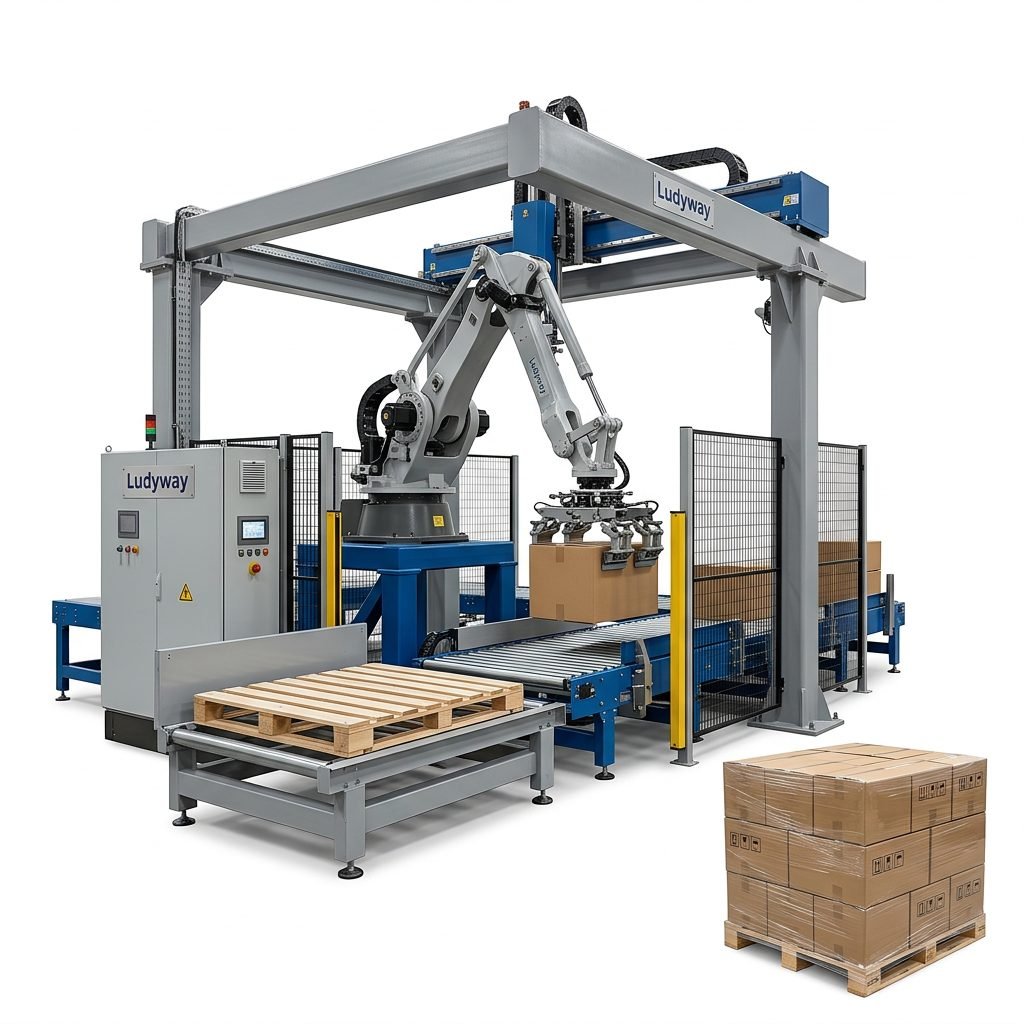
While often considered upstream equipment, automated palletizers are the starting point for effective tertiary packaging. They robotically or mechanically stack secondary packages onto a pallet in a pre-programmed, stable pattern. Depalletizers perform the reverse function at the destination.
Case Erectors, Packers, and Sealers
In some workflows, tertiary packaging involves placing grouped secondary packages into a larger, more robust shipping container or crate. Automatic case erectors form the box, packers insert the product grouping, and sealers close and tape the case shut.
Visual Comparison: Stretch Wrap vs. Shrink Wrap
Stretch Wrap: Applied cold under tension. Excellent for load compression and stability. Generally more cost-effective in film usage. Allows for ventilation.
Shrink Wrap: Applied loosely and then heated. Conforms to irregular shapes perfectly. Creates a full, six-sided weatherproof barrier. Offers tamper evidence.
Key Selection Tips for Your Tertiary Packaging Equipment
Choosing the right system requires a careful analysis of your current and future needs. Here are the critical factors to consider:
1. Analyze Your Load Profile
What are you wrapping? Consider the dimensions, weight, stability, and shape of your typical pallet load. Irregular shapes may favor shrink wrap or robotic arms. Heavy, shifting loads require high-performance stretch film with excellent cling and force.
2. Evaluate Production Volume & Speed Requirements
Match the machine’s throughput (loads per hour) to your production line’s pace. A semi-automatic wrapper may suffice for 50 loads per day, but a fully automatic or inline system is necessary for 200+ loads per shift.
3. Consider Integration with Existing Lines
Will the equipment stand alone, or does it need to integrate with upstream palletizers and downstream conveyors? Ensure compatibility in terms of controls, communication protocols (like PLC), and physical footprint.
4. Prioritize Operator Safety and Ease of Use
Look for features like safety cages, emergency stops, and intuitive touchscreen controls. Easy film threading and changeover mechanisms reduce downtime and operator frustration. A reliable supplier like Ludyway Packing Machine emphasizes designing user-friendly and safe operational interfaces.
5. Calculate Total Cost of Ownership (TCO)
Look beyond the initial purchase price. Factor in:
• Consumables Cost: Film, straps, or energy usage.
• Maintenance: Availability of spare parts and service support.
• Durability: A robust machine built with quality components from an experienced manufacturer reduces long-term repair costs and downtime. Companies with deep industry expertise, such as Ludyway Machinery, often build longevity into their equipment designs.
6. Assess Supplier Support and Expertise
Your relationship with the equipment supplier is crucial. Choose a partner with proven experience in your industry (food, pharma, etc.), who can offer comprehensive after-sales service, training, and technical support. A supplier with a strong global service network ensures help is available when you need it. Exploring the company history of a potential supplier can reveal their commitment to long-term customer partnerships and innovation.
7. Plan for Future Flexibility
Can the machine handle potential changes in your load size, film type, or production speed? Selecting modular or upgradable equipment from a forward-thinking brand provides a better return on investment as your business evolves.
Investing in the right tertiary packaging equipment is an investment in supply chain integrity. It minimizes product loss from damage, optimizes labor and storage costs, and ensures your products make the final leg of their journey safely. By thoroughly understanding the equipment types and carefully applying these selection tips, you can secure a system that protects your products and bolsters your operational efficiency for years to come.
Frequently Asked Questions (FAQs)
Q1: What is the main difference between secondary and tertiary packaging?
A: Secondary packaging is the grouping of primary product units for sale (e.g., a cardboard box holding 12 soda cans). Tertiary packaging is for bulk handling and transport, grouping multiple secondary packages onto a pallet for shipping and storage. It is typically removed before the product reaches the retail shelf.
Q2: Is stretch wrap or shrink wrap better for outdoor storage?
A: Shrink wrap is generally superior for prolonged outdoor storage. It creates a tight, six-sided seal that is highly resistant to moisture, dust, and wind. While stretch wrap can be used, specially formulated UV-resistant grades are needed, and it may not seal as effectively against fine dust or driven rain.
Q3: How do I know if I need a semi-automatic or fully automatic stretch wrapper?
A: The choice hinges on volume and labor. Semi-automatic machines are ideal for lower volumes (e.g., <100 loads/day) where operator involvement is acceptable. Fully automatic systems are necessary for high-speed, high-volume production lines (>150 loads/day) integrated with conveyors, where they significantly reduce labor costs and improve consistency.
Q4: Can the same tertiary packaging equipment handle different load sizes?
A: Many modern machines are designed with flexibility in mind. Look for models with adjustable turntable sizes, programmable height sensors, and film carriage systems that can accommodate a range of pallet dimensions. Always confirm the machine’s specific size range with the supplier before purchase.
Q5: What are the key safety features to look for in this equipment?
A: Essential safety features include physical guarding or safety light curtains to prevent contact with moving parts, emergency stop buttons at multiple points, overload protection for motors, and clear safety warnings. For stretch wrappers, a film break detection sensor is also an important safety and operational feature.