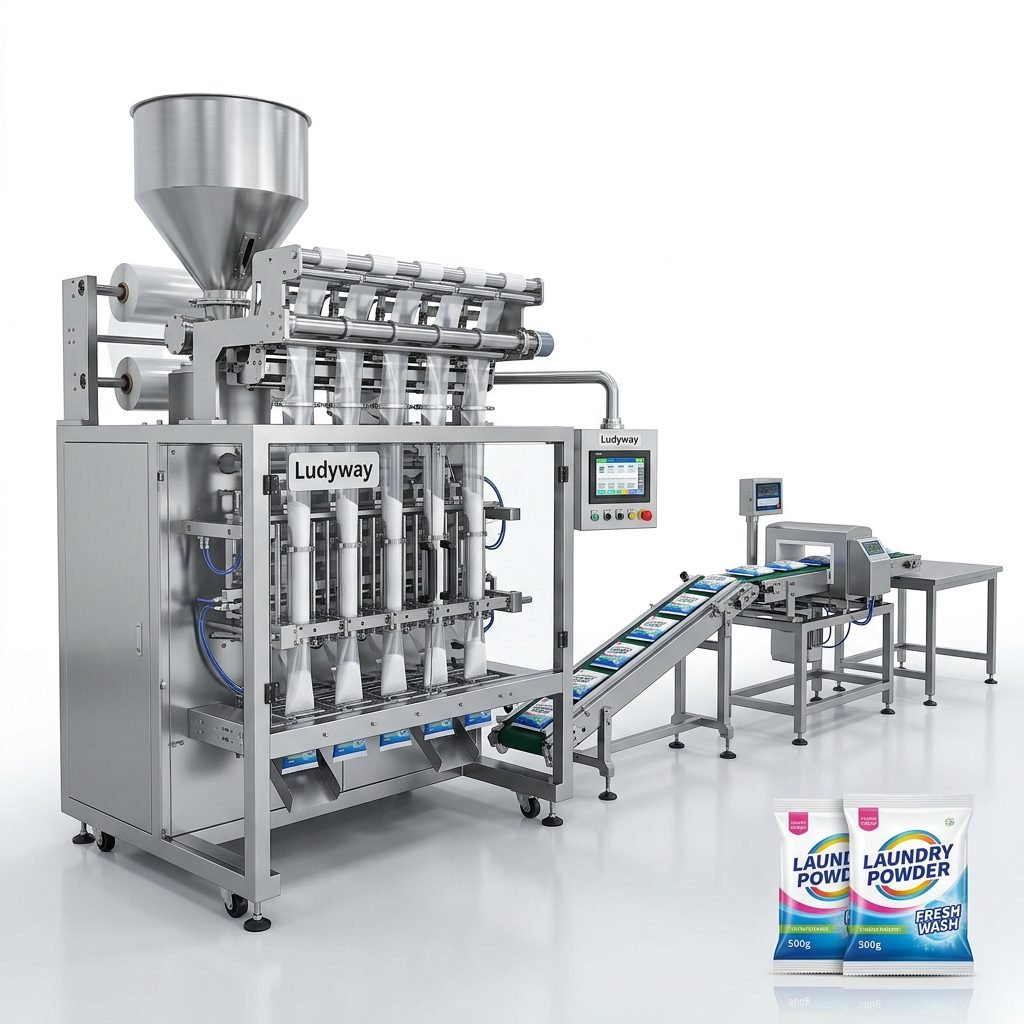
Coffee is one of the least forgiving products to package. Freshly roasted beans keep releasing carbon dioxide for days, ground coffee loses aroma within hours of exposure to oxygen, and instant or powdered coffee is hygroscopic and dusty enough to foul seals and jam volumetric fillers. An automatic coffee packaging machine has to solve all three problems at the same time: dose accurately, protect the product from air and moisture, and hold a tight seal at production speeds that make the investment pay back.
This guide walks roasters, instant coffee manufacturers, co-packers and equipment buyers through the main types of automatic coffee packaging machines for beans, ground coffee and powder, the features that genuinely matter for shelf life and line uptime, the specifications and certifications to check before issuing a purchase order, and how to structure an inquiry so suppliers can quote accurately on the first pass.
Whole Beans
Fragile, low bulk density, still degassing CO₂. Needs gentle multihead weighing, large-format bags, degassing valves and nitrogen flushing to keep residual oxygen low.
Ground Coffee
Free-flowing but oily and aromatic. Auger dosing, dust extraction at the seal jaws and high-barrier film are essential; portion packs for drip bags and single-serve sachets are a growing format.
Instant & Powder
Hygroscopic spray-dried or freeze-dried granules and 3-in-1 mixes. Multi-lane stick pack and sachet machines dominate because dose sizes are small and output volumes are very high.
Why Coffee Needs Purpose-Built Packaging Equipment
A generic granule bagger can fill coffee, but it rarely protects it. Roasted beans can emit several liters of CO₂ per kilogram in the first week after roasting; sealed in a non-vented bag, that gas swells and eventually bursts the pack. Ground coffee exposes vastly more surface area and goes stale measurably within 24 to 48 hours in air, which is why most specifications target residual oxygen below 2–3% and often below 1% for premium whole bean lines.
Powdered coffee creates a different headache. Fine particles become airborne during filling, settle on the sealing zone and produce channel leaks that let moisture in. Over time, the same dust abrades film guides and contaminates servo drives. A coffee-specific machine integrates dust collection, controlled product drop and seal-area purging as standard rather than as afterthought options.
Rule of thumb: if the machine quote does not mention nitrogen or CO₂ flushing, one-way valve application, and dust management as line items, the supplier has probably not built many coffee lines. Ask specifically how residual oxygen is measured and guaranteed at commissioning.
Main Types of Automatic Coffee Packaging Machines
The right machine depends on the product form, the retail pack format and the required output. The table below summarizes the most common configurations and where each one fits.
| Machine Type | Best For | Typical Pack Formats | Typical Output | Dosing System |
|---|---|---|---|---|
| Vertical Form Fill Seal (VFFS) | Whole beans, ground coffee | Pillow, gusseted, quad-seal bags 100 g–2 kg | 30–120 bags/min | Multihead weigher or auger |
| Premade Pouch / Doypack | Premium whole bean, specialty ground | Stand-up pouches with zipper and valve 200 g–1 kg | 20–60 pouches/min | Multihead weigher or auger |
| Multi-Lane Stick Pack | Instant coffee, 3-in-1, creamer mixes | Sticks 1–30 g, 4–12 lanes | 300–1,200 sticks/min | Multi-head auger or volumetric cup |
| Multi-Lane Sachet (3/4-side seal) | Instant powder, ground portion packs | Flat sachets 2–50 g | 200–900 sachets/min | Auger with servo control |
| Drip Bag / Capsule Systems | Single-serve ground coffee | Inner filter + outer envelope, capsules 5–12 g | 40–200 units/min | Precision auger with nitrogen flush |
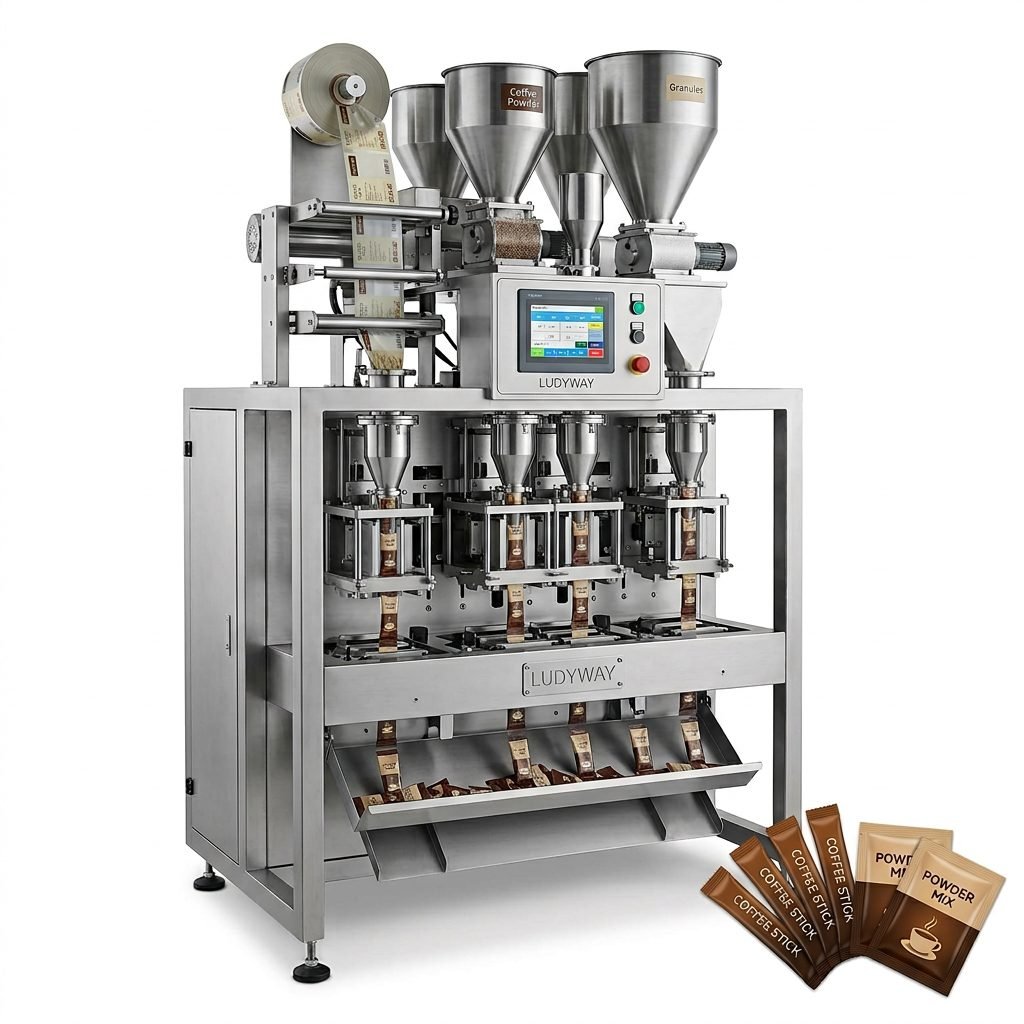
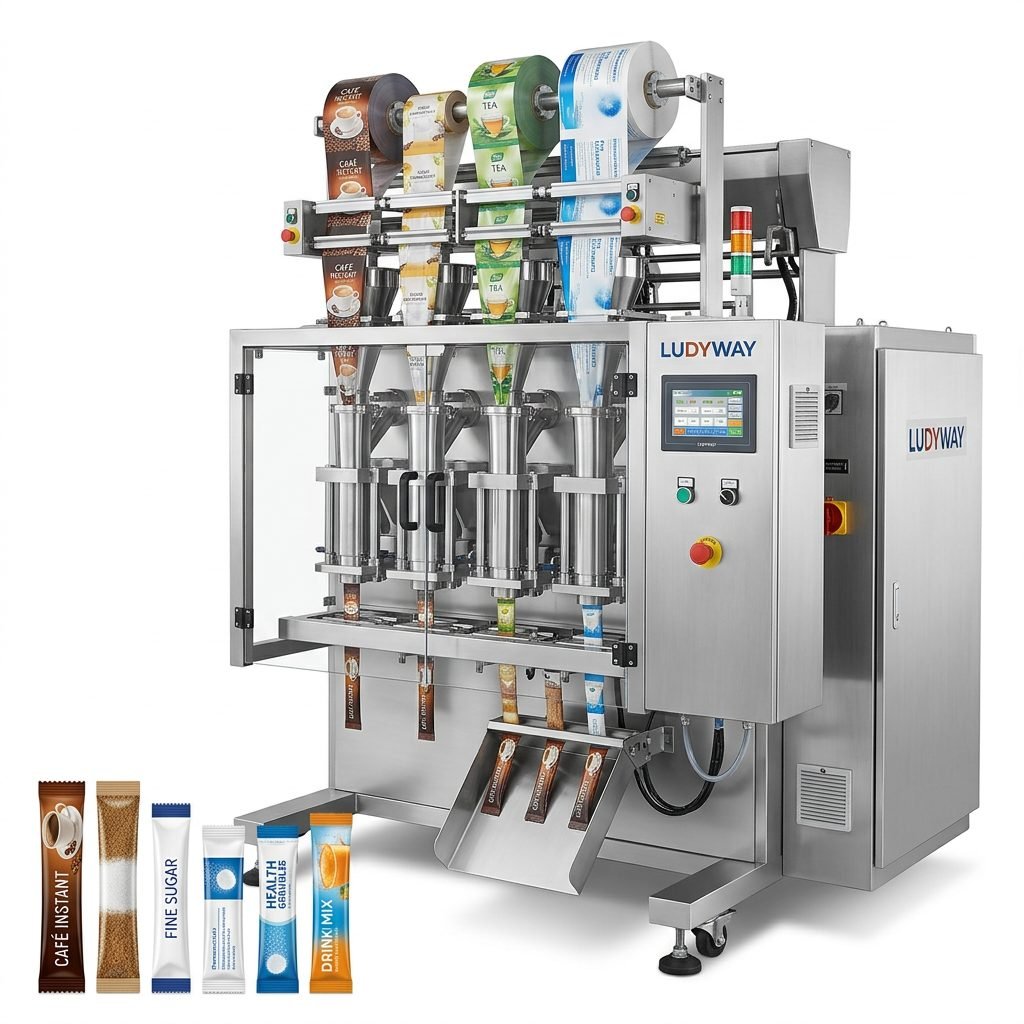
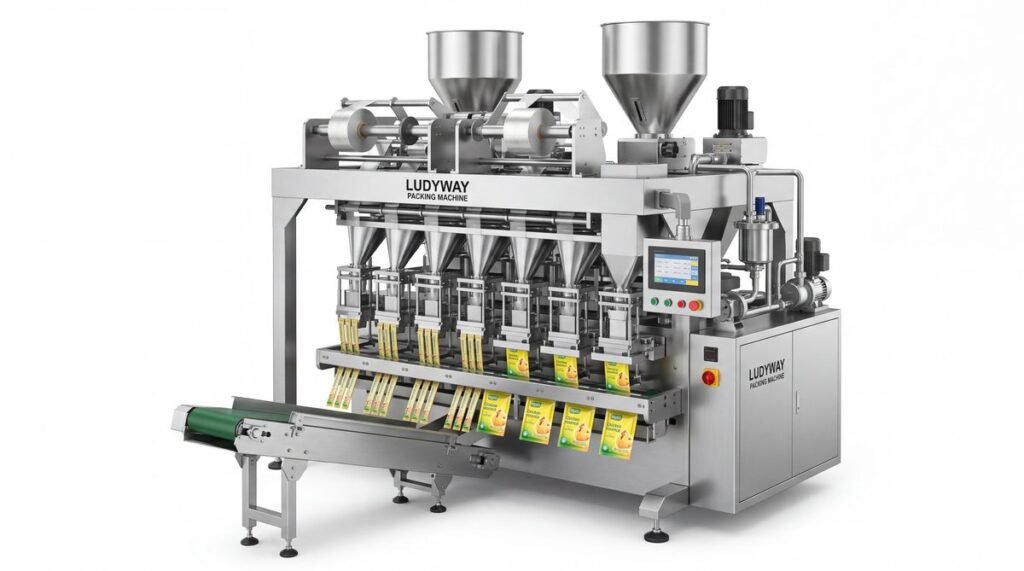
Multi-lane sachet system configured for instant coffee powder
VFFS and Pouch Machines for Beans and Ground Coffee
For retail bags of whole beans, a vertical form fill seal machine paired with a 10- or 14-head combination weigher remains the workhorse. The weigher handles the irregular shape and low density of beans gently, while the former creates pillow or quad-seal bags from roll stock. An inline valve applicator punches and welds a one-way degassing valve before the film reaches the forming tube.
Premade pouch machines suit brands selling in printed stand-up pouches with zippers, where presentation justifies slower speeds and higher per-unit material cost. Both configurations rely on gas flushing inside the forming tube or pouch to displace oxygen before the top seal closes.
Multi-Lane Stick and Sachet Machines for Instant and Powdered Coffee
Instant coffee, 3-in-1 mixes, cappuccino powders and coffee creamers are sold in small portions at enormous volumes, so throughput per square meter of floor space is the deciding metric. A multi-lane powder packaging machine runs 4 to 12 lanes from a single wide web, with one servo auger per lane, giving outputs that a single-lane VFFS cannot approach.
Key details to verify include individual lane weight feedback, automatic film splicing, static elimination for powder that clings to film, and the ability to switch between stick and three-side-seal sachet formats with a tooling change rather than a new machine.
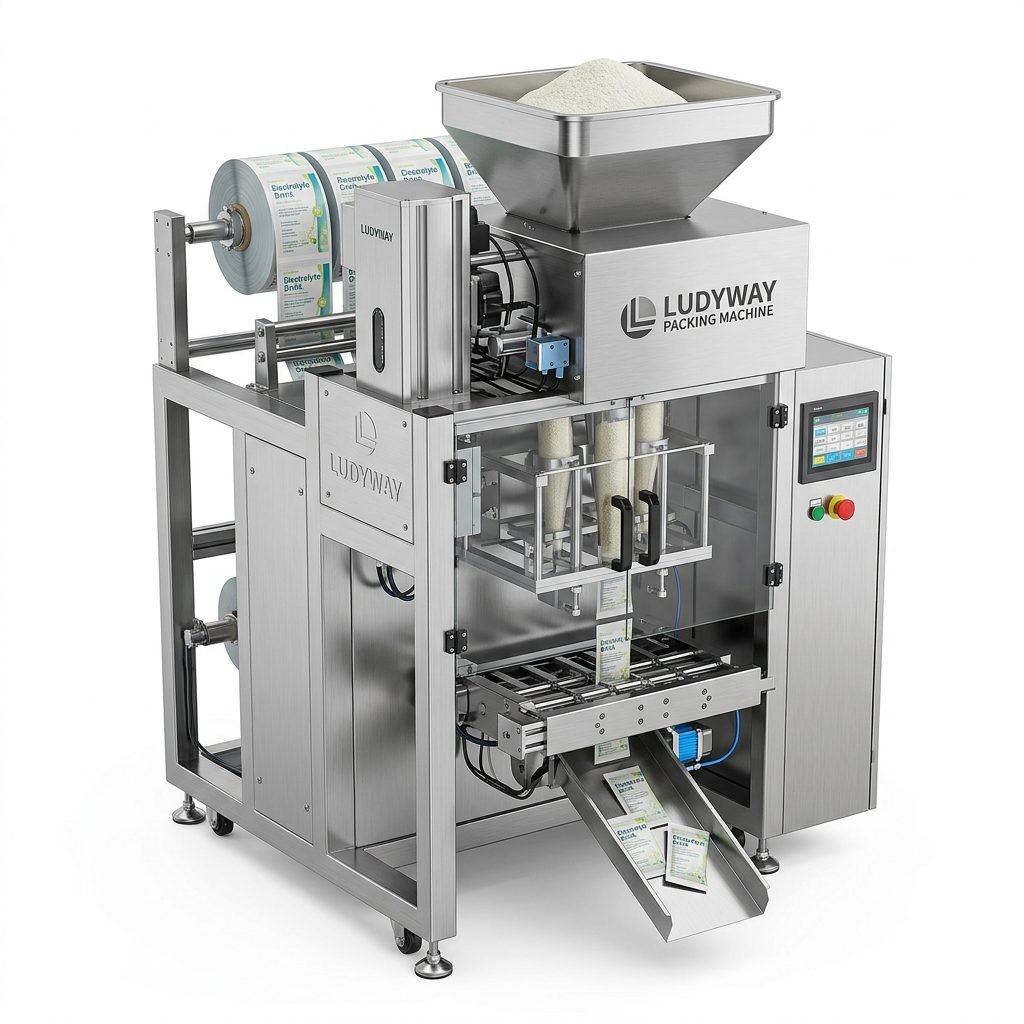
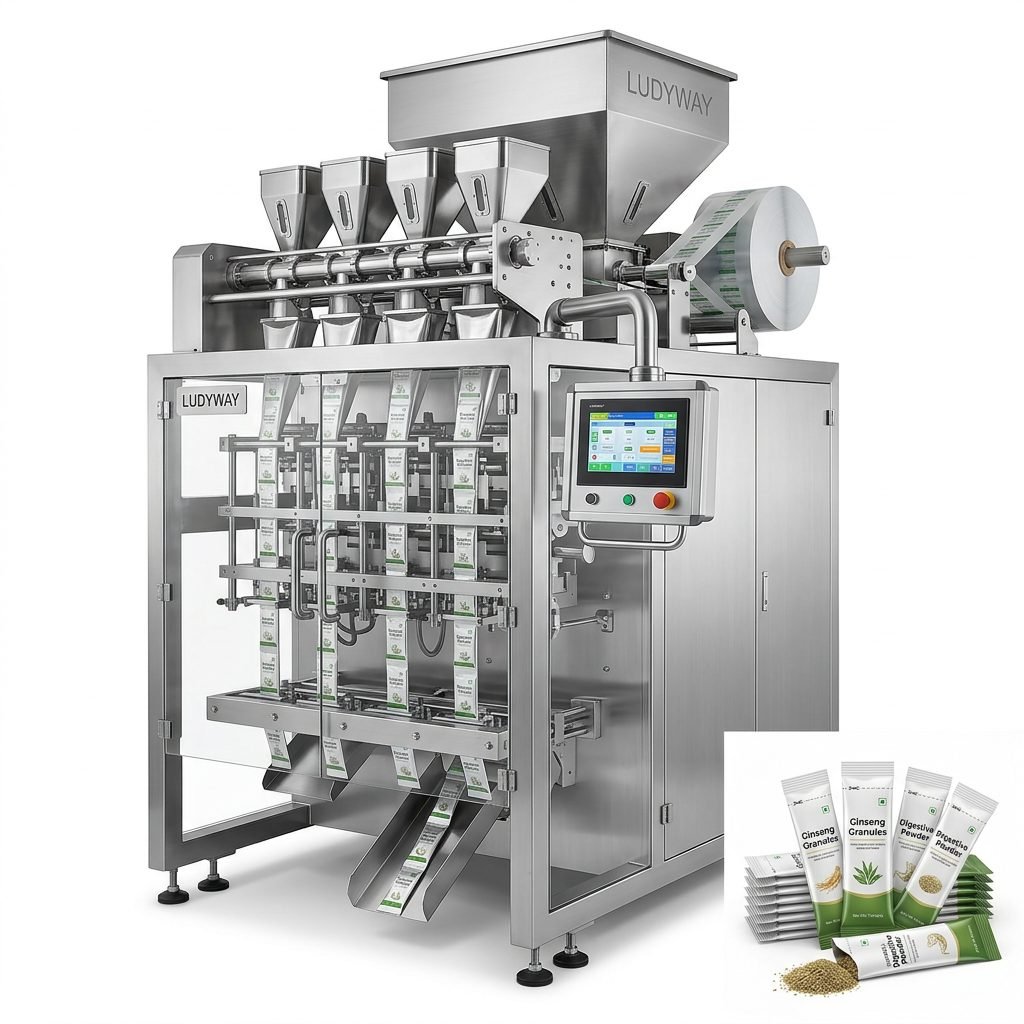
Vertical multi-lane sachet packer with servo auger dosing heads
Dosing Technology: Matching the Filler to the Coffee Form
Dosing accuracy determines both product giveaway and consumer complaints, and the wrong filler is the most common reason a coffee line underperforms. Each coffee format has a clear best-fit technology.
Multihead Combination Weigher
The standard for whole beans. Accuracy of ±0.5–1 g on 250 g bags, minimal bean breakage, and speeds that keep pace with a VFFS. Choose dimpled or coated hoppers so oily dark roasts do not stick.
Servo Auger Filler
Best for ground and instant coffee. Accuracy of ±1–2% by weight, with agitator and screw profiles selected for grind size. Pairs with a checkweigher feedback loop to correct drift automatically.
Volumetric Cup Filler
Economical for free-flowing agglomerated instant granules in fixed portions. Lower cost and very fast, but sensitive to bulk density changes between batches, so it suits consistent, well-controlled products.
Whatever filler you choose, insist on a dynamic inline checkweigher downstream. For a line running 60 bags per minute of 500 g ground coffee, reducing average overfill from 4 g to 1 g saves roughly 90 kg of coffee per shift, which on specialty grades frequently exceeds the annual service cost of the equipment.
Features That Protect Freshness and Uptime
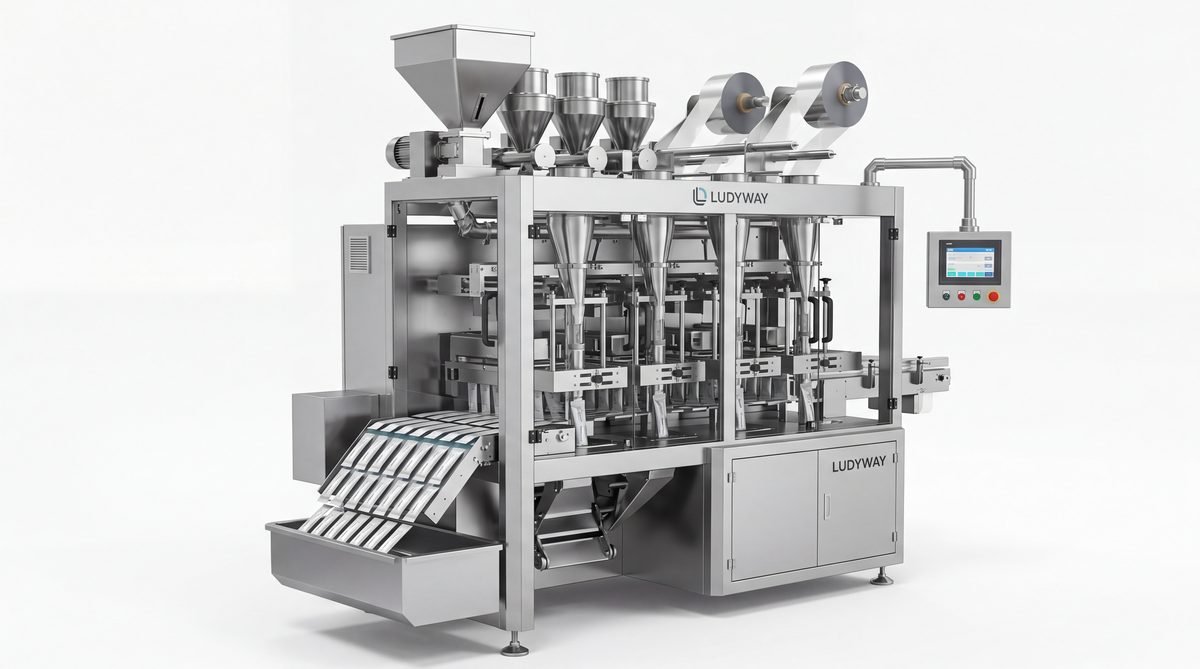
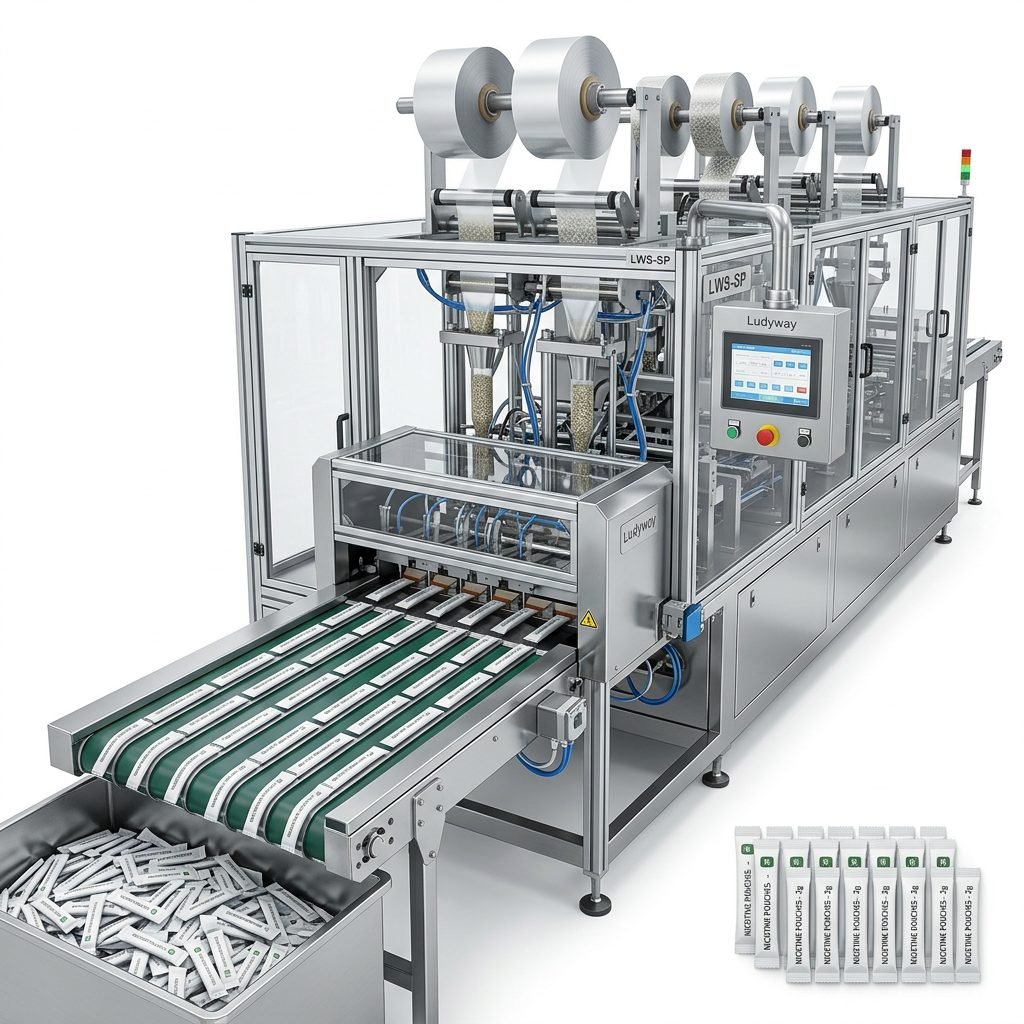
Stainless steel multi-lane packer with integrated dust control
Modified Atmosphere and Gas Flushing
A nitrogen flushing packaging system injects gas through a lance inside the forming tube or directly into the pouch before sealing. Good designs use a two-stage flush, mass-flow control and an optional residual oxygen analyzer at the discharge so operators can verify the <1–2% O₂ target rather than assume it.
Degassing Valve Application
Inline valve applicators place and heat-seal one-way valves at 60 to 120 per minute. Confirm the applicator can handle both film-side and label-style valves, and that valve position is registered to the print so it lands in the correct spot on every bag.
Sealing, Film Handling and Hygiene
Coffee bags are typically high-barrier laminates such as PET/AL/PE, PET/MET-PET/PE or recyclable mono-PE and PP structures with EVOH barrier. Sealing jaws should offer independent temperature zones, pressure adjustment and, ideally, ultrasonic or impulse sealing for mono-material films that have narrow sealing windows. Seal-area air knives or vacuum extraction remove coffee fines before the jaws close.
On the hygiene side, product-contact parts should be AISI 304 stainless steel at minimum, with 316L specified for acidic flavored coffees. Tool-less removal of augers, hoppers and forming tubes shortens changeovers and cleaning; a well-designed machine lets one operator switch from a 250 g to a 1 kg format in under 30 minutes.
<1%
Residual O₂ achievable with two-stage N₂ flushing on whole bean lines
±1%
Typical servo auger accuracy on ground and instant coffee
12 Lanes
Maximum lane count on high-output stick pack systems
30 min
Target format changeover time with tool-less design
Specifications, Standards and Certifications to Check
A professional quotation for an automatic coffee packaging machine should state the parameters below explicitly. Vague entries such as “high speed” or “food grade” are a signal to ask for clarification before comparing offers.
| Parameter | What to Specify | Why It Matters for Coffee |
|---|---|---|
| Fill weight range & accuracy | Min/max grams per pack, accuracy at each point, test product sample | Dark roast oils and grind size change flow behavior; accuracy must be proven on your coffee |
| Rated vs. guaranteed speed | Packs/min at your actual bag size and weight, not the brochure maximum | Gas flushing and valve application reduce achievable cycle rate |
| Film specification | Web width, thickness range, roll OD, core, sealant type | Confirms compatibility with existing printed film stock and recyclable structures |
| Electrical & pneumatic | Voltage/frequency, installed power, compressed air and N₂ consumption | Nitrogen cost is a recurring operating expense that affects ROI |
| Compliance documentation | CE declaration, food-contact material certificates, electrical component brands, GMP-compatible design | Required for import clearance, insurance and retailer audits |
On materials, product-contact surfaces and packaging films sold into the United States must comply with FDA food-contact requirements; the agency’s overview of packaging and food contact substances is the starting reference. Buyers shipping into the EU should also review the European Commission’s packaging and packaging waste rules, which are pushing coffee brands toward recyclable mono-material films that machines must be able to seal reliably.
For machine safety and industry benchmarks, PMMI, The Association for Packaging and Processing Technologies, publishes standards guidance and market reports that are useful when writing a user requirement specification, and the Flexible Packaging Association maintains resources on barrier film performance and sustainability.
Step-by-Step Buying Process for Coffee Packaging Equipment
1. Define the product and formats
List every SKU: coffee form, grind or granule size, bulk density, fill weight, bag style, valve yes/no, target residual oxygen. Include planned SKUs for the next three years.
2. Fix the output requirement
Calculate packs per hour from annual volume, shifts and realistic OEE of 70–80%. Size for peak season, not average month.
3. Send product samples
Reputable manufacturers run your actual coffee on a test machine and send video plus weight data. Request this before shortlisting.
4. Compare total line scope
Include feeding, weighing, N₂ generator, checkweigher, metal detector, coding, case packing and conveyors so quotes cover the same scope.
5. Verify factory and references
Check manufacturing capability, in-house machining, spare-parts stock and references in coffee specifically. A factory visit or live video audit is standard practice.
6. Agree on FAT, SAT and training
Define acceptance criteria (speed, accuracy, seal integrity, residual O₂), installation support, operator training and warranty terms in the contract.
Lead Times, Minimum Orders and Quotation Formats
Standard single-lane VFFS and multi-lane stick pack machines are typically delivered in 30–60 days from deposit, while fully integrated coffee lines with custom feeding, nitrogen generation and end-of-line automation run 90–120 days including factory acceptance testing. Machinery is normally sold at a minimum order of one unit, with pricing quoted EXW or FOB Chinese port and CIF available on request; payment is commonly structured as a deposit on order with balance before shipment after FAT video approval.
Scaling note: many roasters start with a single multi-lane sachet machine for drip bags or instant portions and add a VFFS bean line later. Ask the supplier whether the HMI, recipe management and spare-parts platform are shared across models so operators and maintenance teams are not retrained for every new machine.
About Ludyway Packaging Machinery
Ludyway is one of the largest packaging machine manufacturers in China, founded in 1993 and based in Zhongshan, Guangdong. From a 20,000㎡ production facility with more than 200 manufacturing equipment units and a team of over 130 packaging specialists, the company builds more than 50 intelligent machine models covering multi-lane stick pack, sachet, VFFS, premade pouch and fully automated turnkey lines for granule, powder and liquid products.
For coffee producers, that range means one supplier can deliver the auger-dosed sachet machine for instant powder, the combination-weigher VFFS for whole beans with nitrogen flushing and valve application, and the downstream checkweighing, case packing and palletizing needed to run the line unattended. Ludyway serves customers in over 100 countries and regions, and its export growth trajectory was covered in an industry press release on the company’s global expansion.
Buyers can arrange a factory visit in Zhongshan, meet the engineering team at international packaging exhibitions, or request sample testing on their own coffee before placing an order.
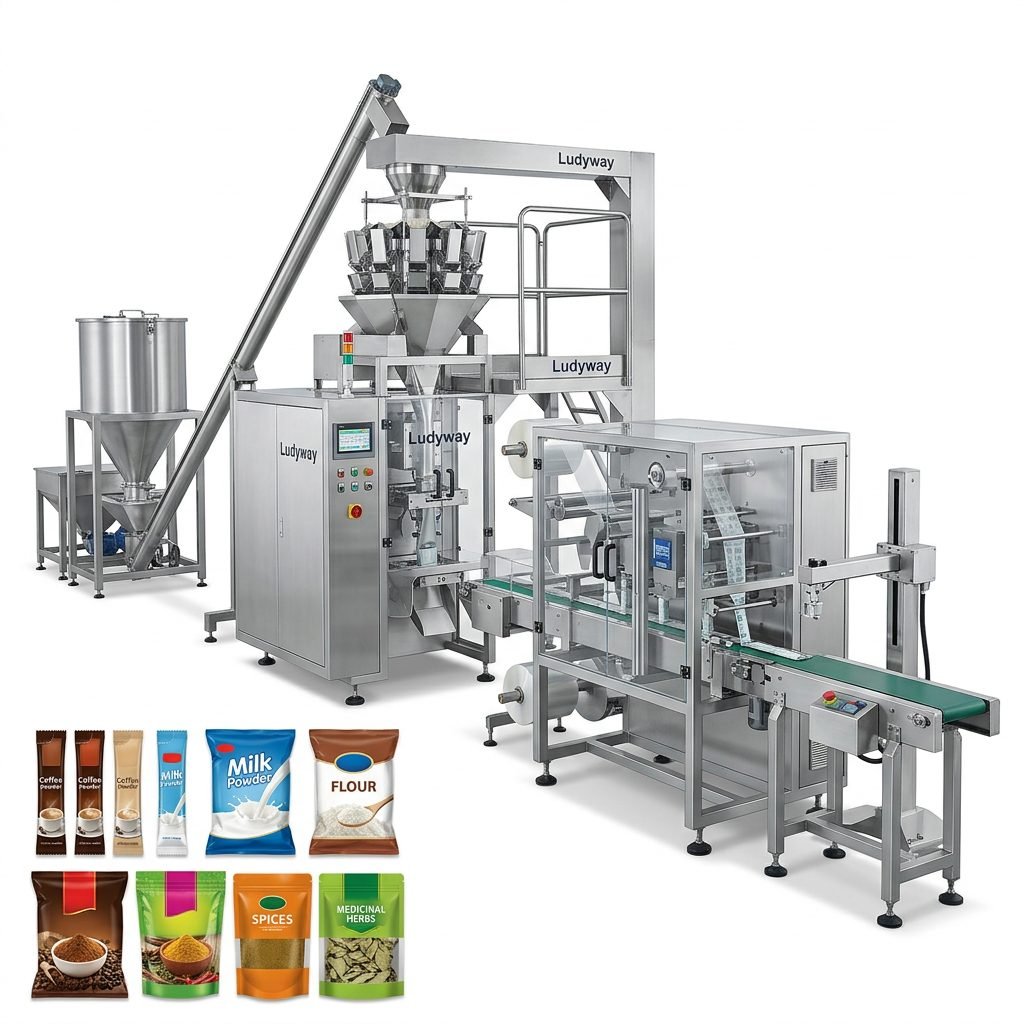
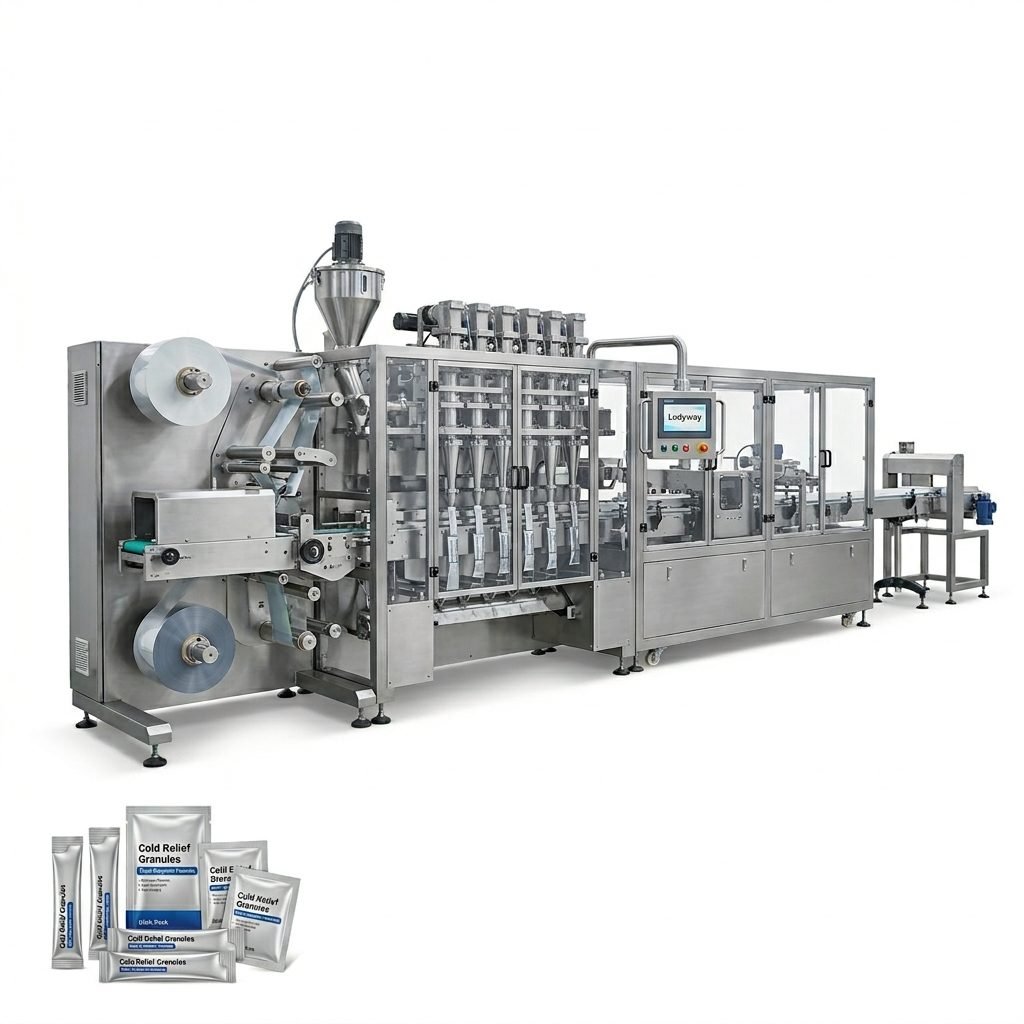
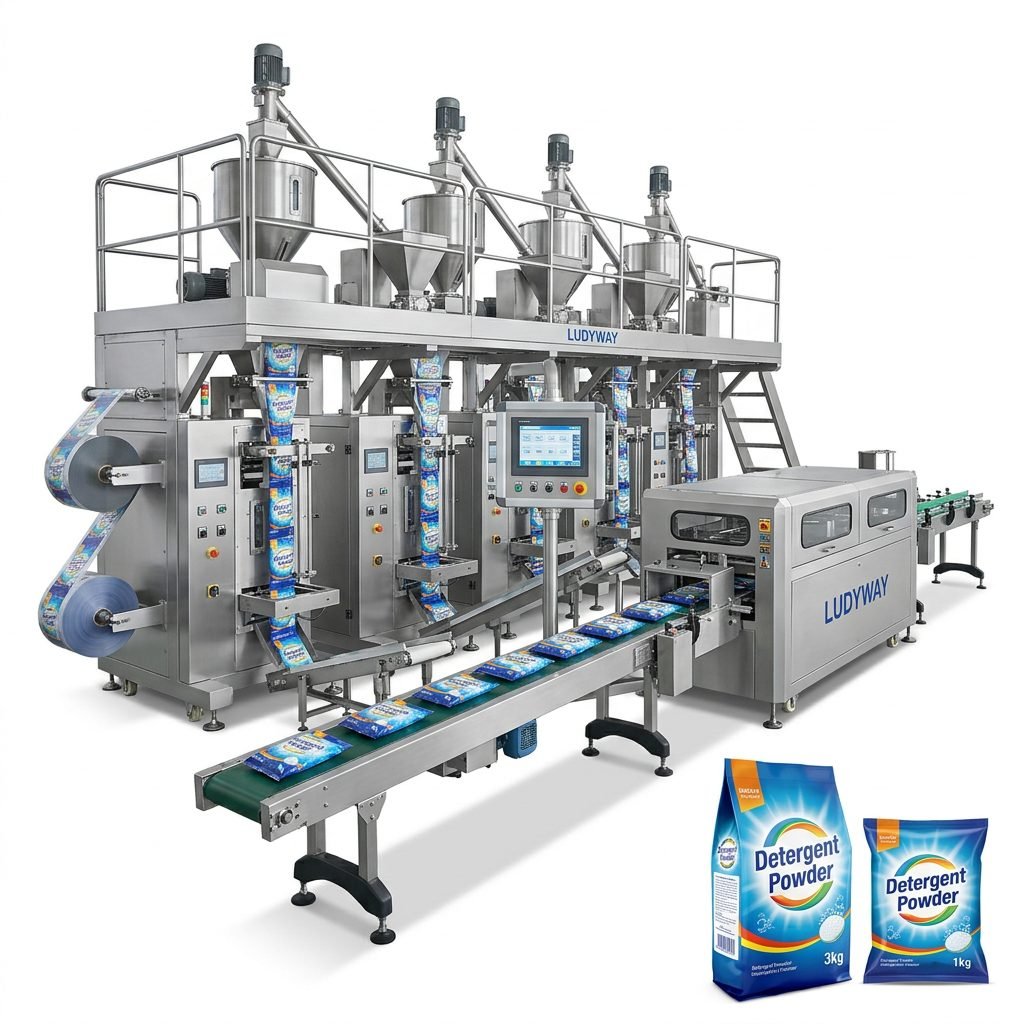
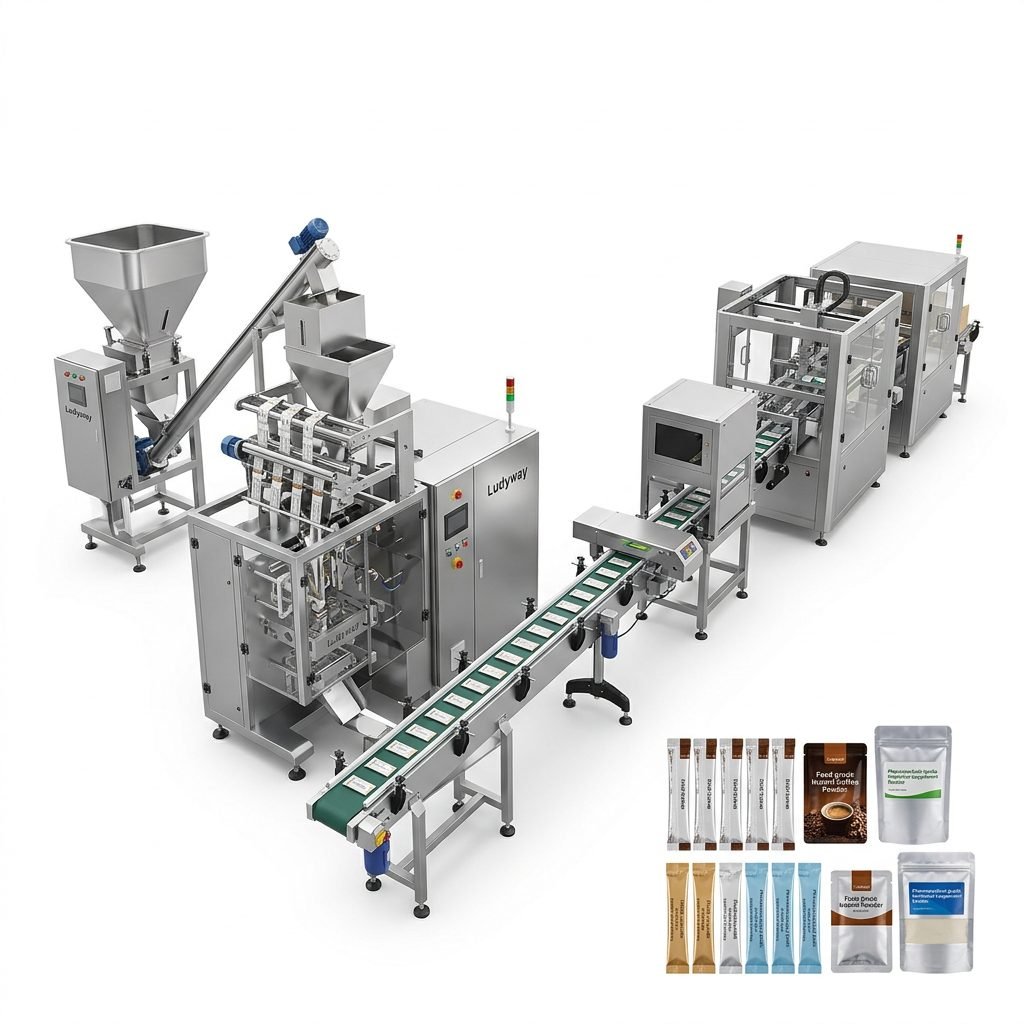
Fully automatic powder packaging line with multi-lane filling and end-of-line integration
Coffee Packaging Machines by Product Format
Multi-Lane Coffee Packaging Machine
Coffee Machinery, Granule & Powder
List Price Quote on Request
Ground Coffee Stick Pack Machine
Coffee Machinery, Ground Coffee
List Price Quote on Request
Instant Coffee Sachet Machine
Coffee Machinery, Instant Powder
List Price Quote on Request
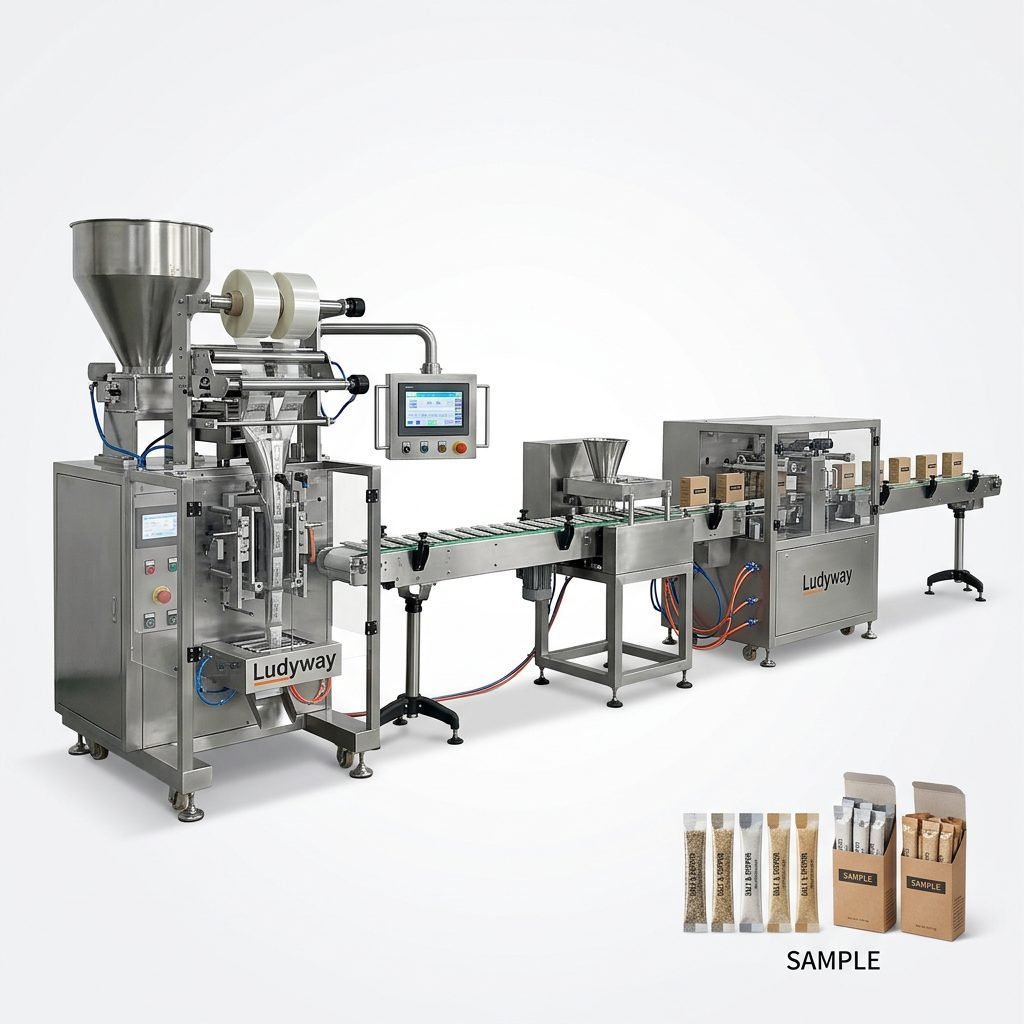
Coffee Bean Packaging Line
Turnkey Lines, Whole Beans
List Price Quote on Request
Related configurations include the drip coffee stick pack machine for single-serve filter bags and the multi-lane coffee capsule packaging system for roasters entering the pod market.
Frequently Asked Questions
What is the difference between a coffee packaging machine for beans and one for ground coffee?
Bean machines use multihead combination weighers and larger forming tubes to handle low-density, fragile product gently, and almost always include a degassing valve applicator. Ground coffee machines rely on servo auger fillers, add dust extraction at the seal zone and often run smaller portion formats such as drip bags or sachets. Many VFFS platforms can be converted between the two with a different dosing head and forming set.
Do I need nitrogen flushing if my bags already have a one-way valve?
Yes, for any product with a shelf life claim beyond a few weeks. The valve lets CO₂ out but does nothing about the oxygen trapped at sealing. Nitrogen or CO₂ flushing removes that headspace oxygen; the valve then prevents bag swelling as the beans degas. Together they typically extend whole bean shelf life from a few weeks to 9–12 months.
How accurate are auger fillers on instant coffee powder?
A well-matched servo auger with agitation holds ±1–2% by weight on free-flowing instant granules and ±2–3% on fine, hygroscopic 3-in-1 mixes. Pairing the filler with an inline checkweigher that feeds corrections back to the auger controller keeps accuracy stable as bulk density drifts during a shift.
Can one multi-lane machine produce both stick packs and flat sachets?
Most modern multi-lane platforms are built for both formats, but the change involves swapping forming collars, sealing jaws and film width settings, and takes one to two hours. If you plan to run both formats daily, dedicated machines are usually more productive than frequent changeovers.
What should be included in a request for quotation?
Coffee form and particle size, bulk density, fill weights, bag dimensions and style, required packs per minute, film structure, voltage, whether nitrogen flushing and valve application are needed, and the scope of upstream feeding and downstream packing. Attaching a sample pack and a short video of your current process helps engineers propose the correct configuration quickly.
Next Steps for Equipment Buyers
If you are specifying a new coffee line or replacing a semi-automatic packer, the fastest route to an accurate proposal is to share your SKU list, target output and pack samples with an engineering team that can run trials on your coffee. Ludyway provides detailed specification sheets, sample test videos with weight data, layout drawings for complete automated coffee packaging lines, and a full product catalog covering machines for beans, ground coffee, instant powder, drip bags and capsules.
Request a Quotation, Sample Test or Catalog
Email info@ludyway.com or message WhatsApp +86 131 2959 2456 with your coffee type, pack sizes and required output. Factory visits in Zhongshan, Guangdong and meetings at international packaging exhibitions can be arranged on request.