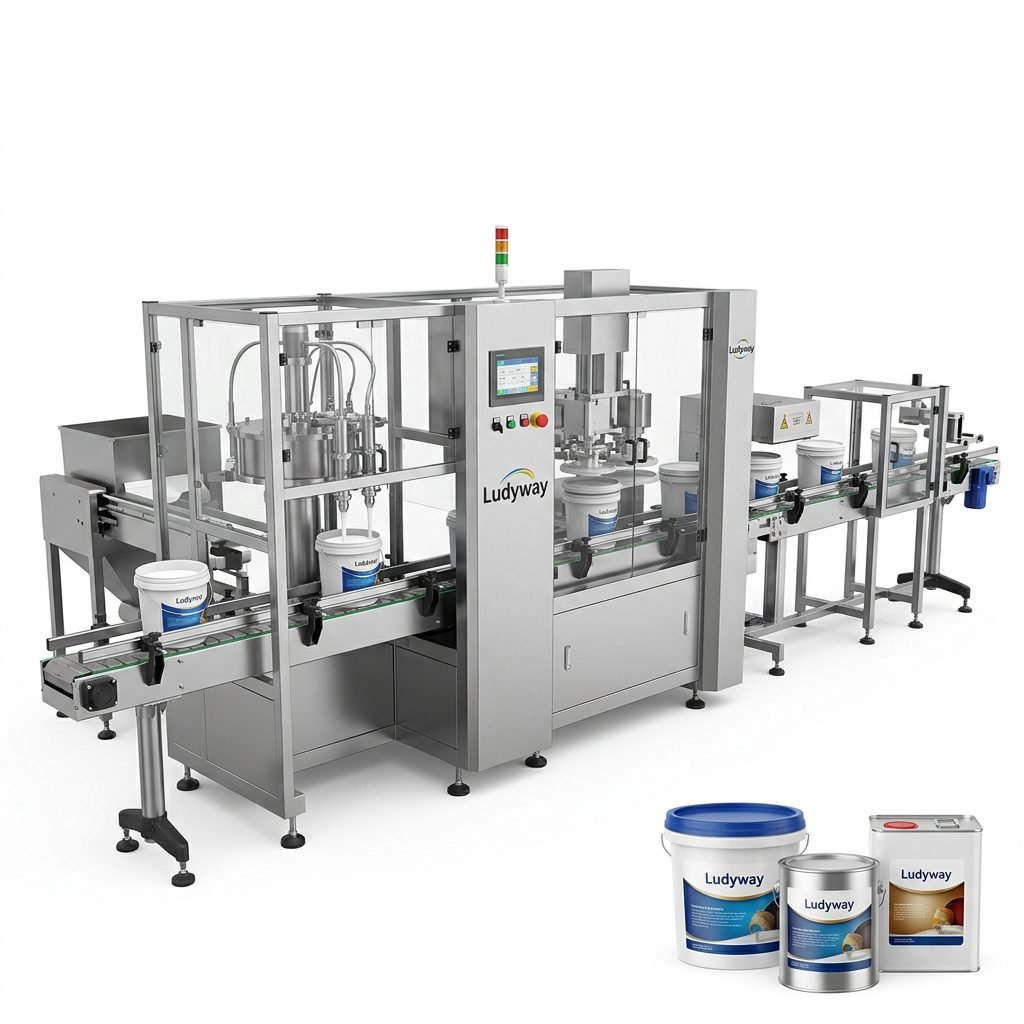
Dry kibble, freeze-dried meat treats, dental chews, probiotic powders, joint-support granules and vitamin sachets all behave very differently once they reach a packaging line. Kibble is abrasive and oily, freeze-dried pieces are fragile and hygroscopic, and nutritional powders demand dose accuracy within one or two percent while being protected from oxygen and moisture. Choosing the right pet food packaging machines for dry food and nutritional products therefore starts with the product itself: particle size, bulk density, fat content, oxygen sensitivity, target pack weight and the throughput your market needs.
This guide is written for pet food manufacturers, co-packers, private-label brands and procurement engineers who are specifying new equipment or upgrading an existing line. It covers the main machine types, dosing and weighing technologies, the features that actually affect shelf life and uptime, the food-contact and packaging regulations you will be asked about, and a practical procurement checklist covering specifications, factory acceptance testing, lead times and how to request a meaningful quotation.
Why Dry Pet Food and Pet Nutrition Need Purpose-Built Packaging Equipment
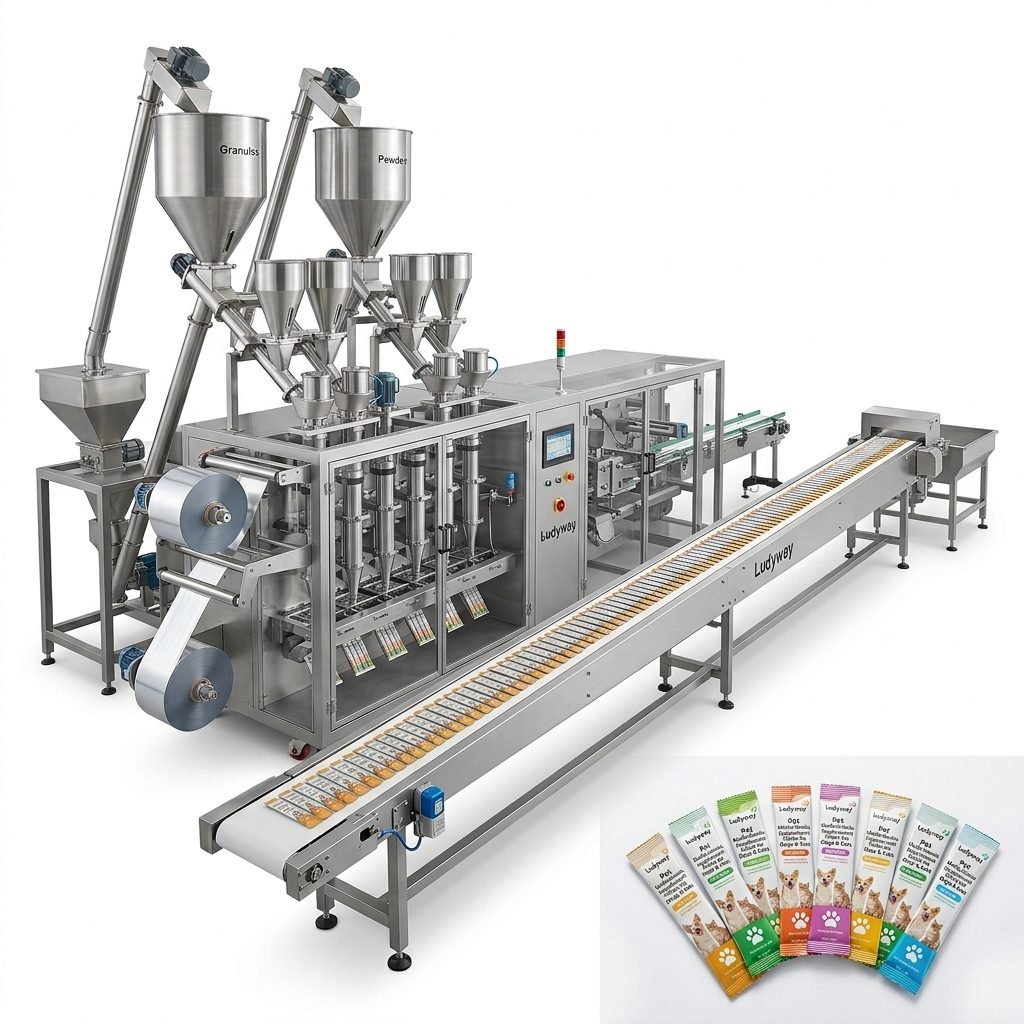
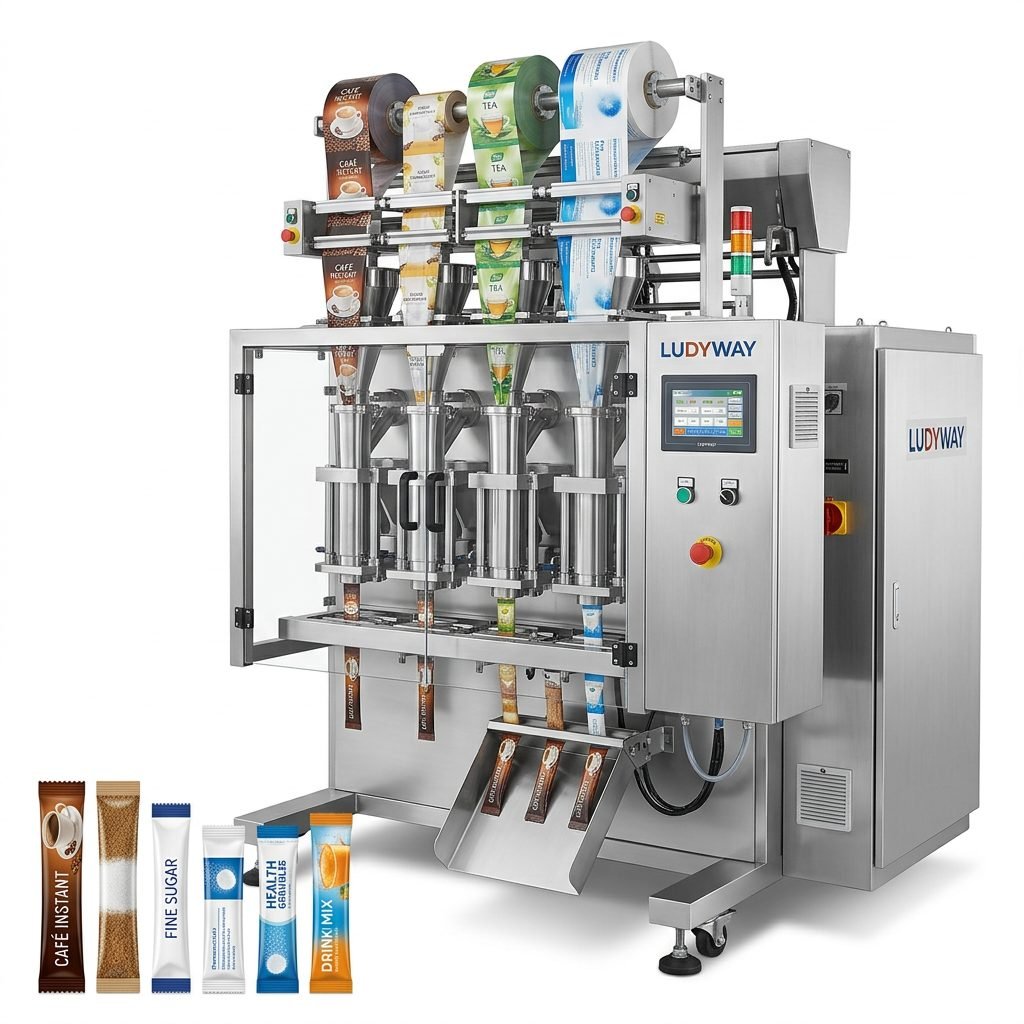
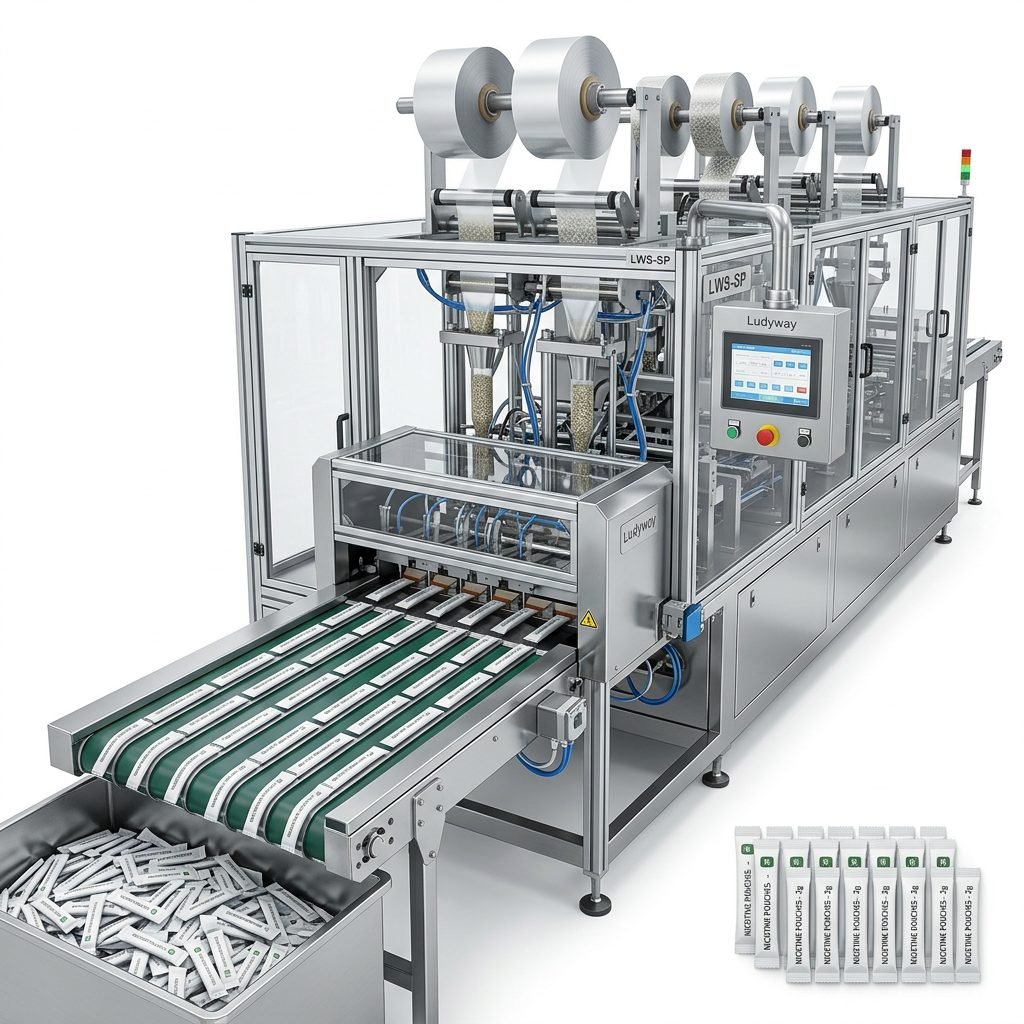
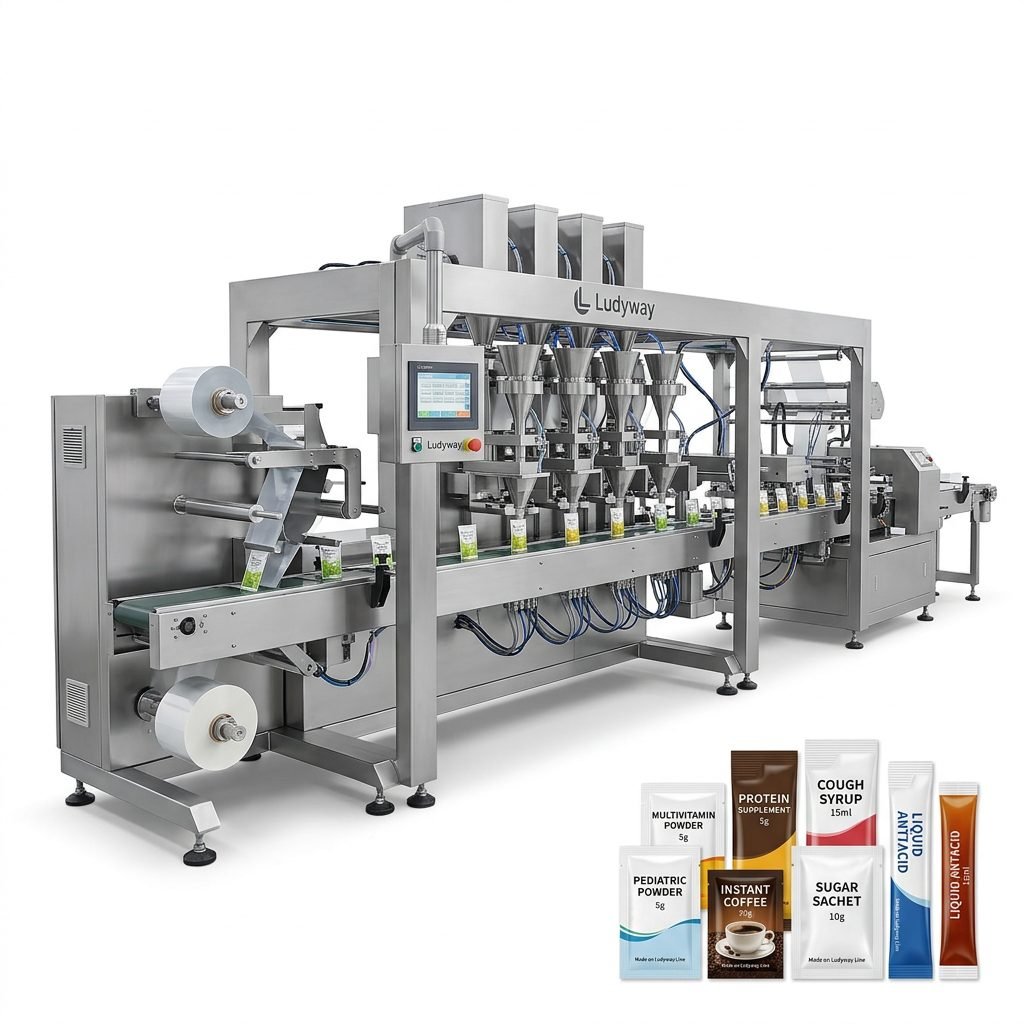
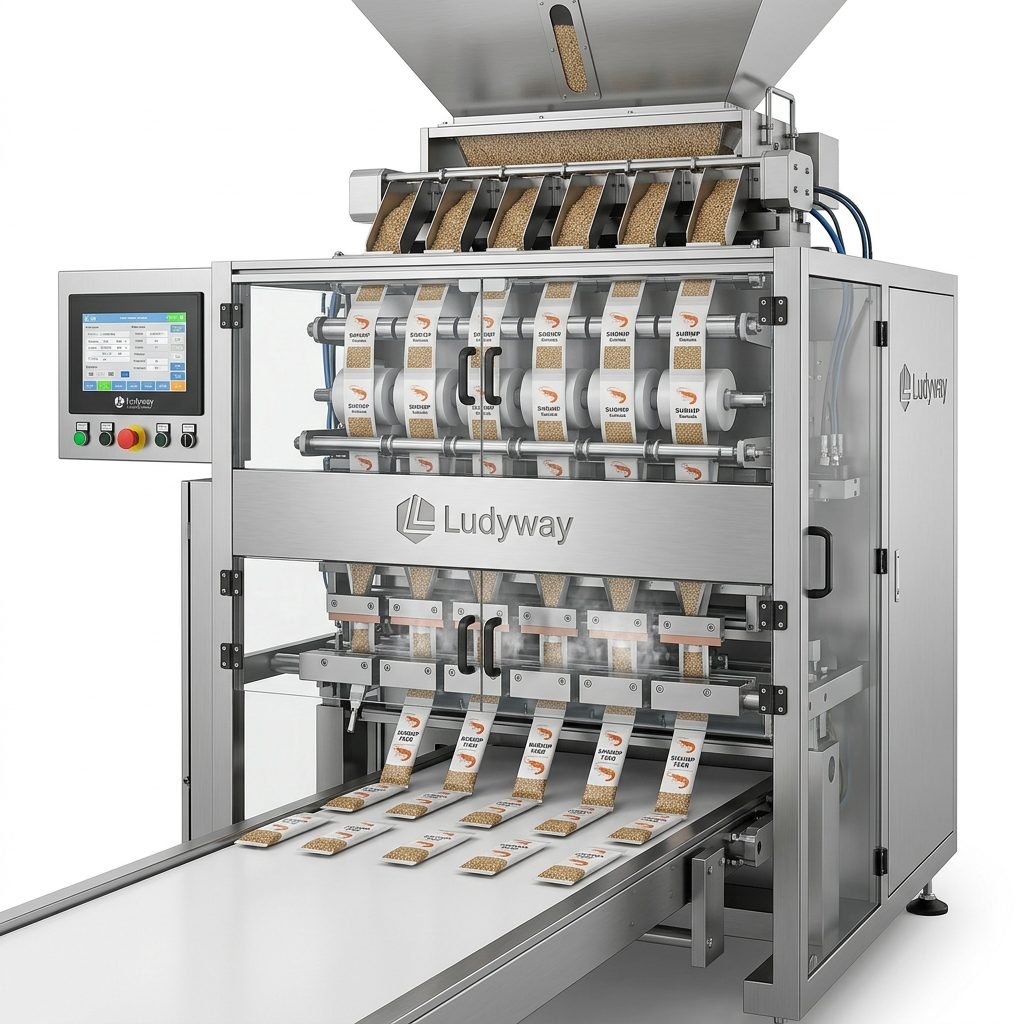
Multi-lane stick pack line configured for pet vitamin granules and nutritional powders
General-purpose snack baggers are often offered for pet food, but they rarely survive long in a kibble plant. Extruded kibble coated with fat and palatant leaves residue on forming tubes and seal jaws, which causes weak seals and frequent cleaning stops. Fines and dust generated during conveying contaminate the seal area unless the machine has dust extraction and a correctly designed product funnel.
Nutritional products raise a different set of issues. Pet probiotics, enzyme blends and vitamin premixes are low-dose, high-value powders that oxidise or clump quickly. These products are usually packed in single-serve stick packs or four-side-seal sachets of 1–20 g, which calls for multi-lane machines with auger dosing, nitrogen flushing and tight seal-integrity control rather than a large-format bagger.
Retail expectations add further pressure: resealable zippers on treat pouches, 12–18 month shelf life claims, recyclable mono-material films, and net-weight accuracy that satisfies labelling rules. The packaging machine must deliver all of this at the output level your sales forecast requires.
Product characteristics that drive machine selection
- Particle size and shape: kibble 4–20 mm, freeze-dried cubes up to 30 mm, powders below 500 µm
- Bulk density: from roughly 0.25 g/ml for freeze-dried meat to 0.65 g/ml for dense kibble, which affects dosing method and bag volume
- Fat and oil content: coated kibble above 12% fat needs anti-stick forming tubes and higher seal-jaw pressure
- Oxygen and moisture sensitivity: omega-3 toppers, probiotics and freeze-dried proteins usually require nitrogen flushing or vacuum
- Pack weight range: 1 g supplement sticks through 25 kg distributor bags rarely run on the same machine
Main Types of Pet Food Packaging Machines for Dry Food and Nutritional Products
Most pet food plants end up with two or three machine families working side by side: a bagger for kibble and treats, a multi-lane system for supplements and toppers, and a bulk bagging station for food-service or distributor packs. The table below summarises where each type fits.
| Machine Type | Best For | Typical Formats | Typical Output | Usual Dosing Pairing |
|---|---|---|---|---|
| Vertical Form Fill Seal (VFFS) | Dog and cat kibble, baked treats, training bites | Pillow, gusseted and quad-seal bags 200 g – 5 kg | 30 – 80 bags/min | Multihead combination weigher |
| Multi-lane stick pack / sachet | Probiotics, vitamins, joint powders, meal toppers, freeze-dried crumbles | Stick packs 1 – 50 g, 3- and 4-side-seal sachets | 2 – 12 lanes, 300 – 1,200 packs/min | Servo auger or volumetric cup |
| Rotary premade pouch (doypack) | Premium treats, freeze-dried raw, small-batch kibble | Stand-up zipper pouches 50 g – 3 kg | 20 – 60 pouches/min | Multihead or linear weigher |
| Vacuum / nitrogen flush packaging | Freeze-dried meat, high-fat treats, export shipments | Vacuum pouches, bricks, barrier bags | 5 – 20 cycles/min | Weigh-and-fill with gas flush |
| Open-mouth / bulk bagging | Bulk kibble, breeder and distributor packs | 10 kg, 20 kg, 25 kg paper, woven PP or PE bags | 3 – 10 bags/min | Net-weigh scale with bag clamp |
VFFS Baggers for Kibble and Treats
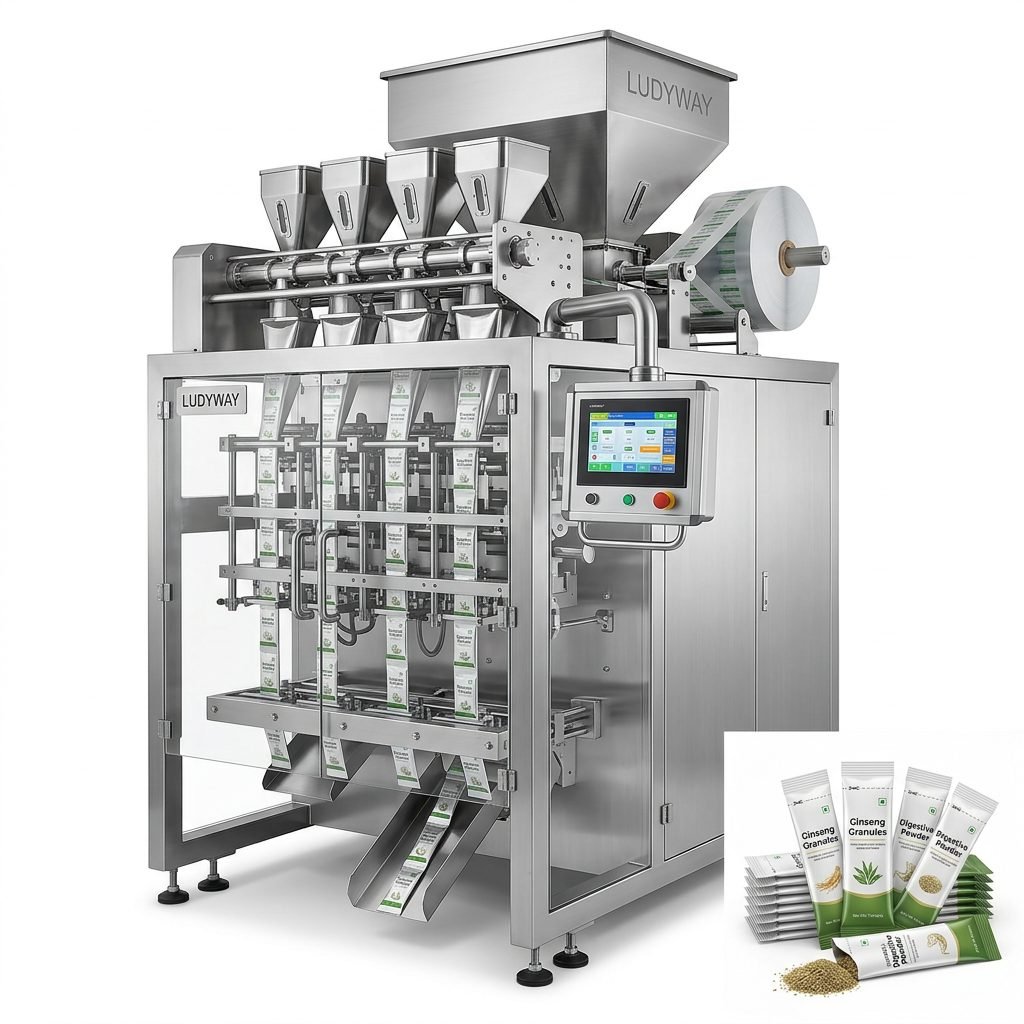
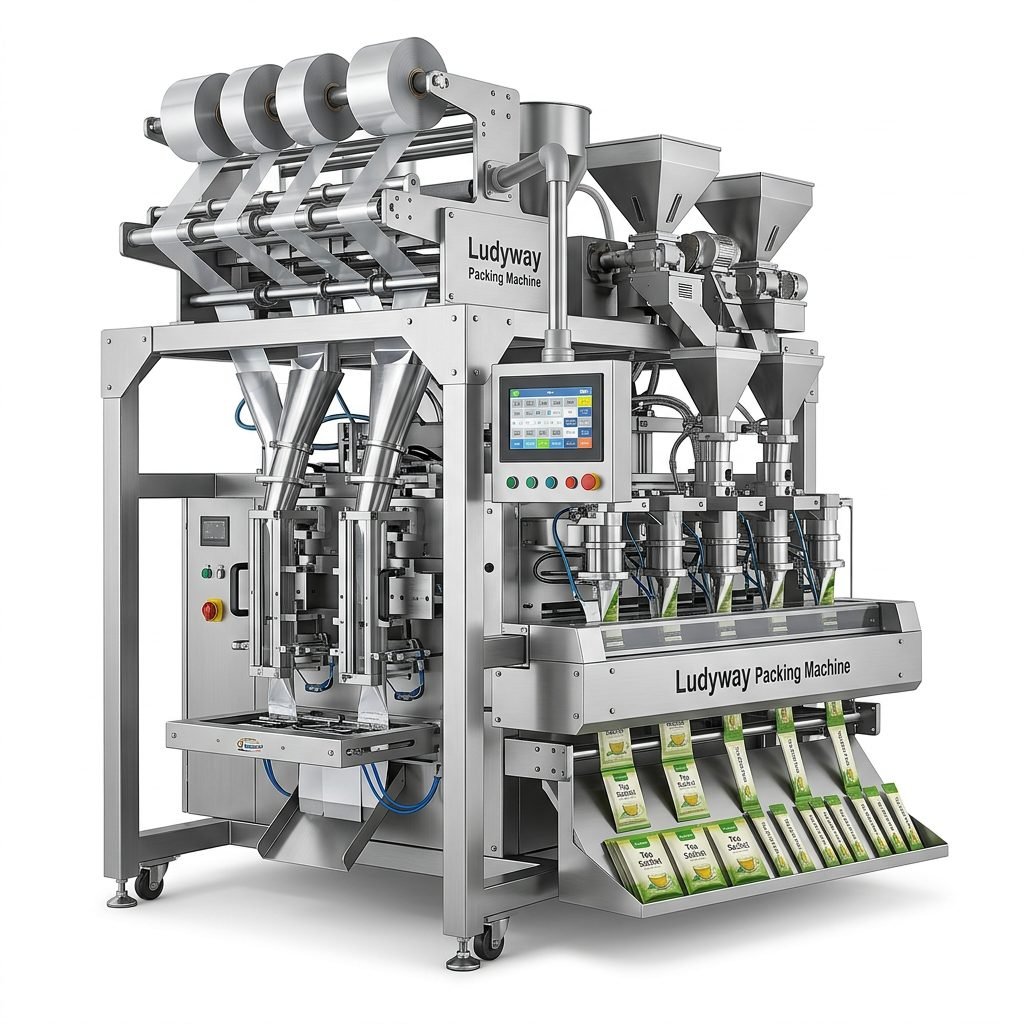
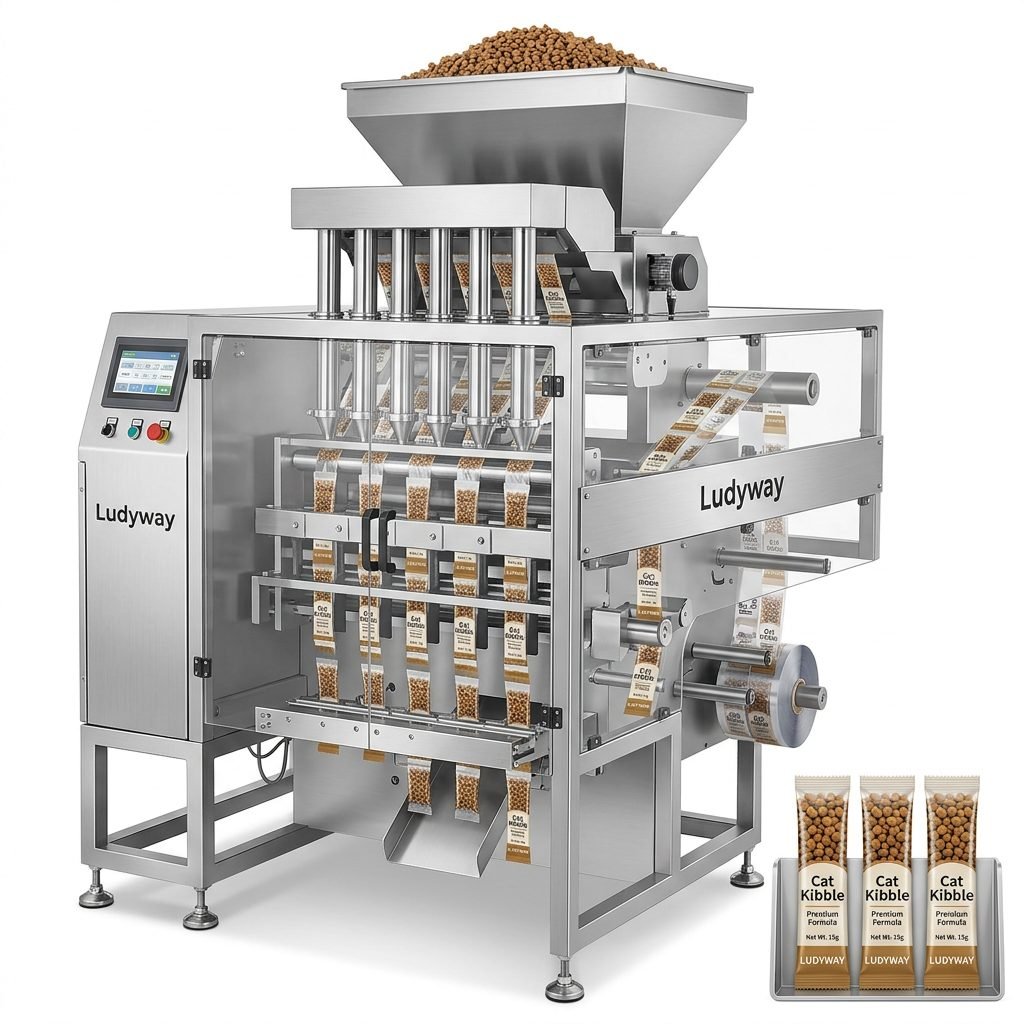
A vertical form fill seal machine remains the workhorse for retail kibble because it forms bags from roll stock, which is far cheaper than premade pouches at volume. For pet food, specify a wide forming tube with a polished or PTFE-coated surface, servo-driven pull belts, and seal jaws with independent temperature zones so that thick quad-seal films can be sealed reliably. A dog kibble packaging machine for granules should also offer gusset formers and optional zipper or carry-handle application for 2–5 kg family packs.
Multi-Lane Stick Pack and Sachet Machines for Pet Supplements
Pet nutrition brands are shifting from tubs with scoops to single-dose sticks and sachets that owners can sprinkle on food. Multi-lane machines produce several packs in parallel from one film web, so a 6-lane system running at 50 cycles per minute delivers 300 sticks per minute from a very small footprint. Dedicated pet supplement multi-lane packaging equipment typically combines servo auger fillers for powders, volumetric cups for granules and optional peristaltic pumps for liquid toppers on the same frame.
Premade Pouch and Vacuum Systems for Freeze-Dried Pet Food
Freeze-dried raw diets and treats are light, brittle and extremely sensitive to humidity. Rotary premade pouch machines handle them gently because the product drops a short distance into an already-formed stand-up pouch, and the pouch can be gas flushed before sealing. For brick-style freeze-dried blocks or export pallets, a chamber or nozzle vacuum system reduces headspace oxygen and prevents rancidity. A purpose-designed freeze-dried pet food packaging machine keeps product breakage low while still achieving commercial speeds.
Dosing and Weighing Systems: Where Accuracy Is Won or Lost
The dosing head determines giveaway, label compliance and ultimately margin. On a 2 kg kibble bag, a 1% overfill costs 20 g per bag; across 40,000 bags per shift that is 800 kg of product given away every day. On a 3 g probiotic stick, under-dosing by even 0.1 g can push the product below its guaranteed CFU claim.
Multihead combination weighers are the standard for kibble and treats. A 10- or 14-head scale selects the combination of hoppers closest to the target weight, achieving accuracy of roughly ±0.5–1.5 g on 500 g bags at 60–120 weighments per minute. For sticky or coated treats, choose dimpled or non-stick hopper surfaces and larger discharge angles.
Servo auger fillers dominate powder applications. Dose accuracy depends on auger pitch, agitator design and keeping powder density consistent in the hopper, which is why a level sensor and automatic refill from a high-precision powder dosing system are worth specifying rather than relying on manual top-ups.
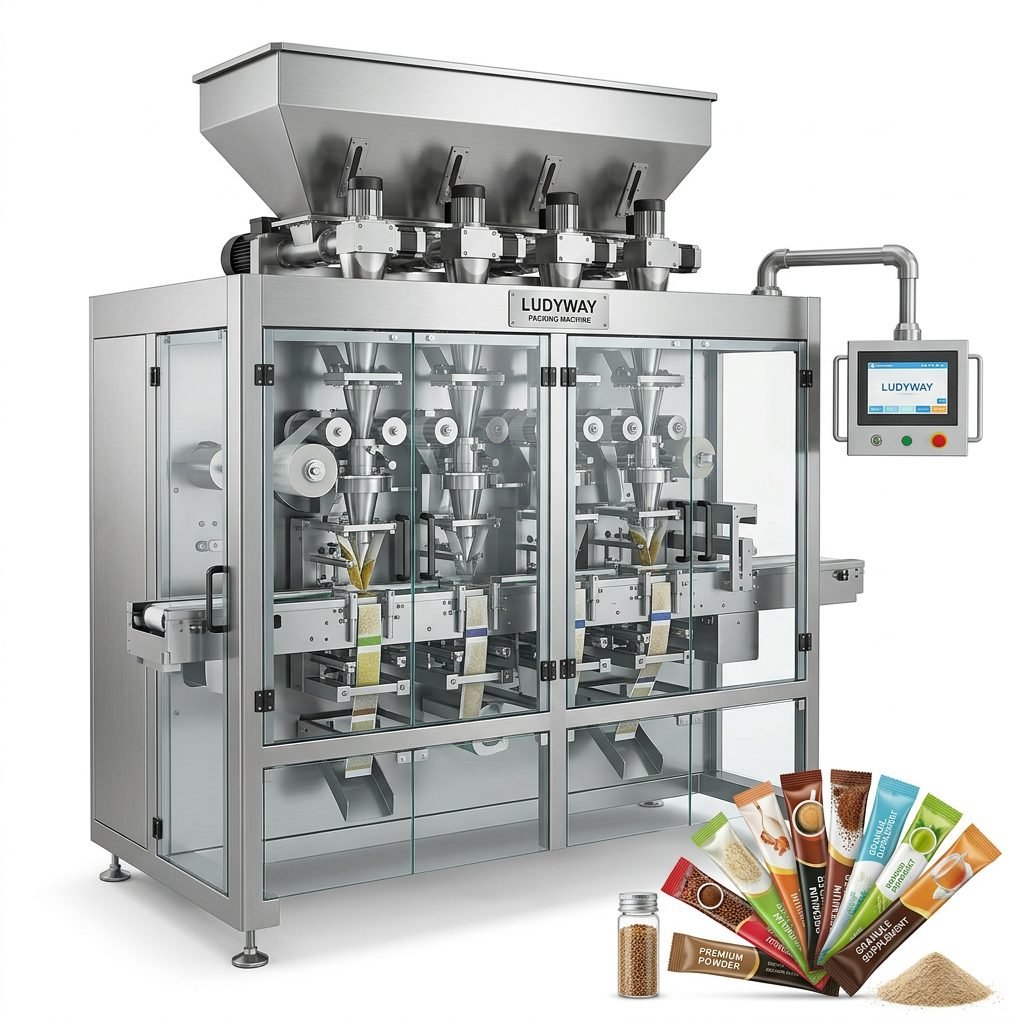
Powder dosing module used upstream of sachet and stick pack machines for nutritional powders
Multihead Weigher
Kibble, biscuits, jerky pieces, mixed treats. Accuracy about ±0.5–1.5 g. Best when product is free-flowing and pack weights exceed 100 g.
Servo Auger Filler
Probiotic, vitamin, collagen and milk-replacer powders. Accuracy typically ±1–2% of target. Supports 0.5 g to 500 g doses with interchangeable augers.
Volumetric Cup Filler
Uniform granules such as coated supplement pellets or fish food. Simple, fast and inexpensive, provided bulk density stays stable batch to batch.
Net-Weigh Bulk Scale
10–25 kg open-mouth bags. Gross-and-dribble feeding reaches ±20–50 g per bag; pair with a bag clamp, sewing or heat-seal closer and a bag flattener.
Key Features to Evaluate Before You Sign a Purchase Order
Headline speed figures in a brochure rarely reflect what a machine will do with your product, your film and your operators. The features below have the biggest influence on real-world output, seal quality and total cost of ownership.
Seal Technology
Independent PID temperature control on every jaw, adjustable dwell and pressure, and optional ultrasonic sealing for dusty powders where particles would otherwise contaminate heat seals. Ask for seal-strength test results on your actual film.
Film Compatibility
PET/PE, PET/AL/PE, paper-based laminates and recyclable mono-PE structures run very differently. Confirm the machine can handle film thicknesses from 60 to 140 µm and that servo tension control is included for thin recyclable webs.
Hygienic Design
304 stainless steel frames as a minimum, 316L on product-contact parts for acidic or salty formulations, sloped surfaces, tool-less removal of forming tubes and hoppers, and IP65 protection where washdown is used.
Nitrogen Flushing and Dust Control
A nitrogen flushing system that holds residual oxygen below 2% protects omega-3 and freeze-dried products; integrated dust extraction protects seals and keeps the plant compliant with housekeeping audits.
Inline Inspection
Checkweighers for net-weight compliance, metal detection or X-ray for foreign bodies, and vision systems for date-code verification are usually mandatory for retailer audits. Confirm reject-conveyor integration and data logging.
Controls and Changeover
PLC plus touch-screen HMI with recipe storage for every SKU, servo-driven format changes under 20 minutes, OEE reporting and remote diagnostics so the supplier can support you across time zones.
Compliance, Food-Contact Materials and Labelling Considerations
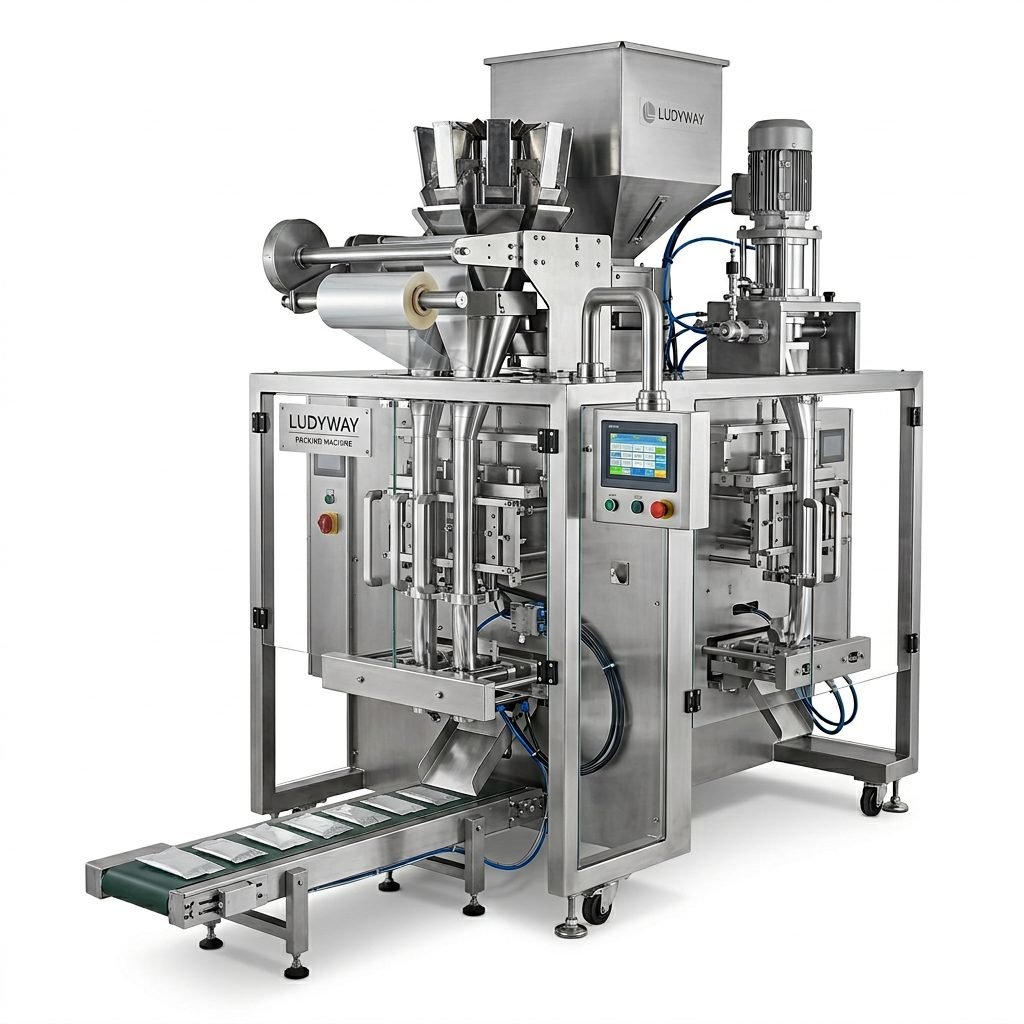
Sachet system suitable for veterinary and pet health formulations requiring documented hygiene standards
Pet food is regulated as food in most major markets, so the materials that touch the product and the packaging itself must meet food-contact rules. In the United States, the FDA regulates pet food and animal feed under the Federal Food, Drug, and Cosmetic Act, and packaging materials fall under the FDA food ingredients and packaging framework, including the food contact substance provisions of 21 CFR Parts 174–179. Machine suppliers should provide material declarations for product-contact components and food-grade lubricant specifications.
In Europe, Regulation (EC) 1935/2004 governs food-contact materials, and the new Packaging and Packaging Waste Regulation sets recyclability and minimisation requirements that are already pushing pet food brands toward mono-material films, as outlined by the European Commission packaging waste pages. Equipment delivered to the EU also needs CE marking under the Machinery Regulation with a Declaration of Conformity.
Net-weight labelling under AAFCO model regulations in the US and average-weight rules in the EU make an inline checkweigher a practical necessity rather than an option. Industry benchmarks for machine performance, OEE and safety are published by PMMI, The Association for Packaging and Processing Technologies, and film trends are tracked by the Flexible Packaging Association.
Documentation to request with any quotation: CE Declaration of Conformity or equivalent, ISO 9001 certificate of the manufacturer, electrical component list (brand of PLC, servos, sensors), food-contact material statement for stainless grades and plastics, wiring diagrams, and a factory acceptance test protocol that specifies accuracy, speed and seal-integrity targets.
How to Choose the Right Pet Food Packaging Machine: A Six-Step Process
Step 1 — Characterise the product
Measure bulk density, particle size distribution, fat content, moisture and angle of repose. Send 2–5 kg samples to shortlisted suppliers for dosing trials.
Step 2 — Define formats and SKUs
List every bag size, film structure, zipper or notch requirement and how often you change over. Ten SKUs on one machine favour servo formats and recipe control.
Step 3 — Calculate real throughput
Take annual volume, divide by planned production hours, then add 20–30% headroom. Specify the machine on net output at your weight, not brochure maximum.
Step 4 — Map the line
Decide how product arrives (bucket elevator, vacuum conveyor), what inspection is needed, and whether cartoning, case packing and palletising will be integrated now or later.
Step 5 — Check utilities and footprint
Confirm voltage and frequency (380 V/50 Hz vs 480 V/60 Hz), compressed air at 6 bar, nitrogen supply, ceiling height for elevators and floor loading for multihead platforms.
Step 6 — Evaluate the supplier
Ask for pet food references, video of your product running during FAT, spare-parts lead times, remote support hours and the engineering team’s experience with your film.
Data to Send for an Accurate Quotation
| Category | What to Provide | Why It Matters |
|---|---|---|
| Product | Type, bulk density, particle size, fat %, dust level, photos or samples | Determines dosing head, forming tube finish and dust control |
| Packaging | Bag style, dimensions, fill weights, film structure and thickness, zipper/notch/valve needs | Sets forming set count, jaw width, film unwind and accessory modules |
| Capacity | Required packs per minute per SKU, shifts per day, growth plan | Selects machine class, lane count and weigher head count |
| Environment | Power supply, air, nitrogen, room temperature and humidity, washdown practice | Defines electrical build, IP rating and material grades |
| Integration | Upstream feeding, inspection, coding, cartoning, case packing, palletising scope | Allows a single-machine or full turnkey line proposal |
Procurement Essentials: Lead Time, MOQ, Acceptance Testing and After-Sales
Packaging machinery is almost always purchased as a single unit or a defined line, so the minimum order quantity is typically one machine; what changes with scope is engineering lead time. A standard VFFS or multi-lane stick pack machine with common formats is usually delivered in 45–90 days after technical sign-off, while a fully integrated pet food line with weighing, inspection, cartoning and palletising generally requires 90–150 days including layout design and factory acceptance.
Insist on a factory acceptance test (FAT) run with your own product and film, witnessed in person or via live video, with measured results for dose accuracy, speed, seal strength and residual oxygen if gas flushing is included. A site acceptance test (SAT) after installation confirms the same targets in your plant before the final payment milestone, which in this industry is commonly structured as a deposit on order and balance before shipment or after SAT.
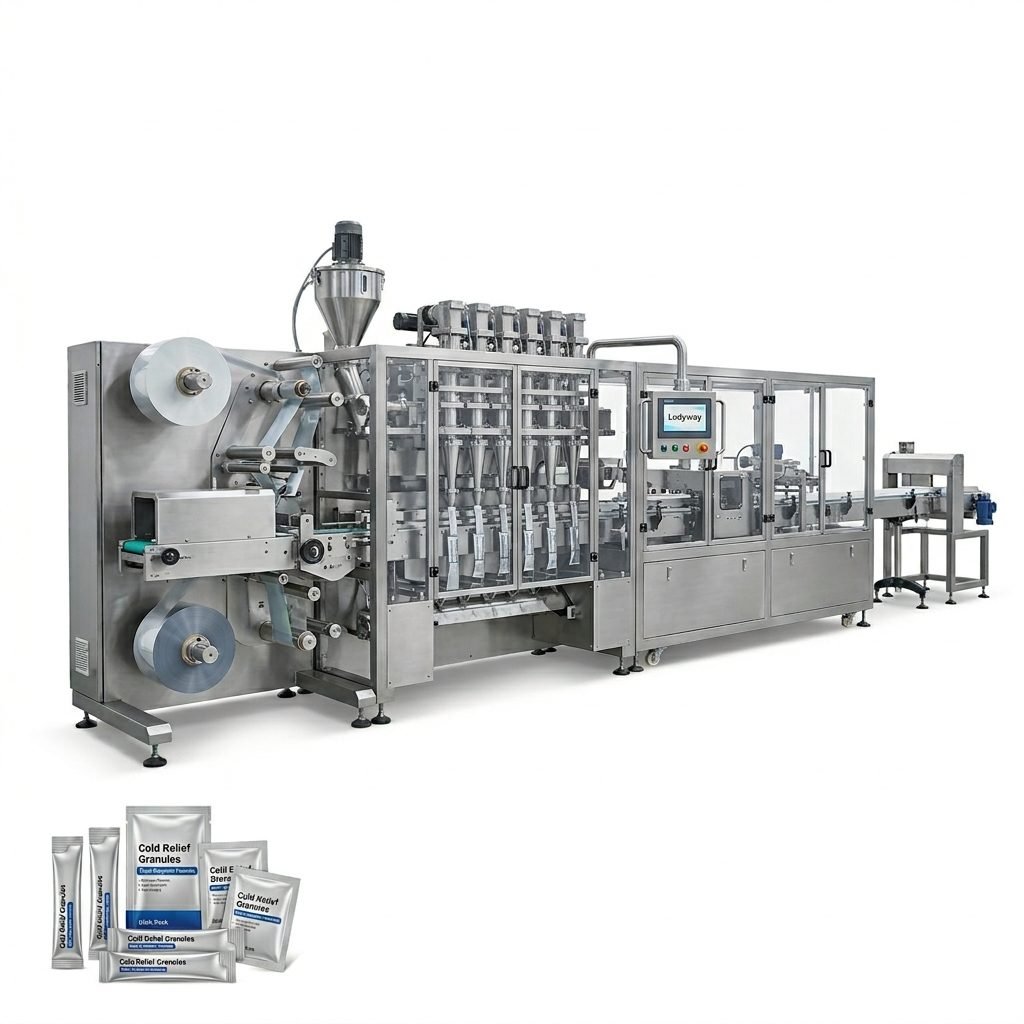
Clarify the recommended spare-parts kit for 12 and 24 months, the warranty period, operator and maintenance training, and remote-support availability. For complete scope, review how an automated pet food packaging line for granules and powder is specified end to end, including conveyors, checkweighers and case packing.
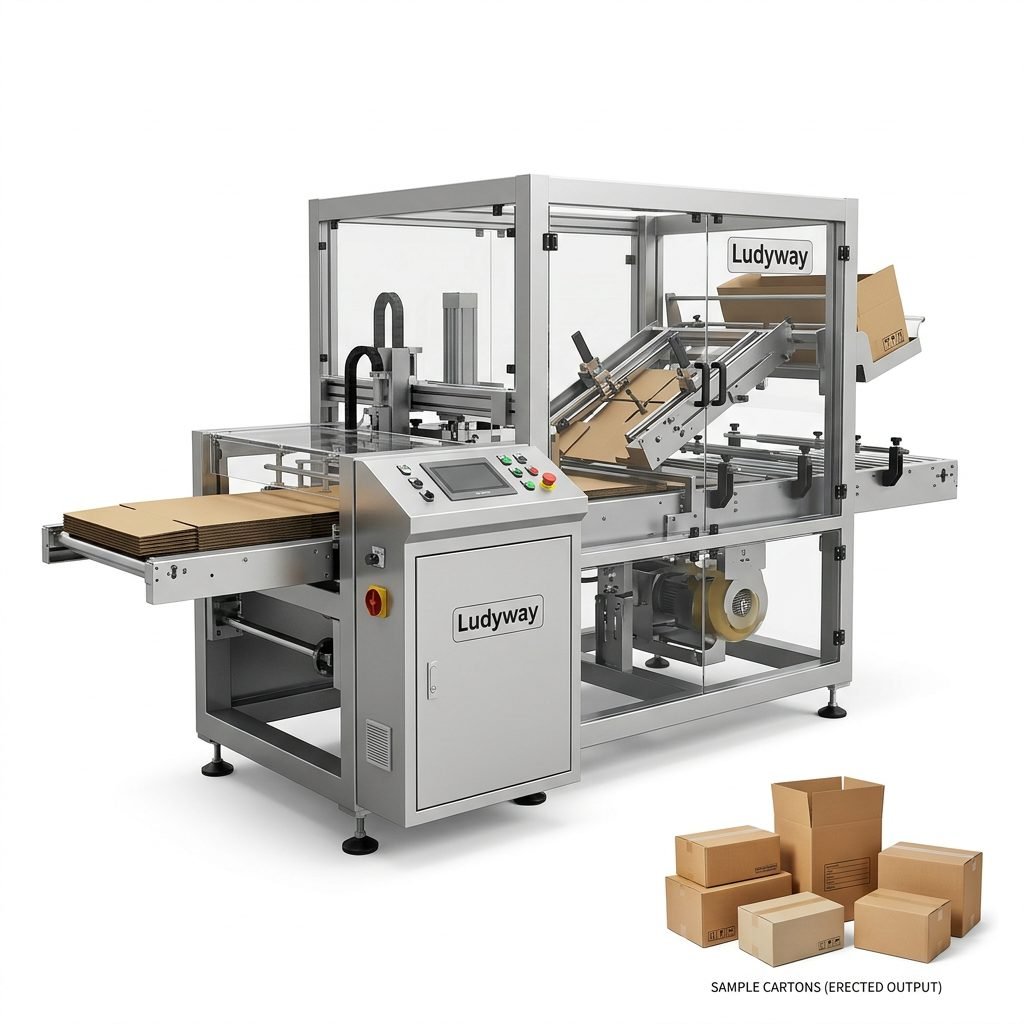
End-of-line carton erecting equipment integrated with pouch and bag packaging systems
Ludyway: Packaging Machinery Built for Pet Food and Pet Nutrition Producers
Ludyway Machinery, founded in 1993 and based in Zhongshan, Guangdong, is one of the largest packaging machine manufacturers in China, specialising in granule, powder, liquid and pouch packaging equipment and turnkey production lines for the food, pharmaceutical and health industries. The company’s multi-lane stick pack and sachet systems, VFFS baggers, vacuum and nitrogen-flush units and complete pet food packaging lines are engineered in a 20,000 ㎡ facility by a team of more than 130 packaging specialists, and are running with customers in over 100 countries and regions. Its export growth and expansion plans have been covered in industry press on Ludyway’s global growth trend. For pet food and pet supplement projects, Ludyway provides product trials, line layout design, FAT with customer product, CE-compliant builds and remote diagnostic support after installation.
30+
Years of packaging machinery experience
50+
Intelligent packaging machine models
200+
Manufacturing equipment units in-house
100+
Countries and regions served
Pet Food and Pet Nutrition Packaging Systems
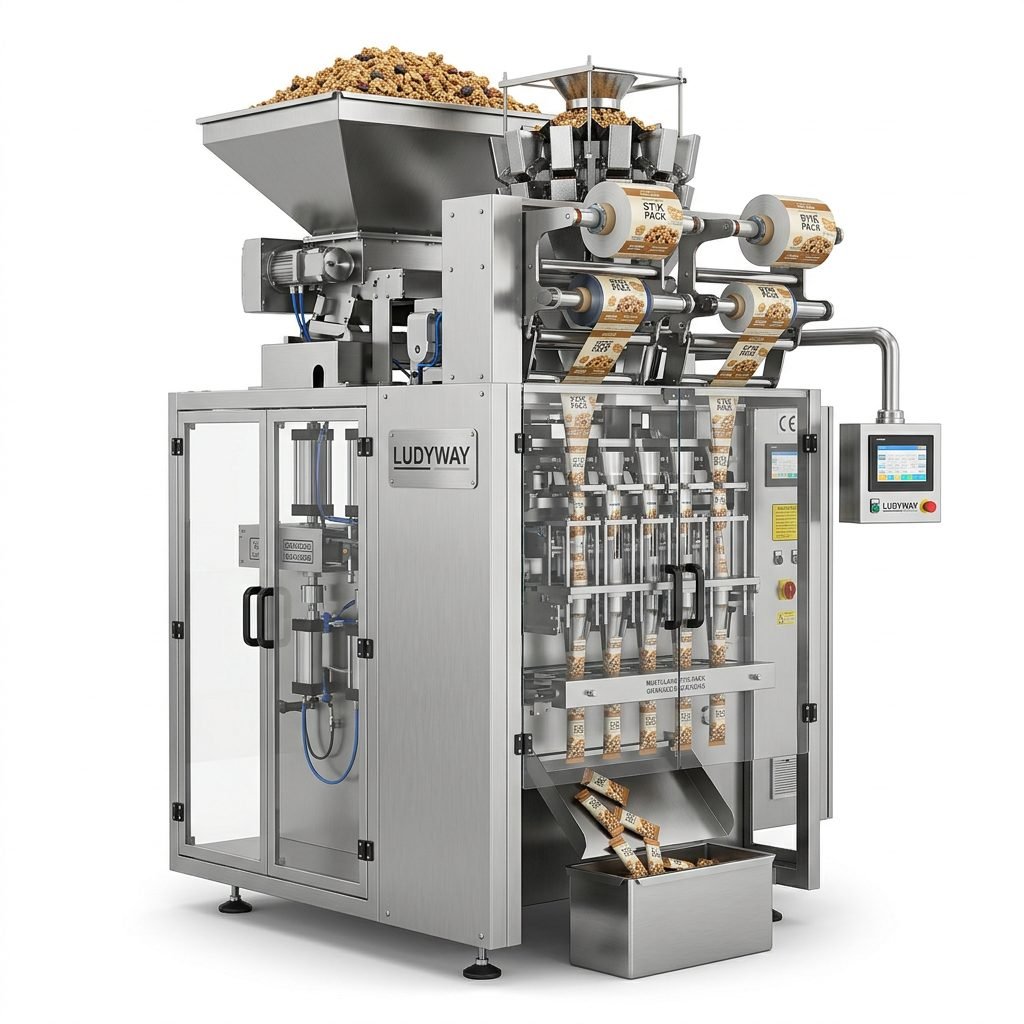
Pet Food Packaging Machine
Kibble & Treats, Granule & Powder
Quote on Request
Pet Vitamin Stick Pack Line
Pet Nutrition, Multi-Lane Stick Pack
Quote on Request
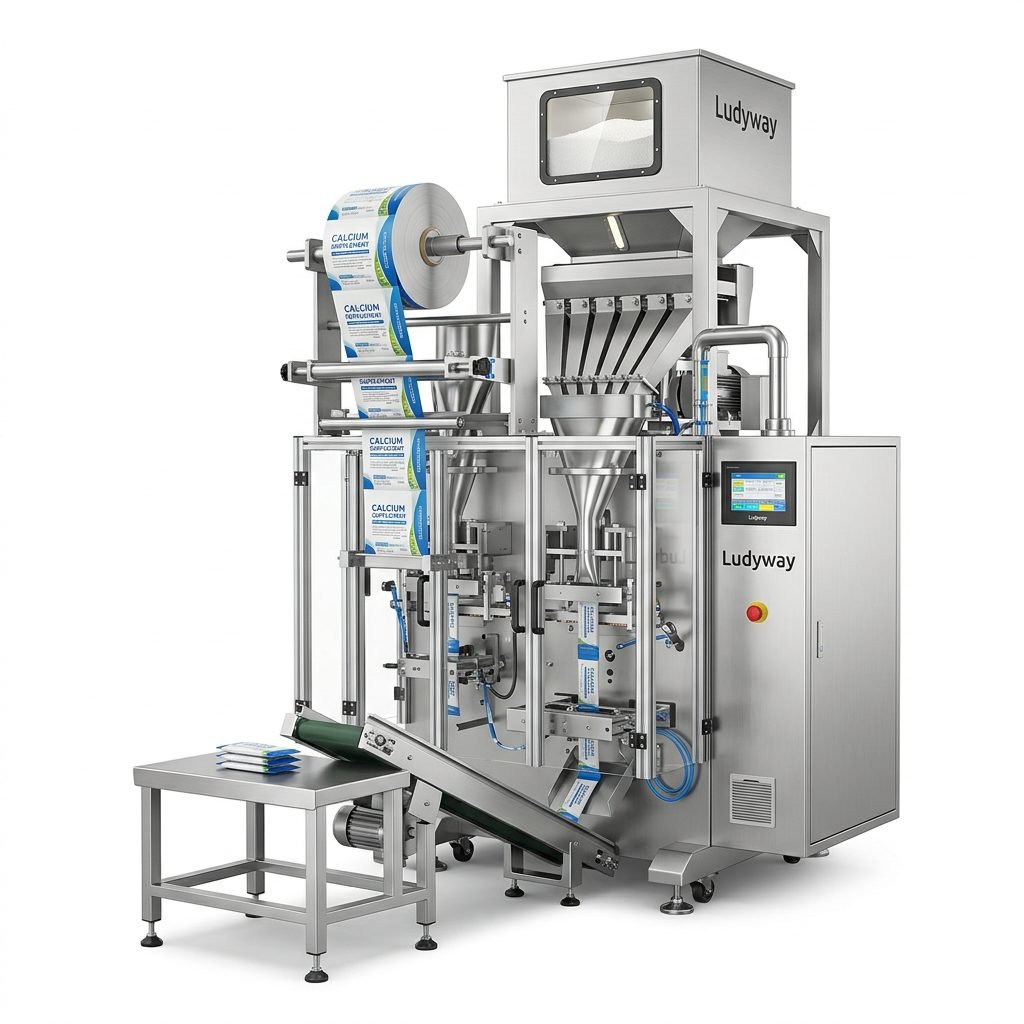
Pet Supplement Sachet Machine
Joint & Calcium Powders, Sachet
Quote on Request
Pet Medicine Sachet System
Veterinary Granule, Powder & Liquid
Quote on Request
Frequently Asked Questions
Can one machine package both dry kibble and pet supplement powders?
Not efficiently. Kibble in 500 g to 5 kg bags needs a VFFS bagger with a multihead weigher, while 1–20 g supplement sticks need a multi-lane machine with auger dosing. Some producers run a single-lane sachet machine for both small treats and powders by swapping the dosing head, but for commercial volumes two dedicated systems deliver far better output and accuracy.
What dosing accuracy should I expect for freeze-dried pet food?
Freeze-dried pieces are light and irregular, so a multihead weigher typically achieves ±1–2 g on 100–200 g pouches. Accuracy improves with more weigh heads and gentle feeding; vibratory feeders should be tuned to avoid breaking the product into fines that fall below the label weight.
Is nitrogen flushing necessary for dry pet food?
For standard kibble with antioxidants and a 12-month shelf life it is often optional, but for high-fat treats, fish-based formulas, omega-3 toppers, probiotics and freeze-dried proteins it is strongly recommended. Residual oxygen below 2% can extend shelf life significantly and reduce rancidity complaints in warm export markets.
Can these machines run recyclable mono-material films?
Yes, provided the sealing system is specified for them. Mono-PE and mono-PP films have narrower sealing windows than PET/PE laminates, so independent jaw temperature control, servo film tension and sometimes longer dwell times are required. Always validate on the exact film during the factory acceptance test.
How long does installation and commissioning take?
A single VFFS or multi-lane machine is usually installed and commissioned in 3–7 working days once utilities are ready. A complete line with weighing, inspection, cartoning and palletising generally takes 2–4 weeks including operator training and site acceptance testing.
Next Step: Request a Pet Food Packaging Proposal
For manufacturers and co-packers
Send your product samples, bag formats and target output to the Ludyway engineering team to receive a machine recommendation, line layout and detailed technical quotation. Dosing trials with your kibble, treats or supplement powder can be arranged before any commitment.
Email info@ludyway.com or WhatsApp +86 131 2959 2456 to request the pet food and pet nutrition equipment catalogue.
For distributors and project engineers
Ask for reference lists in the pet food sector, sample pouches produced on comparable machines, the standard FAT protocol and the recommended spare-parts list, so you can compare suppliers on an equal technical basis.
Factory visits in Zhongshan and meetings at international packaging exhibitions can be scheduled on request, and complete pet treat packaging lines for dry and semi-moist snacks can be reviewed in operation before shipment.