Flour, milk powder and protein powder look alike on a product spec sheet: dry, fine, sold by weight. Inside a packaging machine, however, they behave like three different materials. Wheat flour bridges in hoppers and generates combustible dust, spray-dried milk powder absorbs moisture within minutes and oxidises if oxygen is left in the pack, and whey or plant protein aerates, sticks to seal jaws and fluctuates in bulk density from batch to batch. A powder packaging machine that runs sugar perfectly can fail on all three.
This guide is written for food manufacturers, co-packers, nutraceutical brands and procurement engineers evaluating powder packaging machines for flour, milk powder and protein products. It covers the main machine types, the dosing technologies that determine fill accuracy, the hygienic and safety features worth paying for, the certifications buyers in different markets should ask for, and a practical RFQ checklist so you can compare quotations from different suppliers on equal terms.
Key takeaway: choose the dosing system first (auger, multi-head weigher or net-weigh scale), then the pack format (stick, sachet, pillow bag, doypack, can or 10–50 kg bag), and only then the machine frame. Most costly mistakes in powder packaging come from selecting the bag style before confirming how the product will be metered.
Why Flour, Milk Powder and Protein Powder Each Need a Different Packaging Setup
Before comparing machine types, it helps to understand the physical properties that drive machine design. Bulk density determines hopper and auger sizing, flowability determines whether you need agitation, hygroscopicity dictates sealing speed and barrier film, and dust behaviour dictates extraction and explosion-protection requirements.
Wheat, Rice and Corn Flour
Bulk density roughly 0.45–0.65 g/ml, poor flowability, strong tendency to bridge and rat-hole in hoppers. Flour dust is combustible, so the filling area usually requires dust extraction and, in the EU, an ATEX Zone 22 assessment.
Typical formats: 500 g–2 kg pillow bags, 5–10 kg paper or PE bags, 25–50 kg open-mouth or valve bags for bakery and industrial customers.
Skim, Whole and Infant Milk Powder
Highly hygroscopic and sensitive to oxidation. Industry practice is to flush with nitrogen to a residual oxygen level below 2%, and below 1% for infant formula. Fat-rich whole milk powder also smears, so contact parts need polished stainless steel and tool-less cleaning.
Typical formats: 10–50 g stick packs and sachets, 400 g–1 kg pillow or gusseted bags, 400–900 g cans, 25 kg bulk bags for dairy ingredients.
Whey, Casein and Plant Protein
Low bulk density (often 0.30–0.50 g/ml), easily aerated, electrostatic and prone to sticking in the forming tube. Blends with flavours, gums and sweeteners change density between lots, so the dosing system must self-correct through feedback weighing.
Typical formats: 25–40 g single-serve stick packs, 30–50 g sachets, 500 g–5 kg doypacks and tubs for retail and gym channels.
Types of Powder Packaging Machines and Where Each One Fits
Powder packaging equipment falls into five practical categories. Each is defined by the pack format it produces and the fill range it handles economically. Many flour mills and protein brands run two or three of these side by side to serve retail, foodservice and bulk customers from one plant.
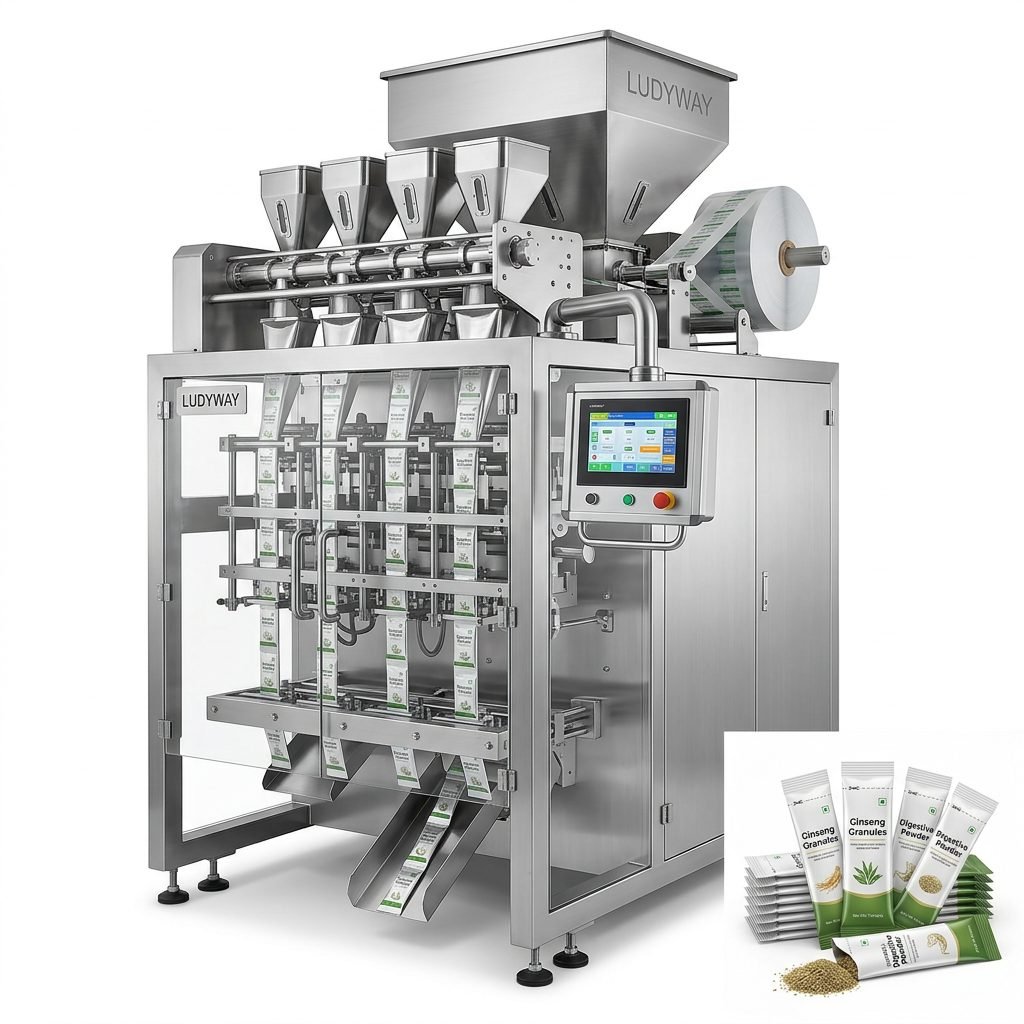
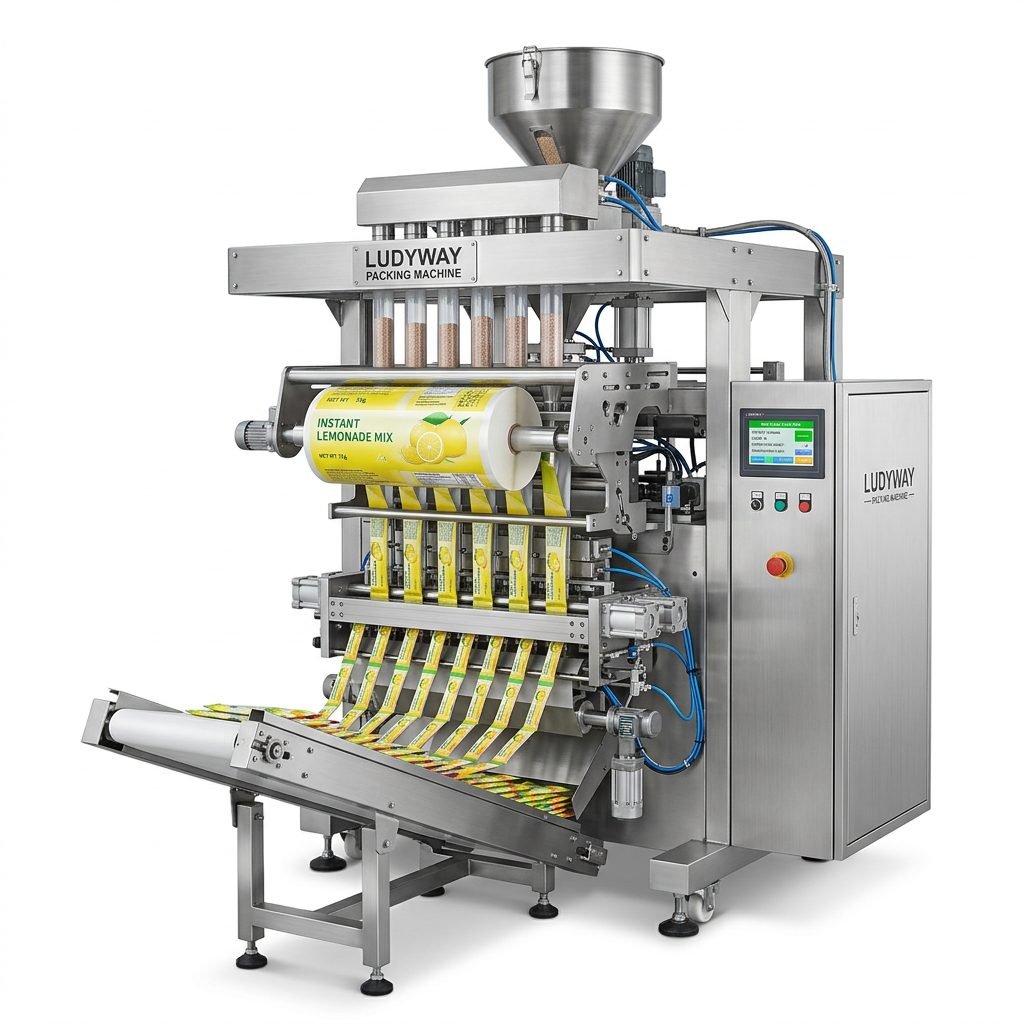
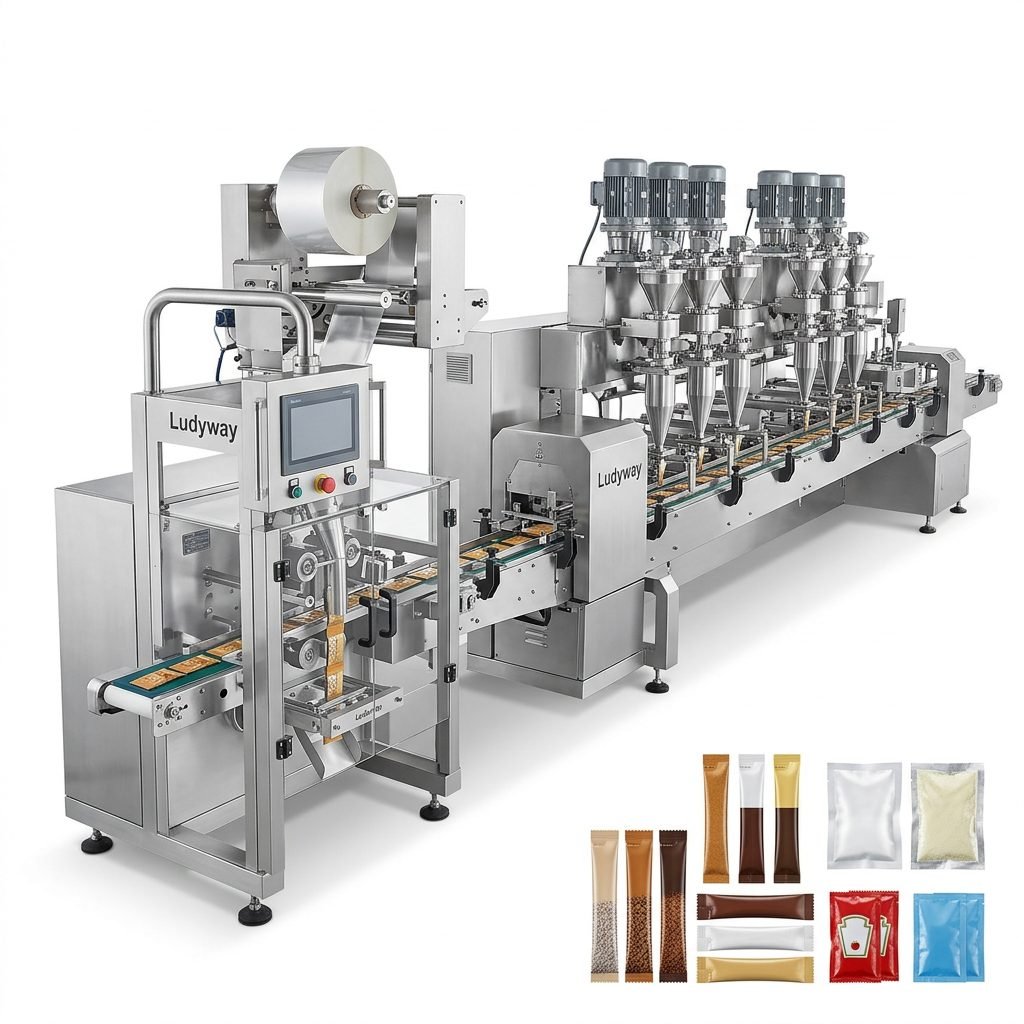
1. Multi-Lane Stick Pack and Sachet Machines

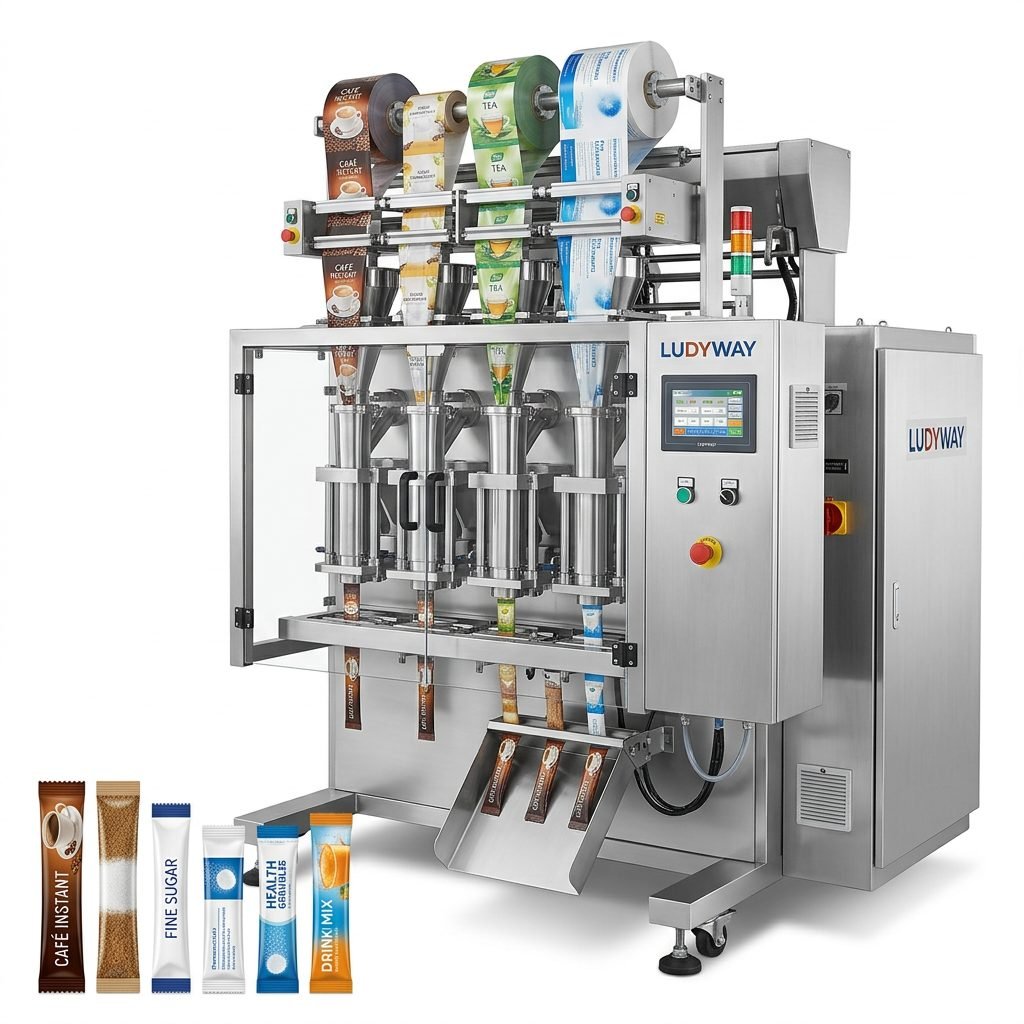
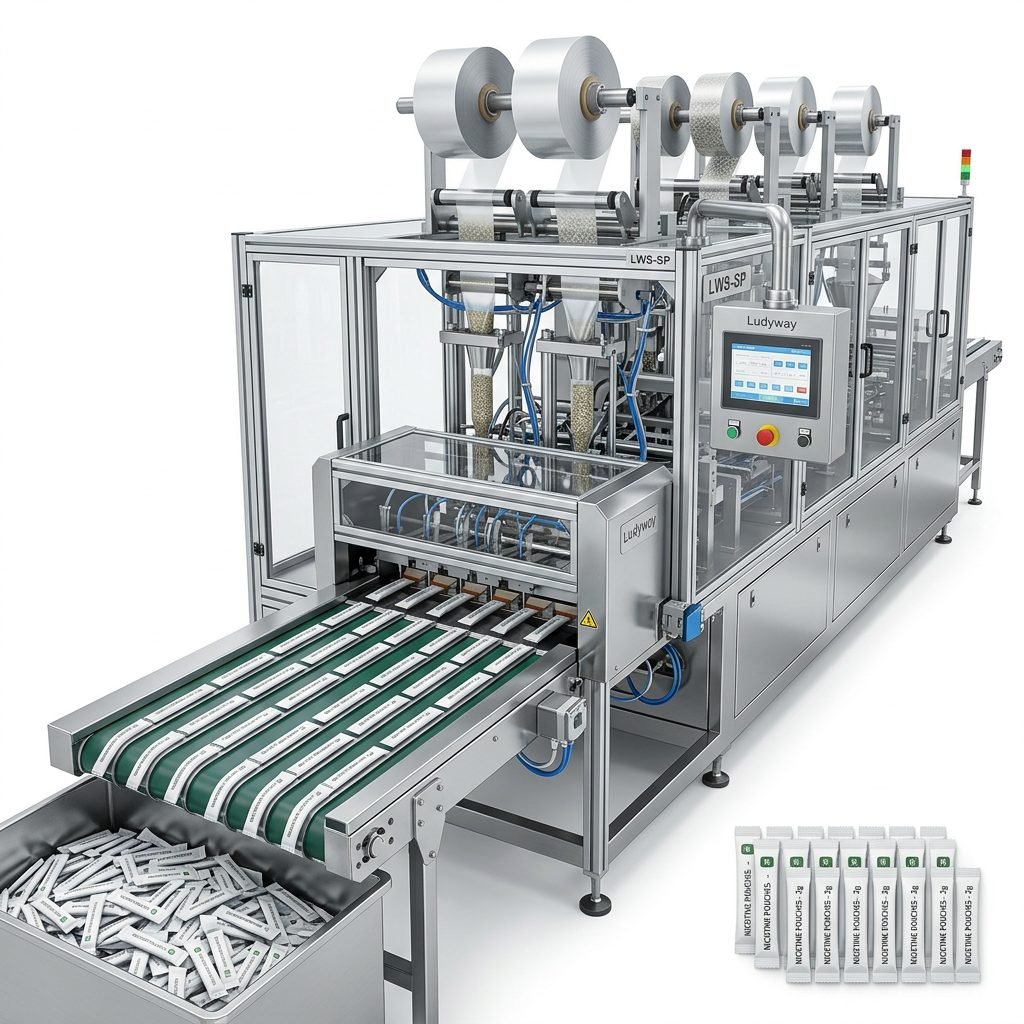
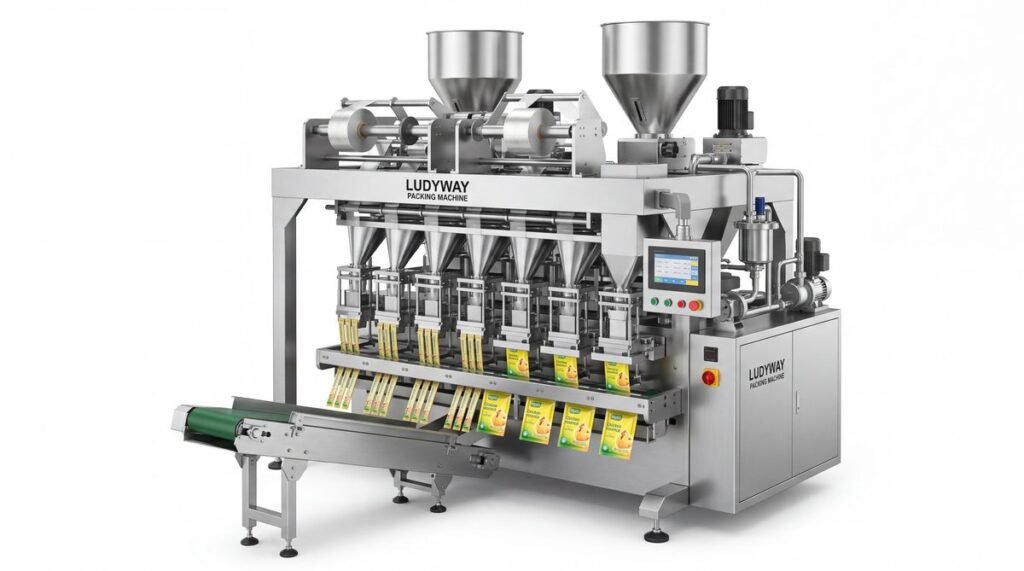
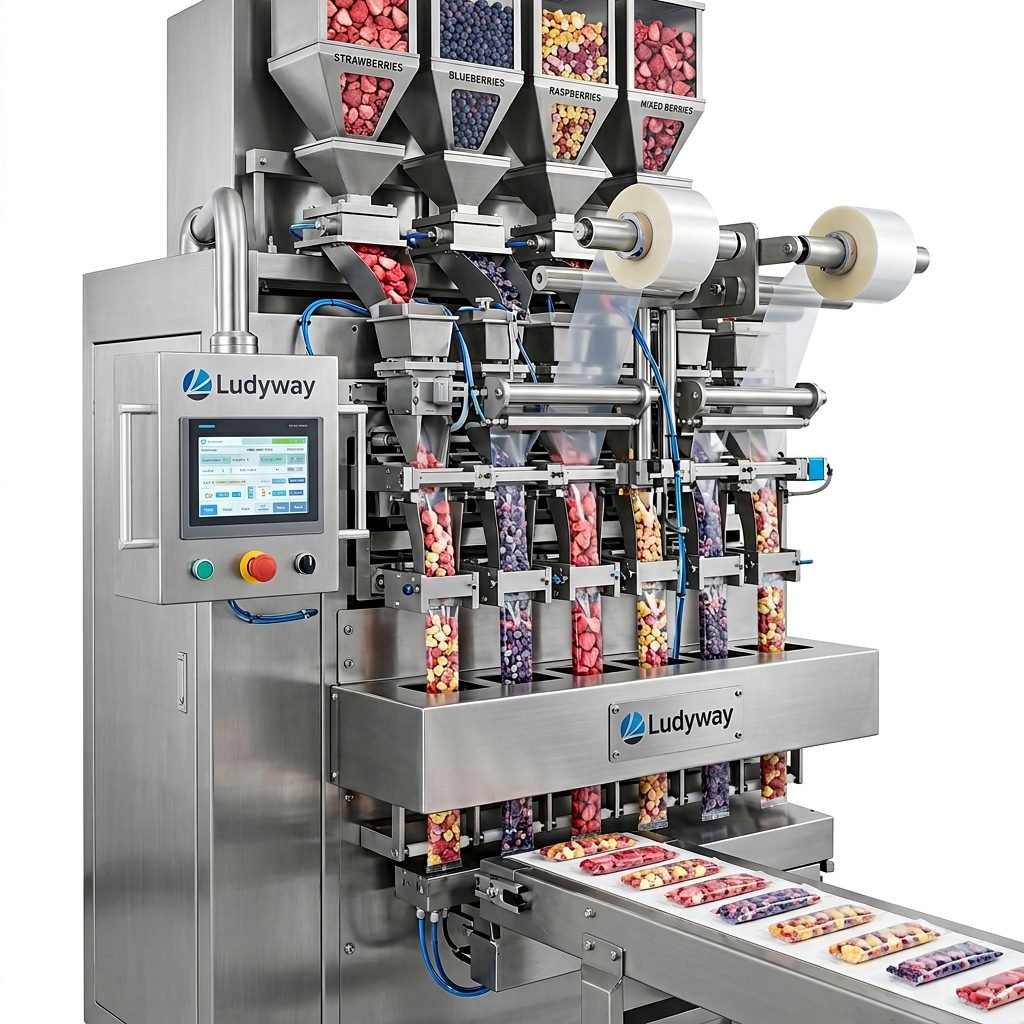
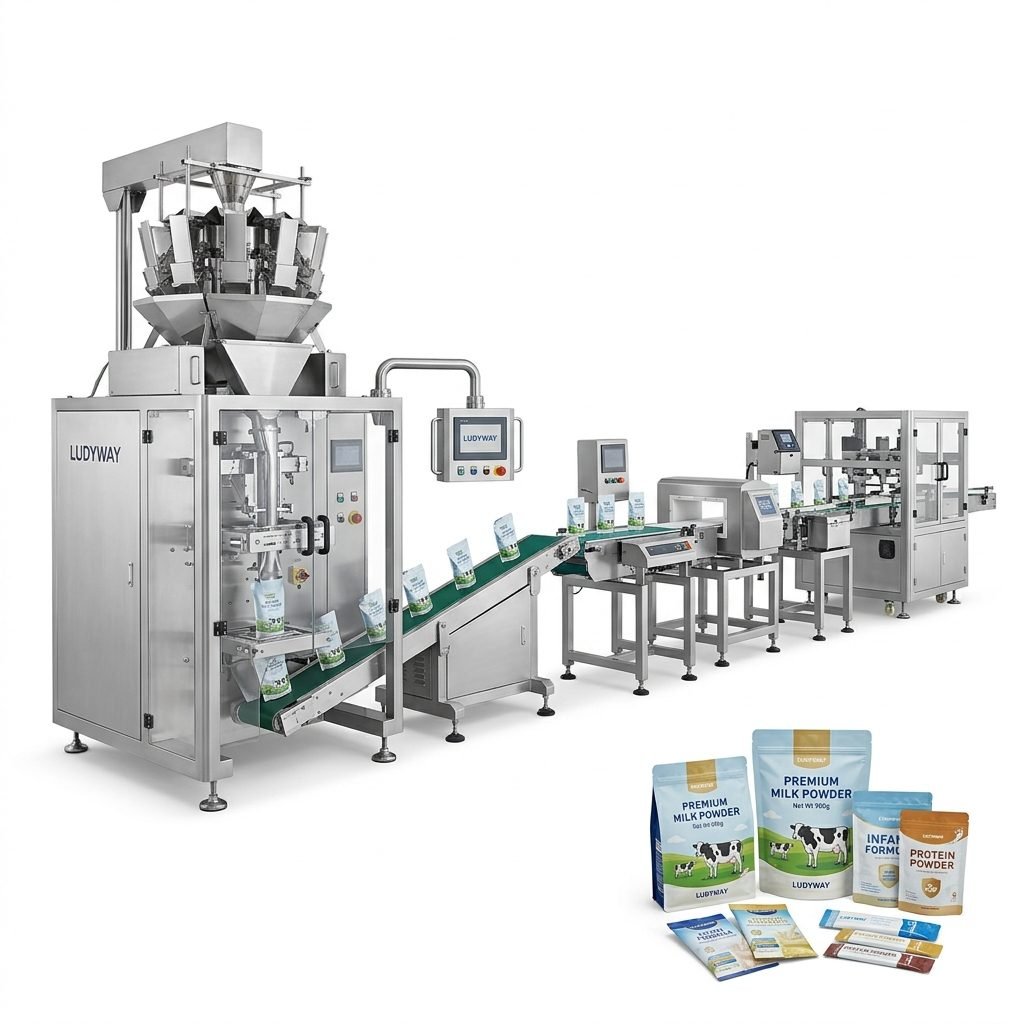
Multi-lane vertical form-fill-seal machines run 4 to 12 lanes from a single roll of film, each lane fitted with its own auger filler. They are the standard choice for single-serve protein, meal replacement, milk powder and creamer portions in the 1–150 g range. Output scales with lane count: a 10-lane stick machine at 50 cycles per minute delivers around 500 sticks per minute from one operator.
Look for servo-driven film pulling, independent lane shut-off, and augers that can be swapped without tools when changing from a 25 g whey portion to a 10 g milk powder portion. Ludyway’s multi-lane powder packaging machine for sachets and stick packs is built on this architecture for food and nutraceutical powders.
Formats available: 3-side seal, 4-side seal, back-seal stick, shaped sachet, with options for tear notches, euro holes and zipper reclose on larger sachets.
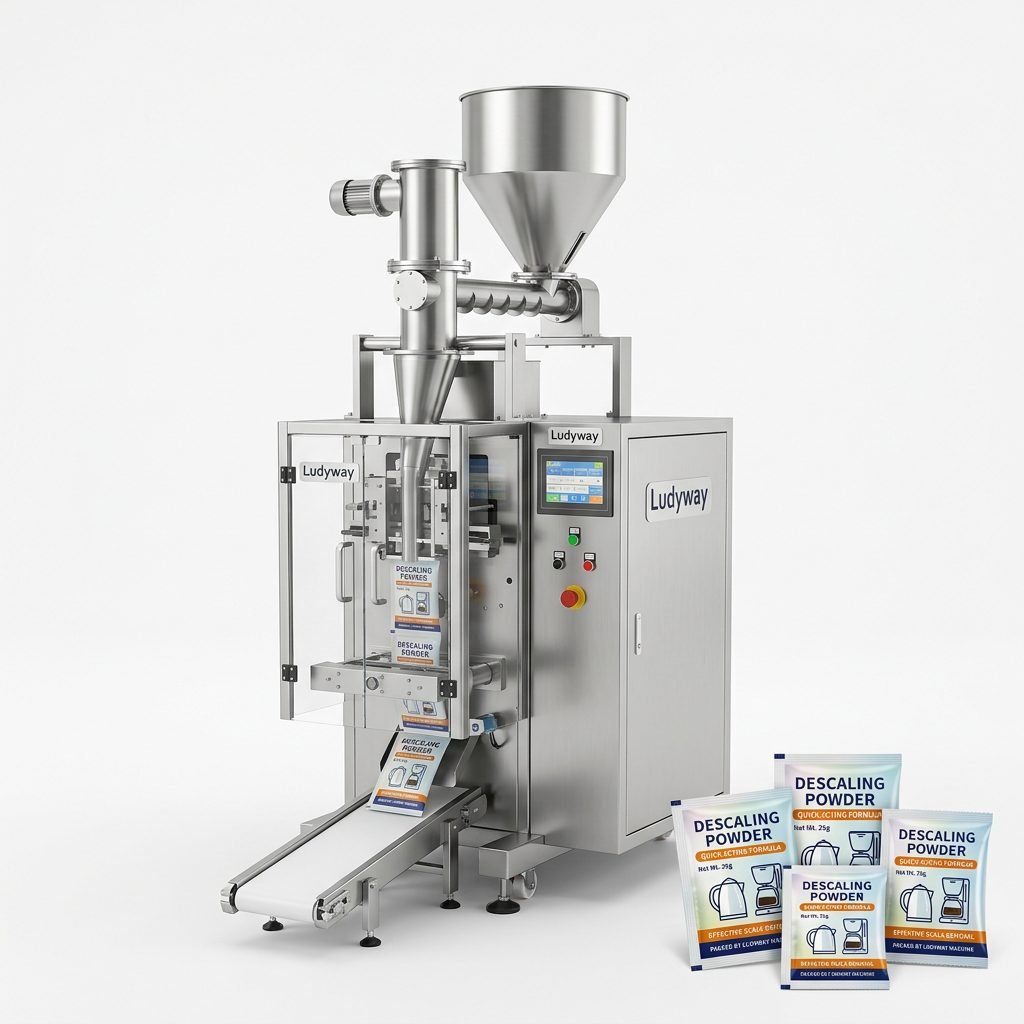
2. Single-Lane VFFS Bagging Machines
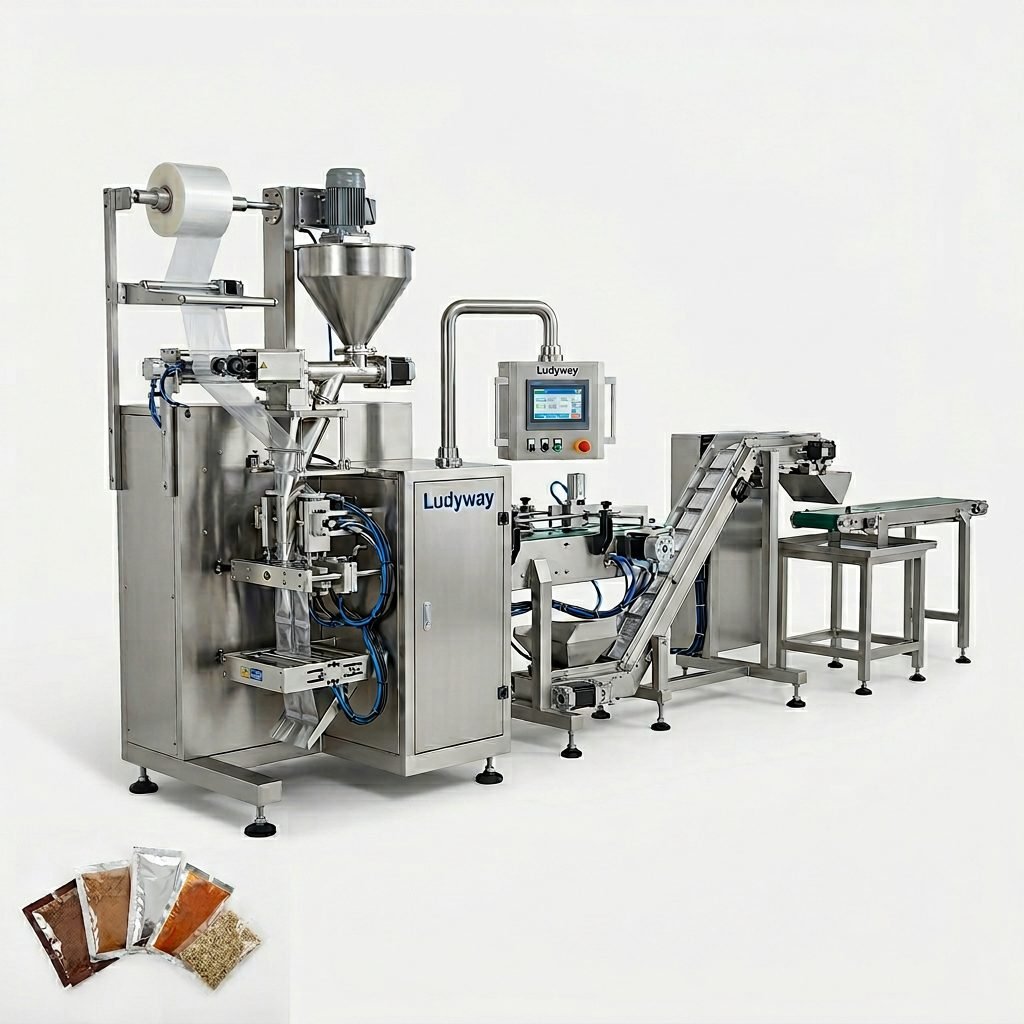
Vertical form-fill-seal baggers with an auger filler on top produce pillow bags, gusseted bags and quad-seal bags from 100 g to 5 kg. This is the workhorse for 500 g and 1 kg retail flour, 400 g to 1 kg milk powder refill bags and 1–2 kg protein economy packs. Speeds range from 30 to 80 bags per minute depending on fill weight and film.
For flour, specify an agitator in the hopper and a dust-tight forming tube with suction at the fill point. For milk powder, specify gas flushing through the forming tube and a sealing system able to handle high-barrier laminates with aluminium foil or metallised PET layers.
The same frame can later be upgraded with a combination weigher for granulated products, which gives flour mills producing both flour and semolina more flexibility.
3. Premade Pouch and Doypack Fillers
Rotary premade pouch machines pick a pre-formed stand-up pouch, open it, fill it from an auger or weigher, flush, and heat seal, typically at 20–60 pouches per minute. They are preferred for premium protein brands that need a zipper, a window or a rigid shelf presence, because pouch quality is controlled at the converter rather than formed on the line. Fill ranges run from 100 g to roughly 5 kg, and changeover between pouch sizes is usually under 20 minutes with servo-adjusted grippers.
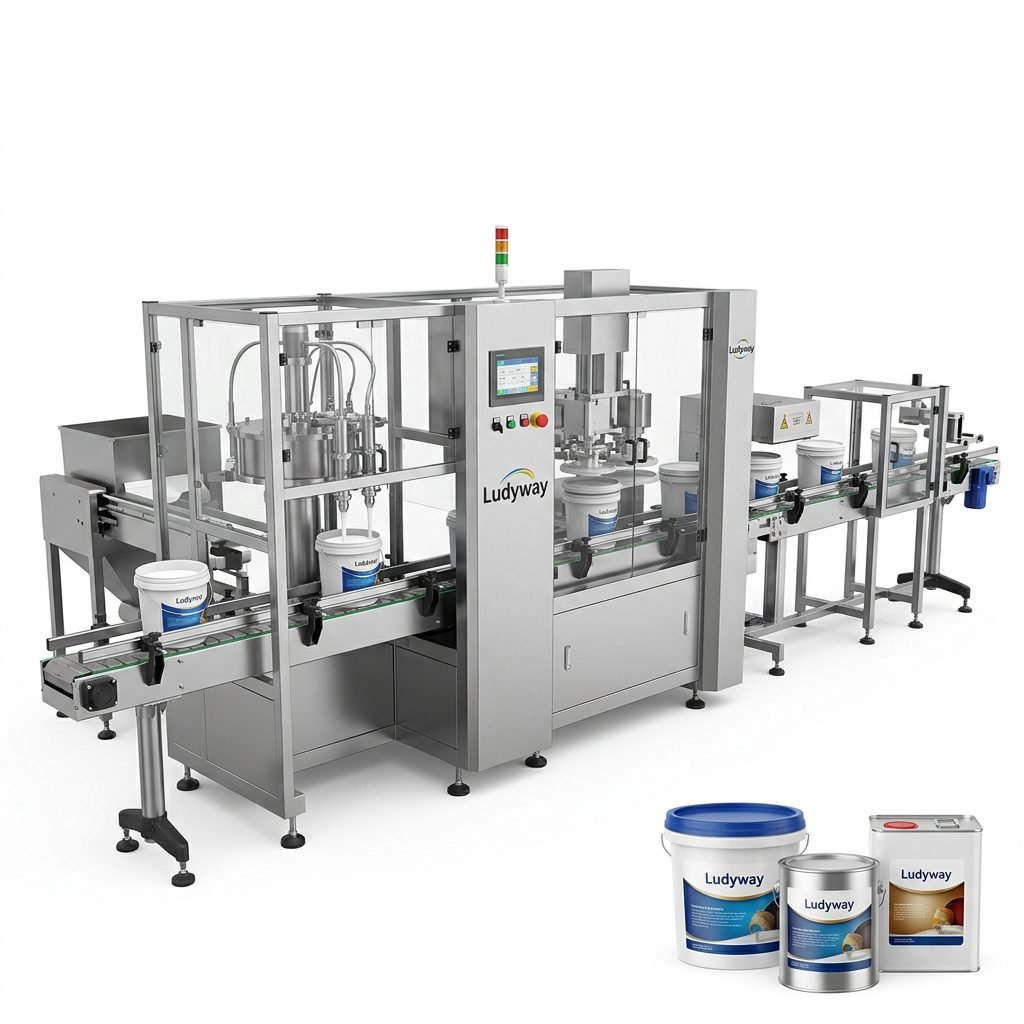
4. Can, Jar and Tub Filling Lines
Infant formula and a large share of whey protein still ship in cans and HDPE tubs. These lines combine an auger filler or multi-head weigher with a container conveyor, inline checkweigher, nitrogen flushing, scoop inserter, lid seaming or induction sealing, and labelling. Accuracy targets are tight because the containers are large and the product value is high, so net-weight feedback from the checkweigher to the filler is standard rather than optional.
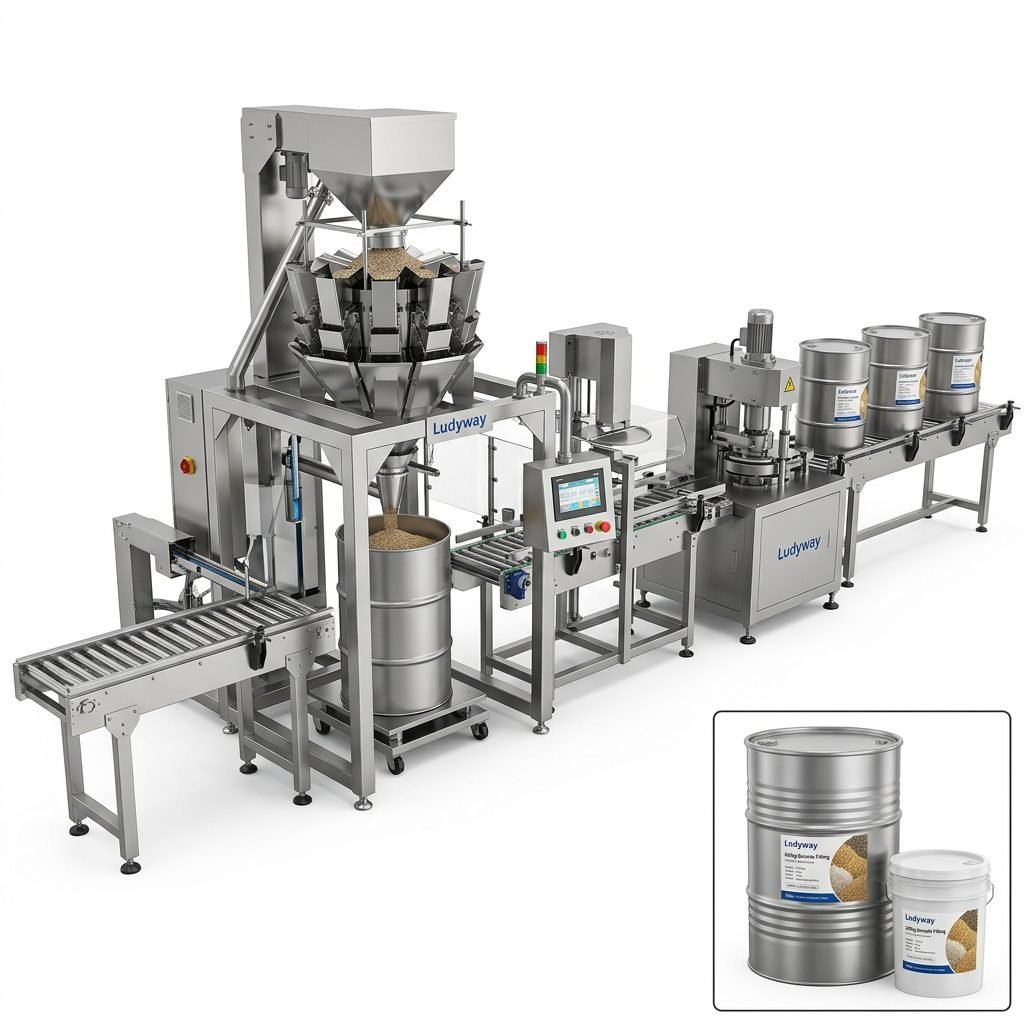
5. Bulk Bag Lines: 10 kg, 25 kg, 50 kg and FIBC
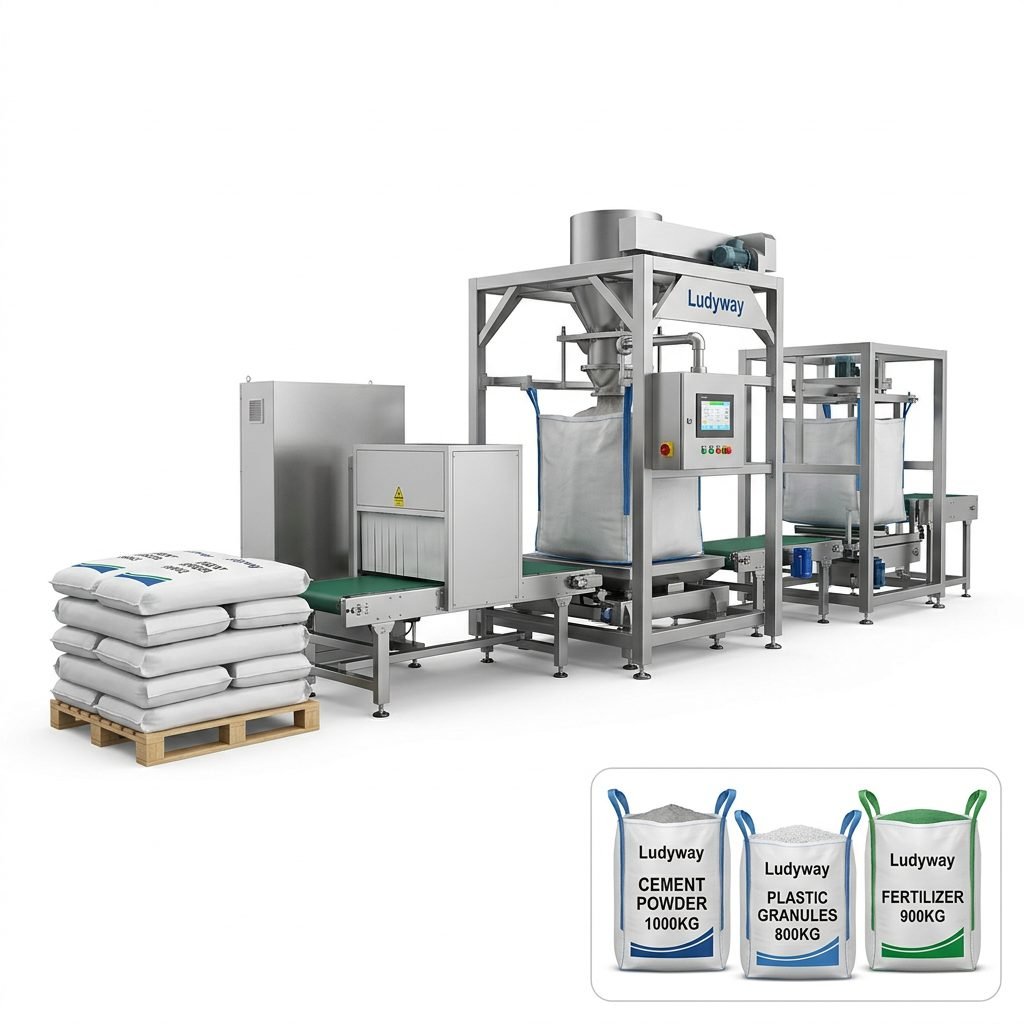
Industrial flour, dairy ingredients and bulk protein isolate move in 25 kg paper valve bags, open-mouth PE bags and 500–1000 kg FIBC big bags. Net-weigh or gross-weigh scales with coarse and fine feed deliver ±0.1–0.2% accuracy at 200–600 bags per hour, followed by bag closing, metal detection, checkweighing and palletising.
Automated 25 kg bag packaging lines for powders are increasingly specified with robotic palletisers and stretch wrappers so that a single operator can supervise the full back end of the line.
Machine Type Comparison for Powder Products
| Machine Type | Typical Fill Range | Indicative Output | Preferred Dosing | Best Suited To |
|---|---|---|---|---|
| Multi-lane stick / sachet | 1–150 g | 200–800 packs/min | Servo auger per lane | Protein single-serve, milk powder portions, creamer |
| Single-lane VFFS bagger | 100 g–5 kg | 30–80 bags/min | Auger with agitator | Retail flour, milk powder refill bags, economy protein |
| Premade pouch / doypack | 100 g–5 kg | 20–60 pouches/min | Auger or multi-head weigher | Premium protein with zipper, specialty flour |
| Can / tub filling line | 200 g–5 kg | 20–120 containers/min | Auger + checkweigher feedback | Infant formula, whey protein tubs |
| Bulk bag / FIBC line | 10–1000 kg | 200–600 bags/hour | Net-weigh or gross-weigh scale | Industrial flour, dairy ingredients, protein isolate |
Dosing Technology: The Decision That Determines Fill Accuracy
Fine, cohesive powders cannot be weighed accurately by a standard multi-head weigher because they do not flow cleanly through the buckets. The auger filler is therefore the default metering device for flour, milk powder and protein, with weighing used either as the primary method for bulk bags or as a feedback loop to correct the auger.
Servo Auger Filler
A rotating screw inside a funnel delivers a fixed volume per revolution. Servo motors allow fractional-turn control, giving typical accuracy of ±0.5–1% on free-flowing milk powder and ±1–2% on flour or aerated protein. Auger pitch, funnel geometry and agitator speed are tuned to each product; expect to specify two or three auger sets to cover your full weight range.
Best for: all sachet, stick, bag and can formats from 1 g to about 5 kg.
Auger with Inline Checkweigher Feedback
Every pack is weighed after sealing and the average deviation is fed back to the auger controller, which adjusts revolutions automatically. This compensates for bulk density drift between protein batches and reduces giveaway, which on a 25 g stick at high volume can represent several tonnes of product per year. A high-precision checkweigher also provides the batch records required under GMP and HACCP.
Best for: protein blends, infant formula, any product sold under strict net-content legislation.
Net-Weigh and Gross-Weigh Scales
For 10–50 kg bags and FIBCs, product is fed by screw or belt in a fast coarse stream and then a slow fine stream until the target weight is reached on load cells. Accuracy of ±0.1–0.2% is typical. Net-weigh (weigh then discharge) is faster; gross-weigh (weigh in the bag) is simpler and cheaper.
Best for: flour mills, dairy ingredient plants and protein isolate producers shipping to industrial customers.
Features That Matter When Packaging Flour, Milk Powder and Protein
Beyond the dosing head, a handful of features separate a machine that merely runs powder from one that runs it reliably for three shifts a day. These are the items worth confirming line by line in a supplier quotation.
Nitrogen or CO₂ flushing. Gas is injected into the forming tube or pouch before sealing to displace oxygen. For milk powder and whey protein specify residual O₂ targets in the contract and ask for an oxygen analyser to be included. A dedicated nitrogen flushing packaging system can be retrofitted to most VFFS and pouch machines.
Dust extraction and explosion protection. Suction at the fill point keeps powder off the seal area, which is the number one cause of leaking sachets. Flour and some protein powders are combustible dusts, so motors and sensors in the hopper zone may need ATEX Zone 22 or NFPA 652 compliance depending on destination market.
Hygienic construction. Product-contact parts in SUS 304 or 316L with surface roughness Ra ≤ 0.8 µm, sloped surfaces, no exposed threads, and FDA or EU 1935/2004 compliant seals and belts. Infant formula lines frequently require 316L throughout and a documented cleaning validation.
Tool-less changeover. Quick-release augers, forming tubes and seal jaws allow a trained operator to change from 10 g to 30 g portions in under 30 minutes. Recipe storage on the HMI stores film tension, seal temperature, dwell time and auger revolutions for each SKU.
Film and seal compatibility. Milk powder and protein require high-barrier laminates such as PET/AL/PE or PET/VMPET/PE. Confirm the machine can seal your specific structure at target speed, and ask whether ultrasonic sealing is available for powder-contaminated seal areas.
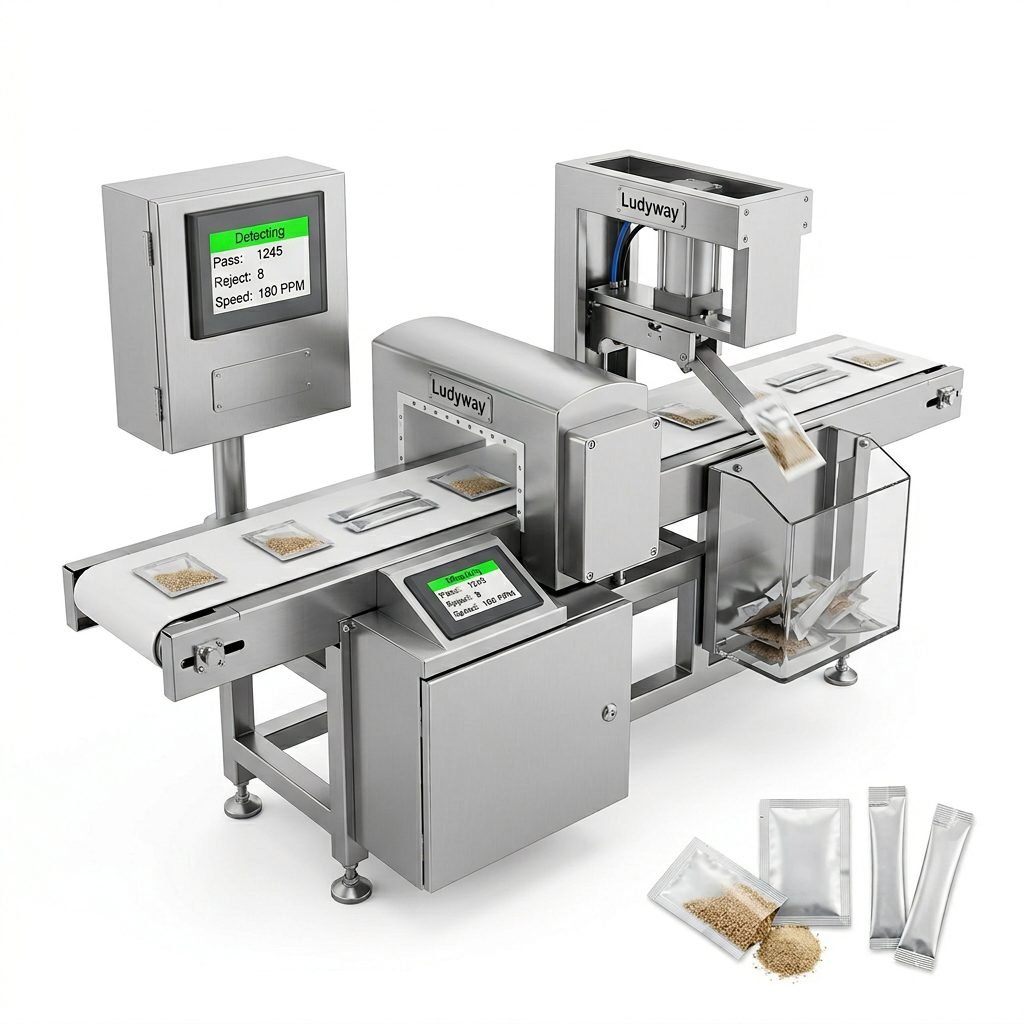
Inspection and traceability. Metal detection or X-ray before casing, date and lot coding, and data export from the PLC for HACCP records. Buyers supplying major retailers increasingly require OPC-UA or MQTT connectivity for line monitoring.
Certifications and Standards Buyers Should Ask For
Powder packaging machines are regulated at two levels: the machine itself as a piece of industrial equipment, and the food-contact materials and hygiene of the parts that touch product. Requirements differ by destination, so list your target markets in the RFQ and request documentary evidence rather than a verbal confirmation.
| Market | Machine Safety | Food Contact Materials | Typical Additional Requirements |
|---|---|---|---|
| European Union / UK | CE marking under the Machinery Directive and successor Machinery Regulation, EN 415 series for packaging machines, UKCA for Great Britain | Regulation (EC) 1935/2004, EU 10/2011 for plastics, declarations of compliance for seals and belts | ATEX for dust zones, EHEDG hygienic design guidance, packaging waste and recyclability rules |
| United States / Canada | UL 508A or cUL listed control panels, NFPA 79 wiring, OSHA guarding, ANSI/PMMI B155.1 risk assessment | FDA food contact substance regulations under 21 CFR Parts 174–178 | NFPA 652/654 combustible dust, 3-A Sanitary Standards for dairy, FSMA preventive controls documentation |
| Middle East, Africa, Southeast Asia | CE accepted in most tenders; SASO or G-mark for Gulf states; local electrical approvals | FDA or EU declarations generally accepted | Halal-compatible lubricants, tropicalised electrical cabinets, 380–415 V 50 Hz supply |
| Infant formula (all markets) | As above plus GMP documentation, FAT/SAT protocols, IQ/OQ support | 316L contact parts, full material certificates, cleaning validation | Residual oxygen verification, batch traceability, audit trail on HMI |
For a broader view of how packaging machinery buyers are specifying automation, hygienic design and sustainability features, PMMI’s State of the Industry reports and the Flexible Packaging Association industry resources are useful benchmarks when preparing a business case.
Buying Guide: A Six-Step Process for Selecting a Powder Packaging Machine
Characterise the Product
Record bulk density (loose and tapped), particle size, moisture content, flowability, fat content and whether the powder is dusty, sticky or electrostatic. Send a 5–10 kg sample to shortlisted suppliers for test filling.
Fix the Pack Formats and Weights
List every SKU with target weight, tolerance, bag or pouch dimensions, film structure and features such as zippers or scoops. Group SKUs by machine type and note which formats are likely to be added within three years.
Calculate Real Throughput
Convert annual volume to packs per minute at your planned shifts, then add 20–30% headroom for changeovers, cleaning and growth. Rated speed on a brochure is rarely sustained on cohesive powders, so ask for guaranteed speed on your product.
Define Hygiene and Safety Level
Decide between 304 and 316L, wash-down or dry-clean design, dust zone classification and inspection equipment. Infant formula and organic products often justify a higher specification than general flour.
Plan Upstream and Downstream
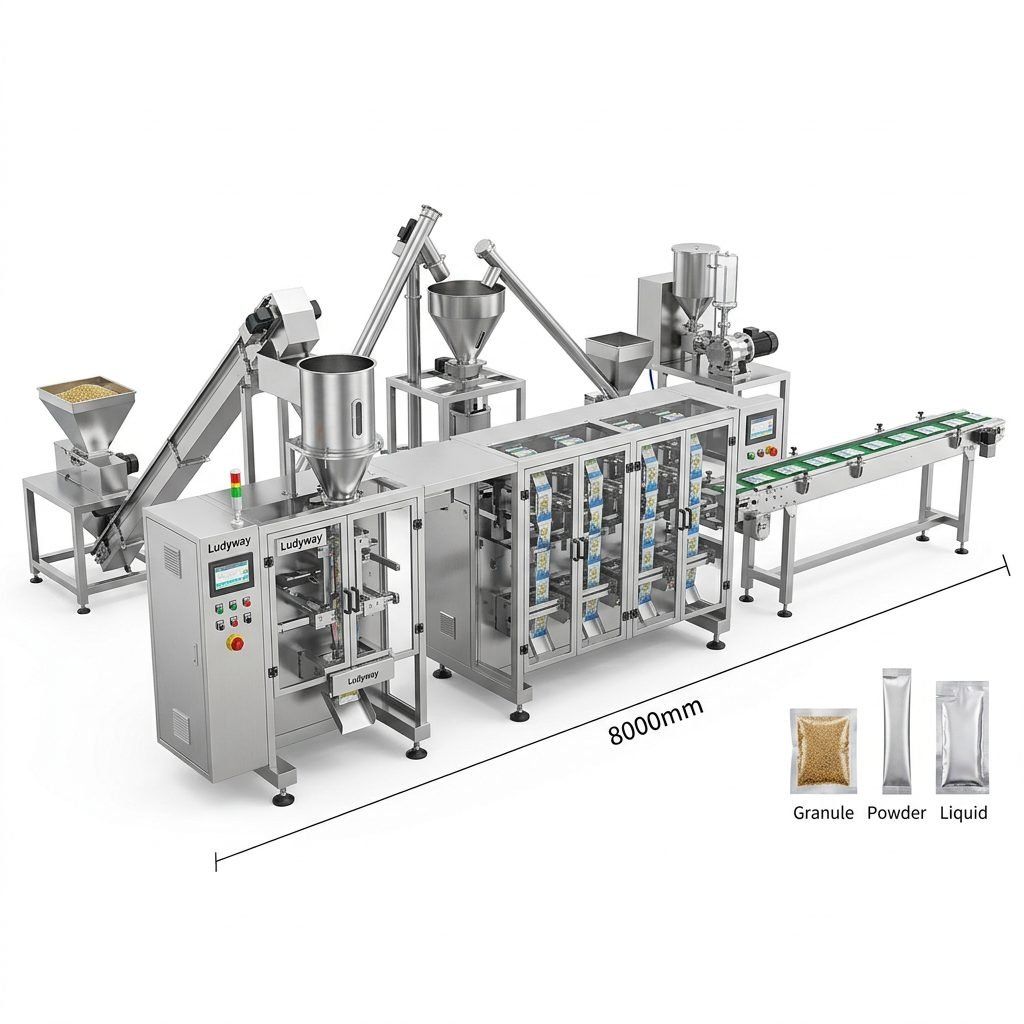
Powder must reach the hopper without segregation or dust: vacuum conveyors, screw feeders and powder dosing systems upstream; checkweigher, metal detector, cartoner, case packer and palletiser downstream. Integration is where turnkey suppliers add most value.
Agree Acceptance Criteria
Write FAT and SAT protocols covering speed, fill accuracy, seal integrity, residual oxygen and changeover time. Include training, spare parts kit, remote support and warranty terms in the purchase contract, not in a side e-mail.

What to Include in Your RFQ for a Powder Packaging Machine
Quotations from different manufacturers are only comparable when they answer the same questions. Sending a structured request also signals to the supplier that you expect engineering detail rather than a generic brochure price.
Product and Pack Data
- Product name, bulk density, particle size, moisture and fat content
- Target fill weights with legal tolerance per SKU
- Pack style, dimensions and film or container specification
- Required output per hour at planned shift pattern
- Gas flushing and residual oxygen target
Commercial and Site Data
- Destination country, voltage, frequency and compressed air availability
- Required certifications and documentation language
- Incoterm preference (EXW, FOB, CIF, DAP) and payment terms
- Installation, commissioning and training scope
- Spare parts list for two years and remote diagnostic access
Typical commercial terms for B2B equipment orders: minimum order quantity is normally one machine; standard multi-lane and VFFS machines ship in roughly 30–60 days after drawing approval, while integrated turnkey lines take 90–150 days; payment is commonly a deposit with balance before shipment or against FAT acceptance; warranty is usually 12 months on mechanical and electrical components. Confirm each point in writing with the supplier, as lead time depends heavily on dosing configuration and inspection equipment.
Ludyway: Powder Packaging Equipment Built for Food, Dairy and Nutrition Producers
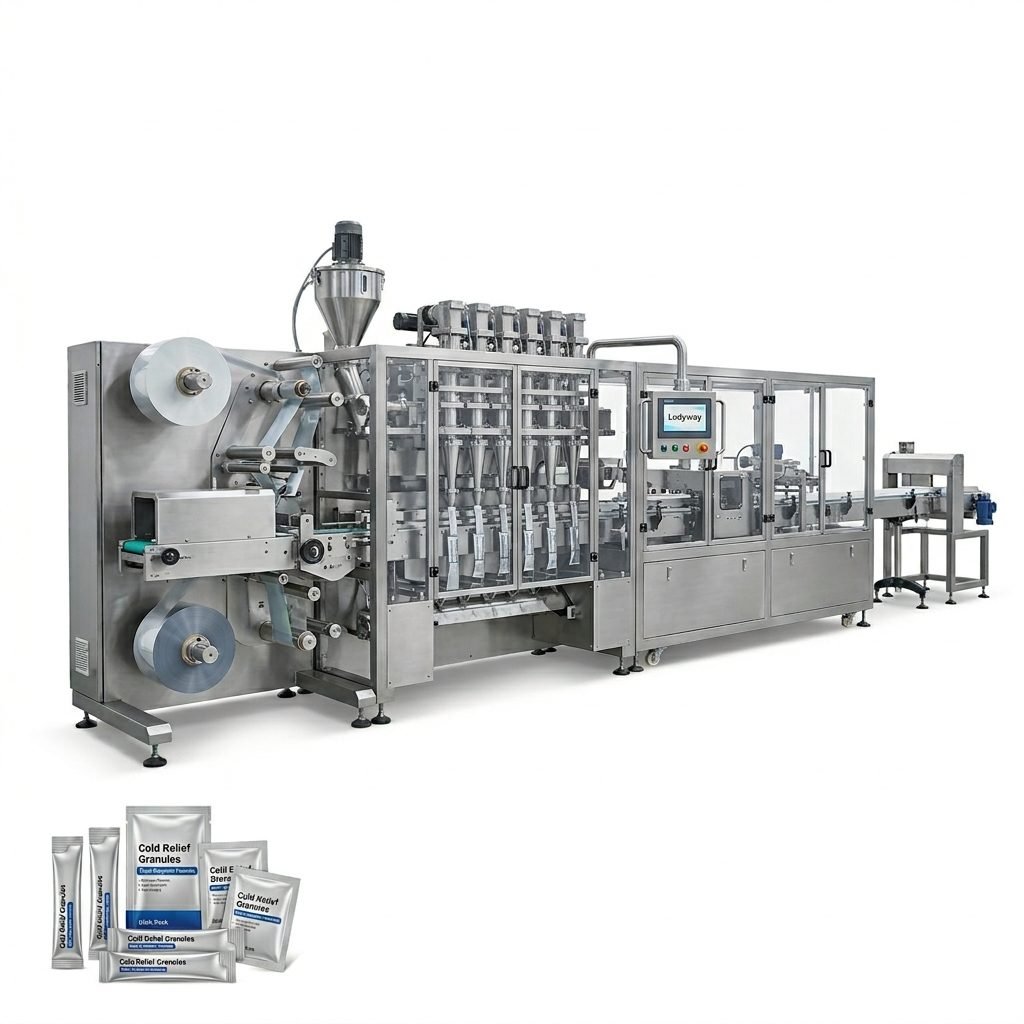
Ludyway is one of the largest packaging machine manufacturers in China, founded in 1993 and based in Nanlang Town, Zhongshan, Guangdong. The company specialises in advanced packaging equipment and turnkey production solutions for the food, pharmaceutical and health industries, with particular depth in granule, powder, liquid and pouch applications. Its portfolio of more than 50 intelligent machine models includes multi-lane stick pack and sachet systems, VFFS baggers, premade pouch fillers and fully automated lines with checkweighing, inspection, cartoning and palletising.
Production takes place in a 20,000 m² facility supported by 130+ packaging specialists and over 200 manufacturing equipment units, which allows customer powder samples to be test-run on actual machines before an order is placed. Ludyway serves customers in more than 100 countries and regions, and its export growth has been profiled by industry media as it expands its international project services.
For flour, milk powder and protein customers, this means one supplier can cover a 10 g stick pack line, a 1 kg retail bagger and a 25 kg bulk bag line, with common HMI logic, shared spare parts and a single point of technical support.
Recommended Powder Packaging Machines for Flour, Milk Powder and Protein
Related equipment frequently specified alongside these machines includes the whey protein multi-lane stick pack machine, the wheat flour packaging machine and the industrial dust collection system for packaging machinery.
Frequently Asked Questions
Can one powder packaging machine handle flour, milk powder and protein powder?
Mechanically yes, if the machine has interchangeable auger sets and an agitator. In practice, most producers avoid running flour and dairy or protein on the same machine because of allergen cross-contact and the very different cleaning regimes. If you must share a machine, specify full tool-less strip-down of the hopper, auger and forming tube and a validated cleaning procedure.
What fill accuracy should I expect from an auger filler on protein powder?
On well-conditioned whey or pea protein, servo auger fillers typically achieve ±0.5–1% standard deviation at 25–40 g. Heavily aerated or electrostatic blends may widen to ±1.5–2% without checkweigher feedback. Always request accuracy data from a trial run on your own product rather than relying on generic figures.
Is nitrogen flushing necessary for milk powder stick packs?
For whole milk powder, infant formula and any product with an extended shelf life claim, yes. Residual oxygen below 2% significantly slows fat oxidation and vitamin degradation. Skim milk powder in short shelf-life channels is sometimes packed without gas, but barrier film with a low oxygen transmission rate is still required.
How many lanes should a stick pack machine have for a new protein brand?
Start from your volume. A 4-lane machine at 40 cycles per minute produces roughly 160 sticks per minute, or about 70,000 sticks per 8-hour shift allowing for changeovers. Brands expecting rapid growth often choose 6 or 8 lanes and run fewer hours initially, because adding lanes later is not possible on most frames.
What documentation should a supplier provide with a CE or FDA compliant powder packaging machine?
Expect an EC Declaration of Conformity with the applicable directives listed, a risk assessment, electrical schematics, operation and maintenance manuals in the agreed language, material certificates for product-contact stainless steel, declarations of compliance for seals and belts, and FAT and SAT reports. For infant formula projects, add IQ/OQ templates and cleaning validation support.
Next Step: Request a Test Run With Your Own Powder
The most reliable way to select a powder packaging machine is to watch your flour, milk powder or protein blend being filled and sealed on the actual equipment. Ludyway’s engineering team reviews your product data and SKU list, recommends the dosing method and machine configuration, and can arrange sample trials and a video or in-person factory acceptance test before shipment.
To receive a technical proposal, machine catalogue and quotation tailored to your fill weights, output and destination market, send your product details to info@ludyway.com or contact the team on WhatsApp at +86 131 2959 2456. Factory visits in Zhongshan, Guangdong and meetings at international packaging exhibitions can be arranged on request.
Procurement teams comparing several suppliers are welcome to share their RFQ template; Ludyway will respond point by point so that specifications, certifications, lead time and acceptance criteria can be evaluated side by side.