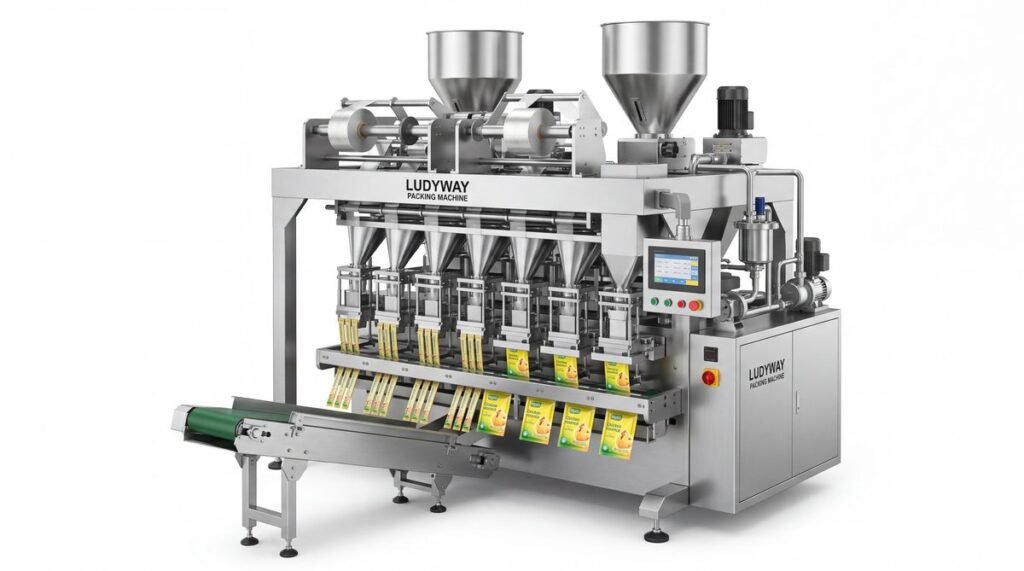
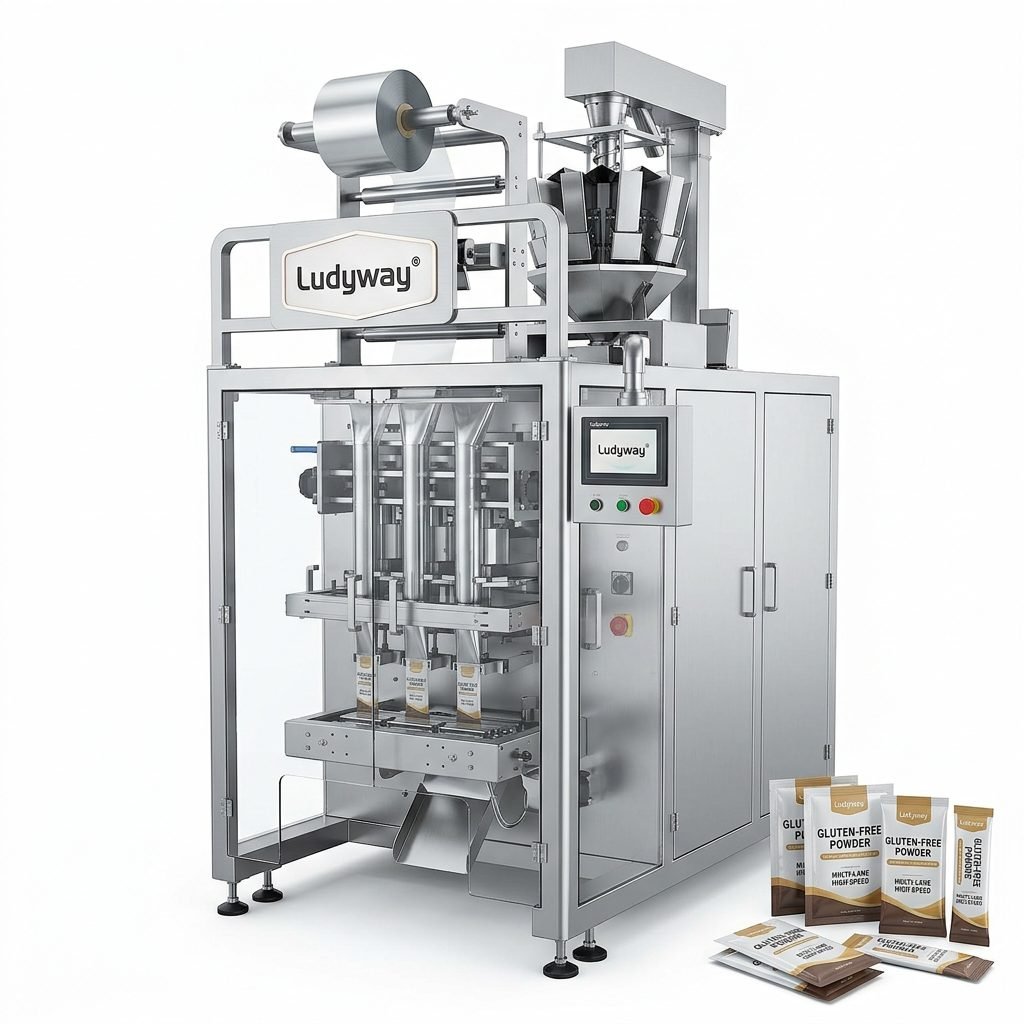
Modern manufacturing lines rarely fail at the mixing or forming stage; they fail at the point where a finished product has to be dosed, sealed, labelled and boxed at speed without a single leaking pack. That is why choosing the right packaging machine is a production decision as much as an equipment purchase. Whether you run a food plant filling 2 g sugar sticks, a pharmaceutical facility sealing oral rehydration salts, or a chemical operation bagging 25 kg of granules, the machine architecture you select sets your output ceiling, your changeover time and your cost per pack for the next ten to fifteen years.
This guide walks through the top 10 types of packaging machines used in modern manufacturing, explains what each is engineered to do, which product forms it handles best, the specifications procurement teams should ask for, and how to compare quotations from suppliers in China, Europe and North America. It is written for plant engineers, purchasing managers, distributors and project owners planning a new line or replacing ageing equipment.
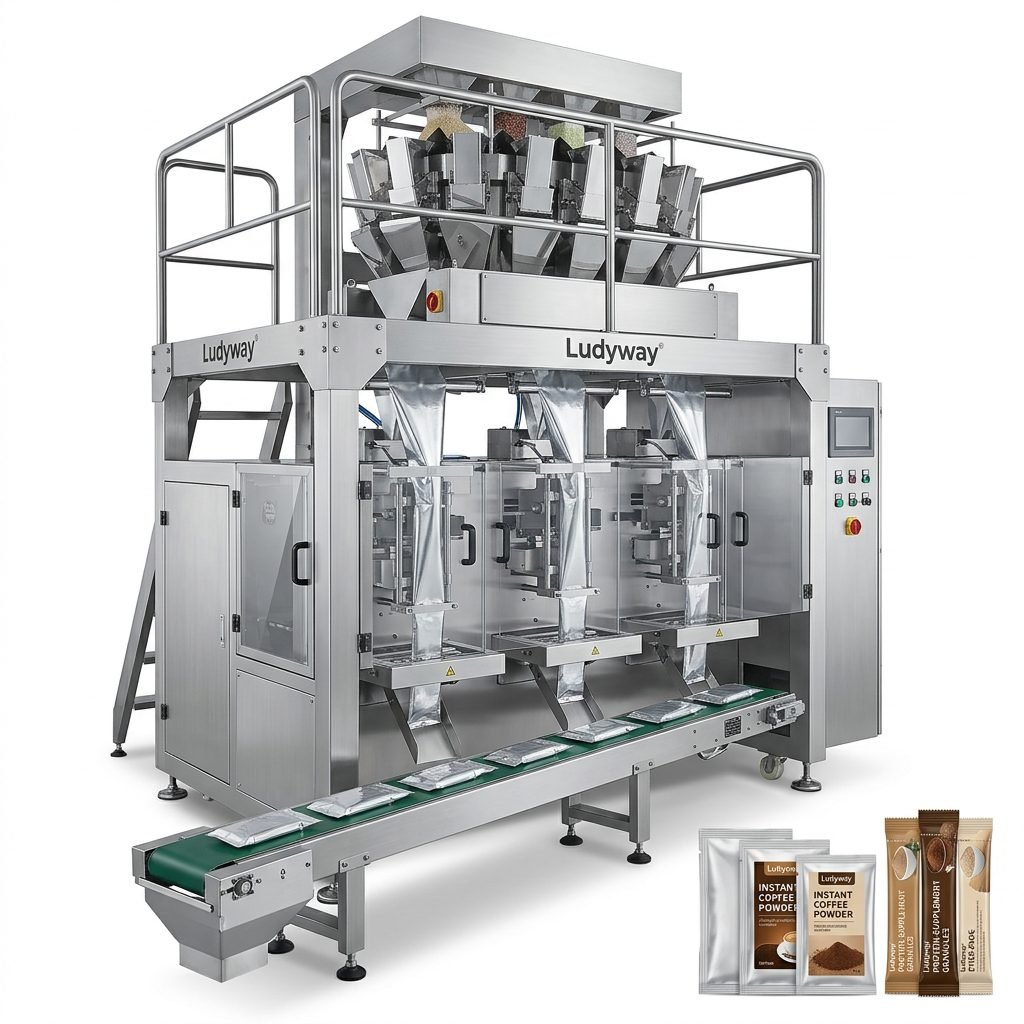
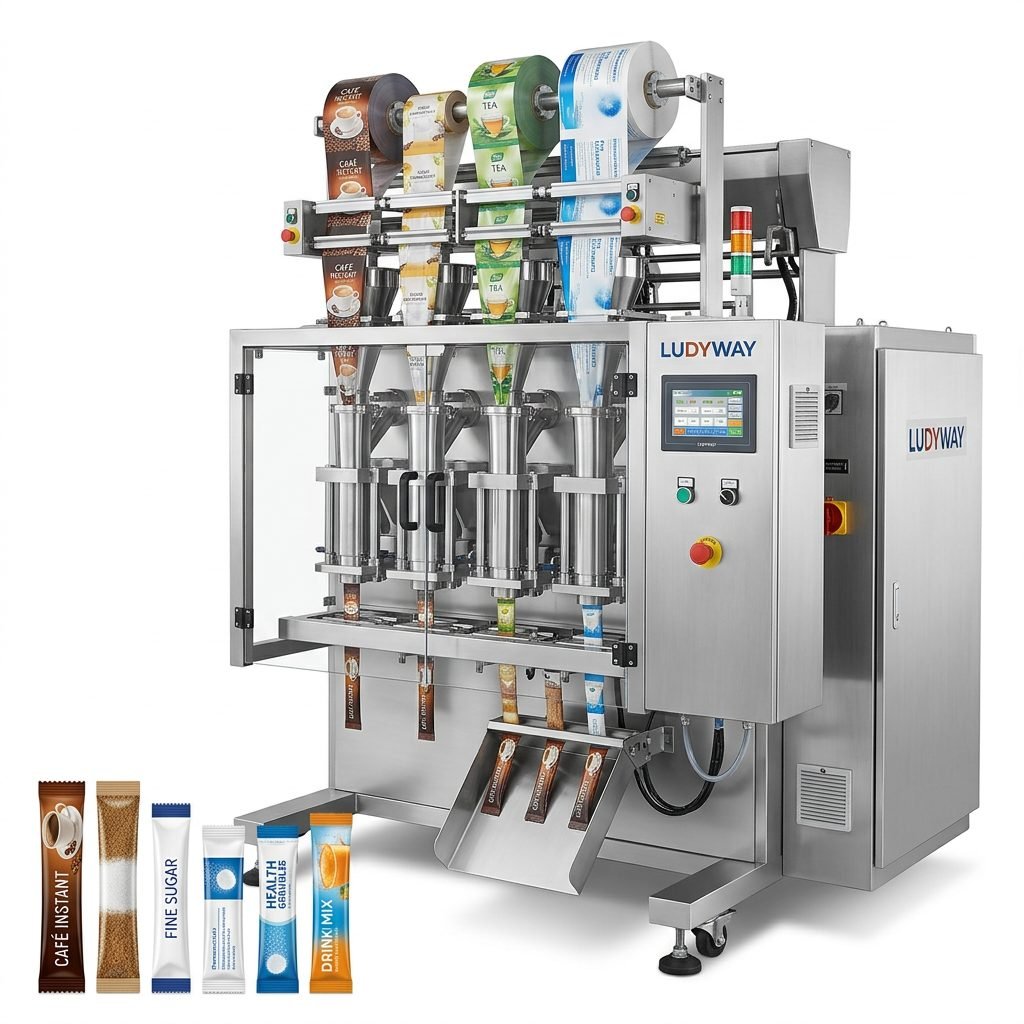
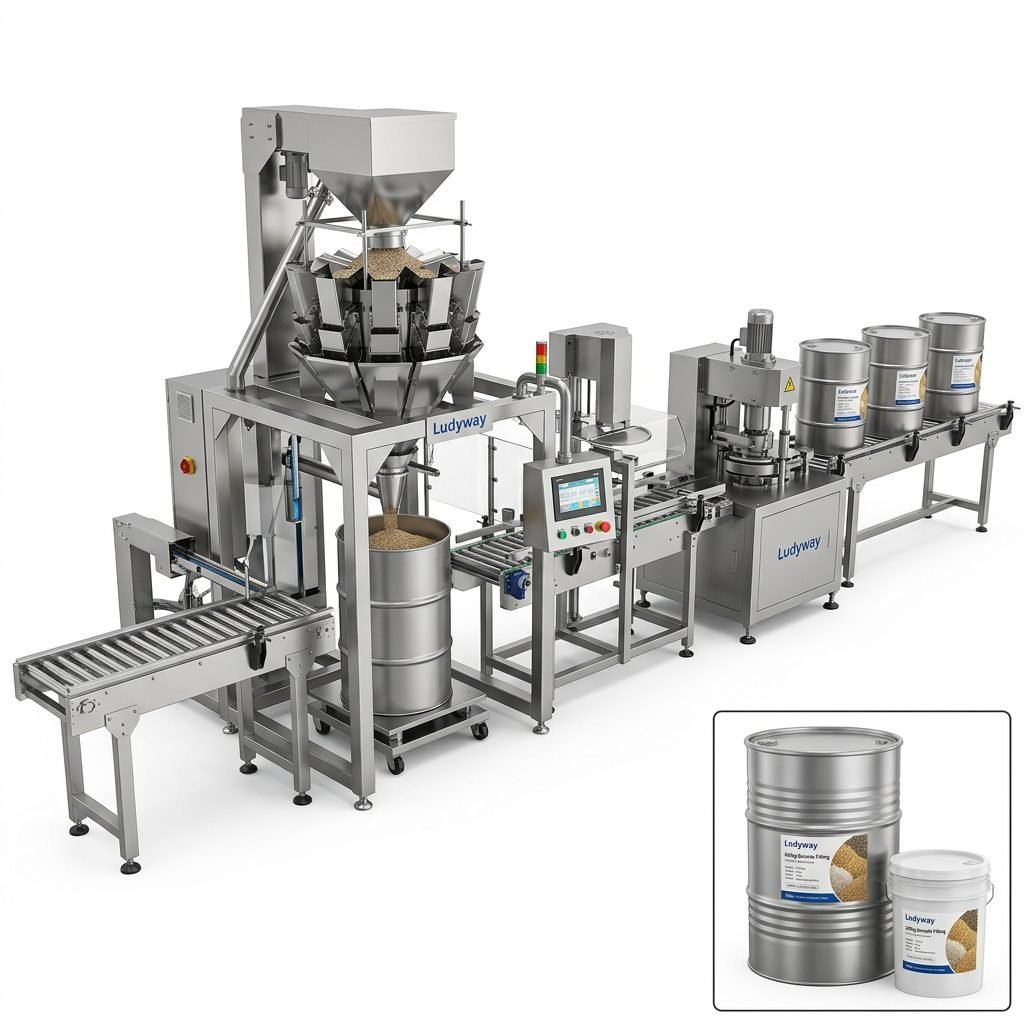
A multi-lane weighing, filling and sealing system is the core of many high-volume powder and granule packaging lines.
10
Core machine categories covering primary, secondary and end-of-line packaging
4–16 lanes
Typical lane count on multi-lane stick pack and sachet machines
±1–2%
Dosing accuracy expected from auger and volumetric fillers on free-flowing products
85%+ OEE
Realistic overall equipment effectiveness target for a well-integrated line
How Packaging Machines Are Classified in Industrial Production
Engineers normally group packaging equipment by where it sits in the line. Primary packaging machines put the product into its first container: form-fill-seal machines, pouch fillers, bottle fillers, blister machines and vacuum sealers. Secondary packaging machines group those primary packs into cartons, trays or shrink bundles. Tertiary or end-of-line machines build and wrap pallets for distribution.
A second useful axis is the physical form of the product. Granules, free-flowing powders, cohesive powders, liquids, pastes, gels, tablets and solid pieces each demand a different dosing system, and the dosing system usually determines the machine family. The association PMMI’s State of the Industry report tracks demand across these categories and consistently shows flexible packaging formats, automation and changeover speed as the top drivers of new machinery investment.
Rule of thumb: match the dosing technology to the product first, the bag or container format second, and the speed third. A fast machine with the wrong filler simply produces rejects faster.
The Top 10 Types of Packaging Machines Used in Modern Manufacturing
The following ten categories account for the overwhelming majority of packaging equipment installed in food, beverage, pharmaceutical, nutraceutical, cosmetic, chemical and pet-food plants worldwide. Each section covers the working principle, best-fit products, indicative throughput and the specifications worth checking before you request a quotation.
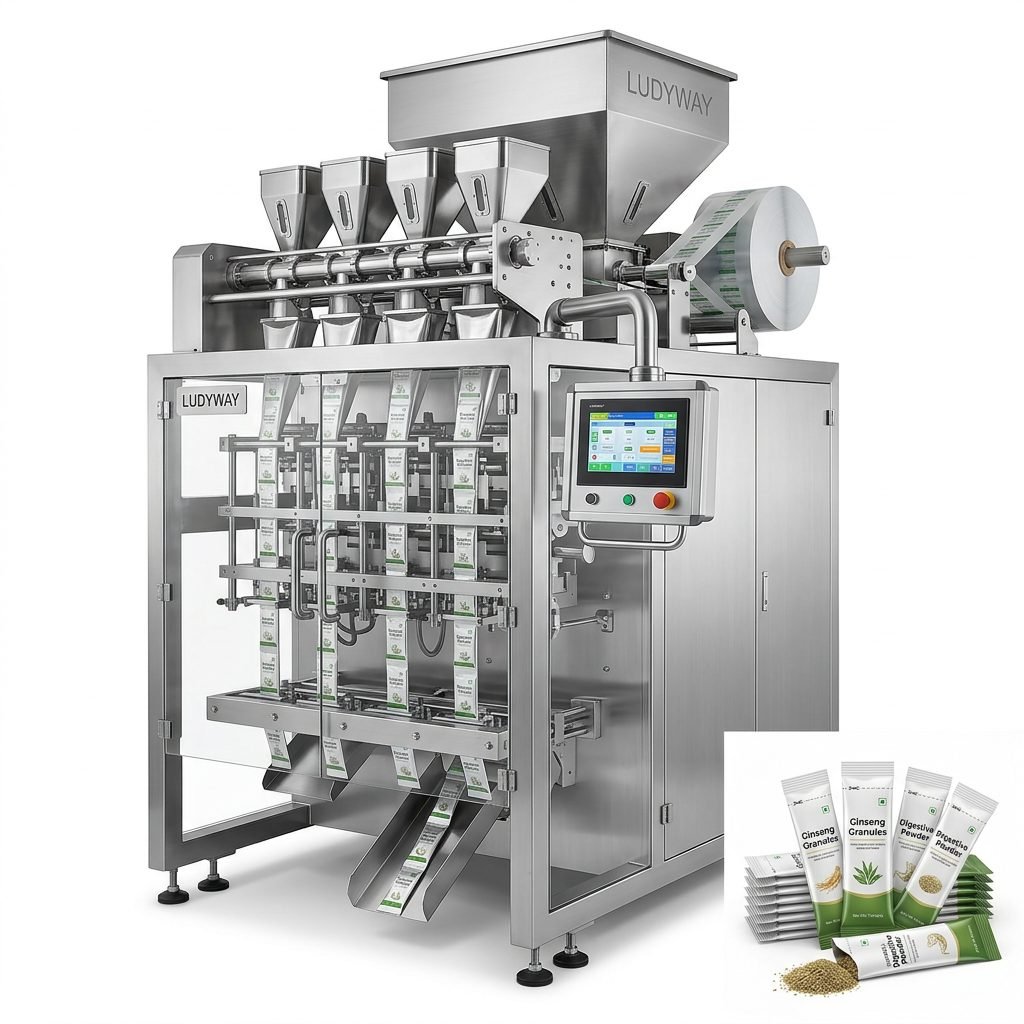
1. Vertical Form Fill Seal (VFFS) Machines
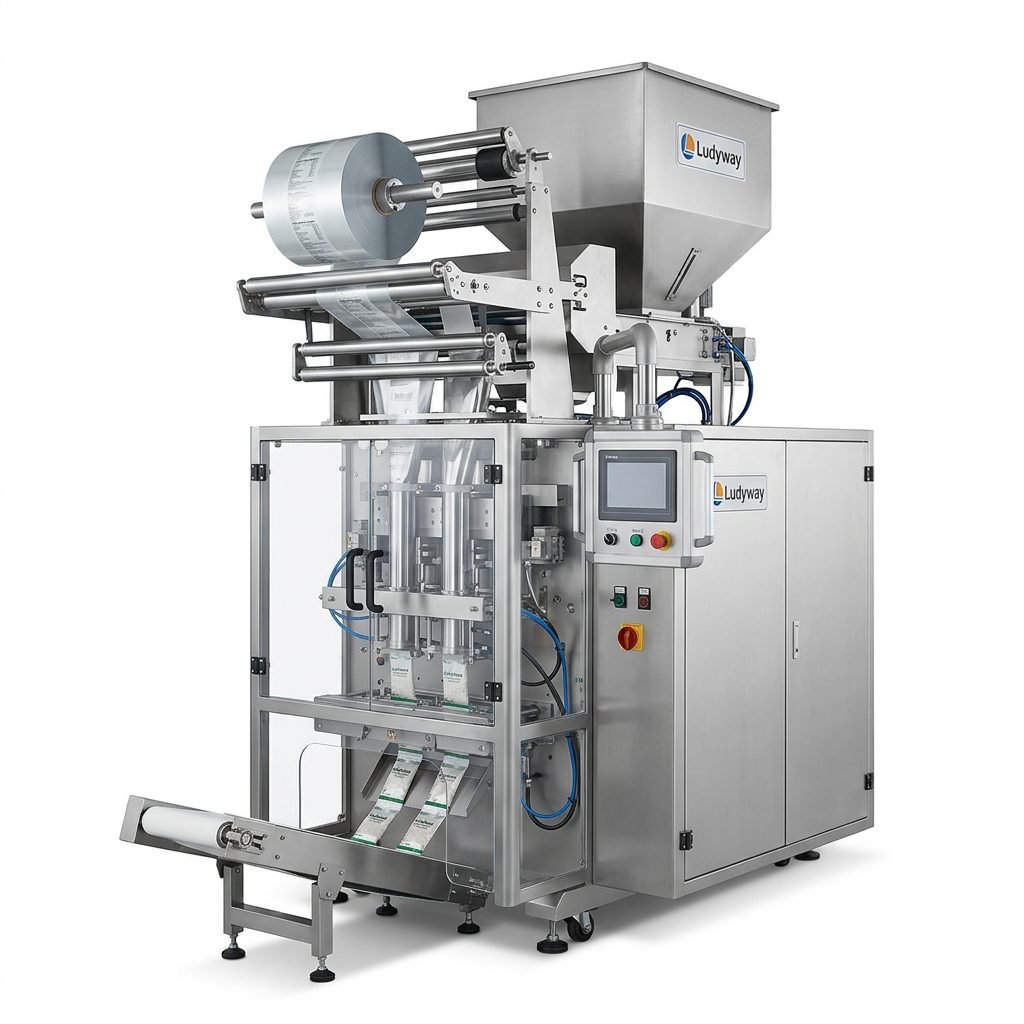
VFFS bagger configured for rice and granular food products.
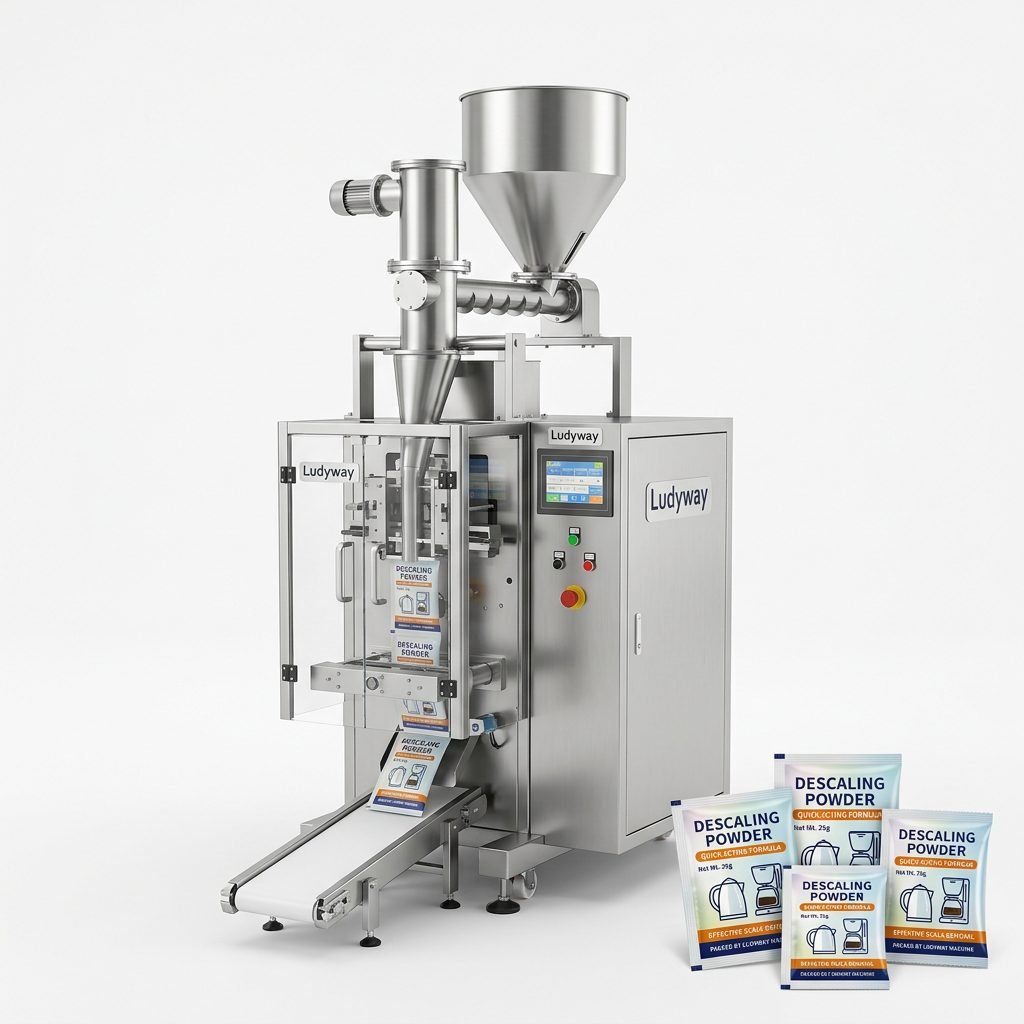
A VFFS machine pulls flat film from a roll, forms it into a tube around a forming collar, seals the back and bottom, drops in a measured dose from above, then seals the top and cuts the bag free. It is the workhorse of snack, rice, sugar, coffee, pet-food and frozen-food plants because it produces pillow bags, gusseted bags and quad-seal bags from inexpensive roll stock.
Typical speeds range from 30 to 150 bags per minute depending on bag size and dosing method. Multihead weighers suit granules and pieces; auger fillers suit powders; liquid pumps handle sauces and oils.
Specs to check: film width range, bag length range, sealing jaw type (heat seal or ultrasonic), servo-driven film pull, gas flushing option, and compatibility with recyclable mono-material films.
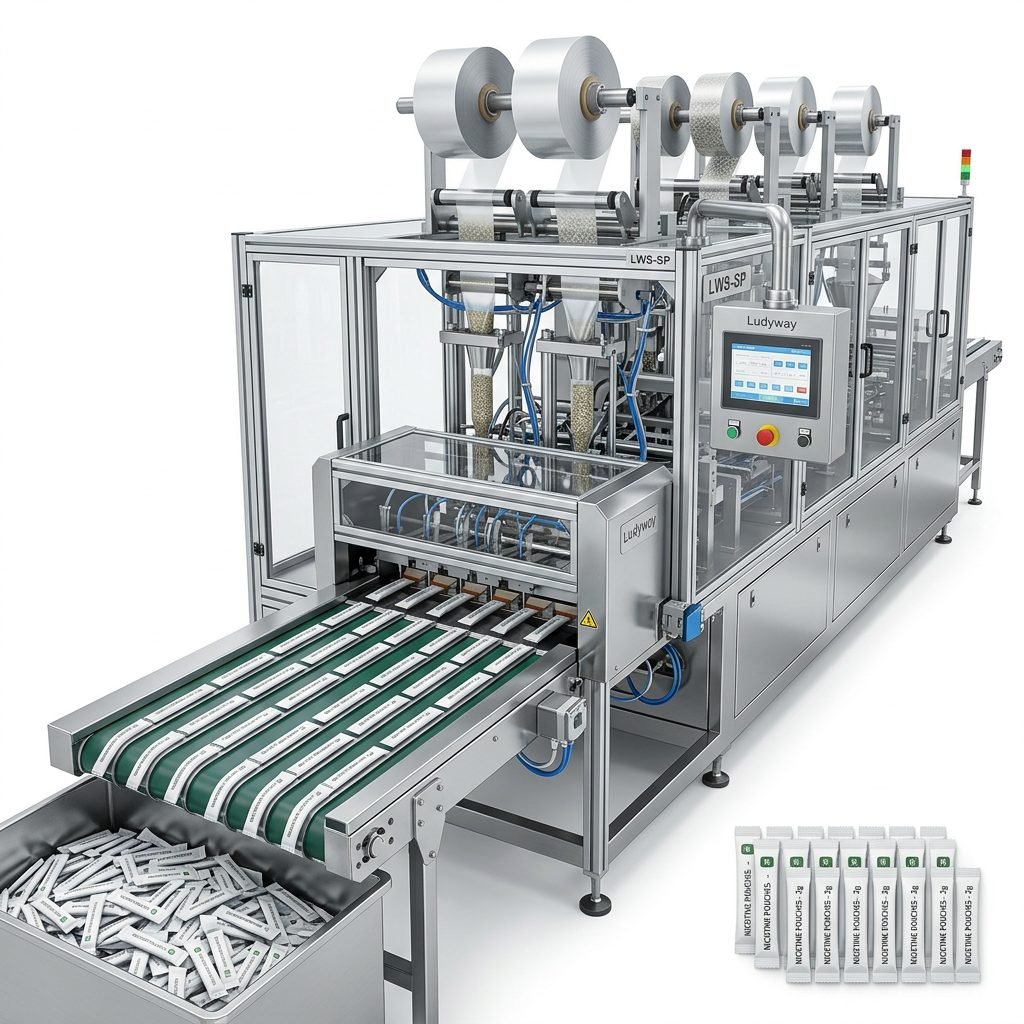
2. Multi-Lane Stick Pack Machines
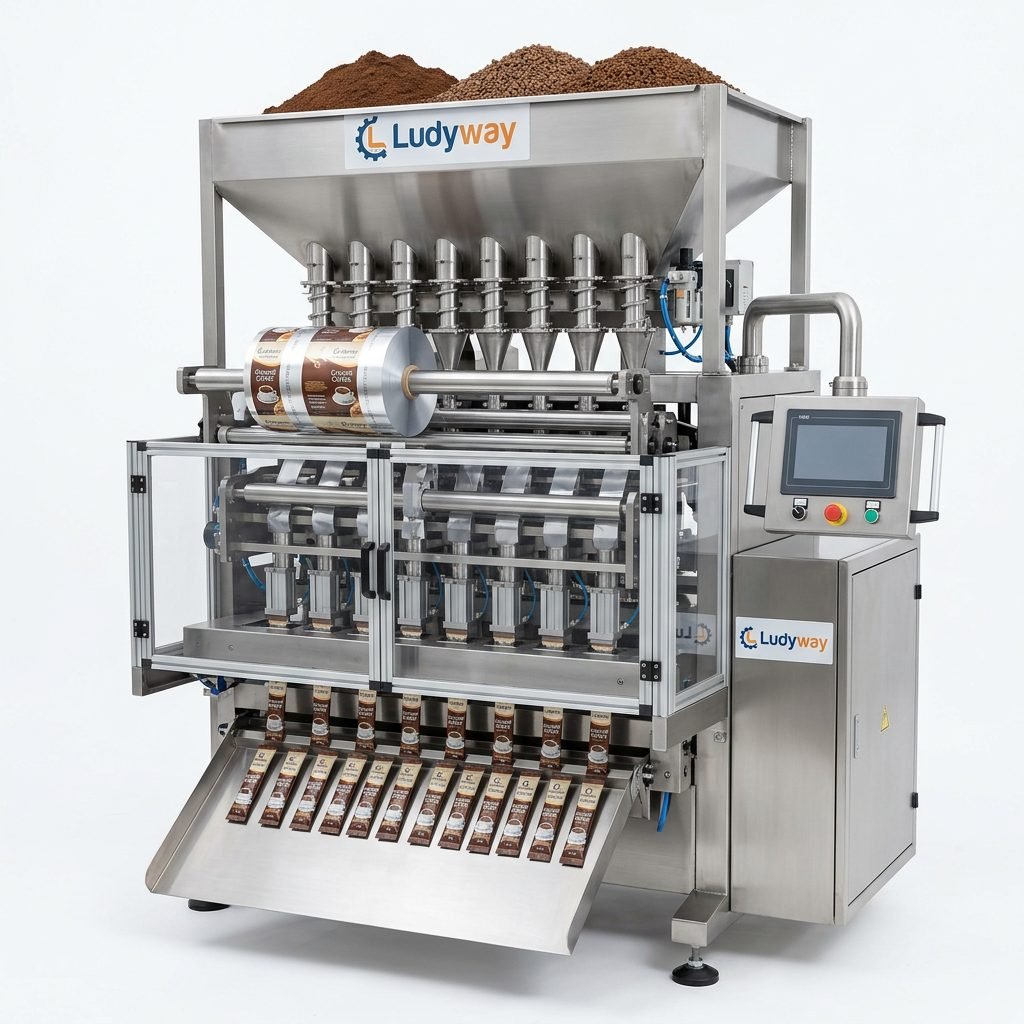
Stick pack machines are a specialised VFFS architecture that forms several narrow tubes side by side from one wide film web. A 10-lane machine running at 50 cycles per minute produces 500 sticks per minute from a single operator station, which is why stick packs dominate instant coffee, electrolyte powders, protein, collagen, sweeteners, honey and pharmaceutical granules.
Because the pack is long and slim, it fits in a pocket and pours cleanly, making it the preferred format for single-dose nutraceuticals. Machines are available with auger dosing for powders, volumetric cups for granules and piston pumps for liquids and gels, often on the same frame.
Specs to check: lane count, stick width range (typically 17–50 mm), stick length range, dosing accuracy, tool-free changeover, and whether the machine is built in stainless steel 304 or 316L for food and pharma contact. See the multi-lane stick pack and sachet packaging machine for granule, powder and liquid for a reference configuration.
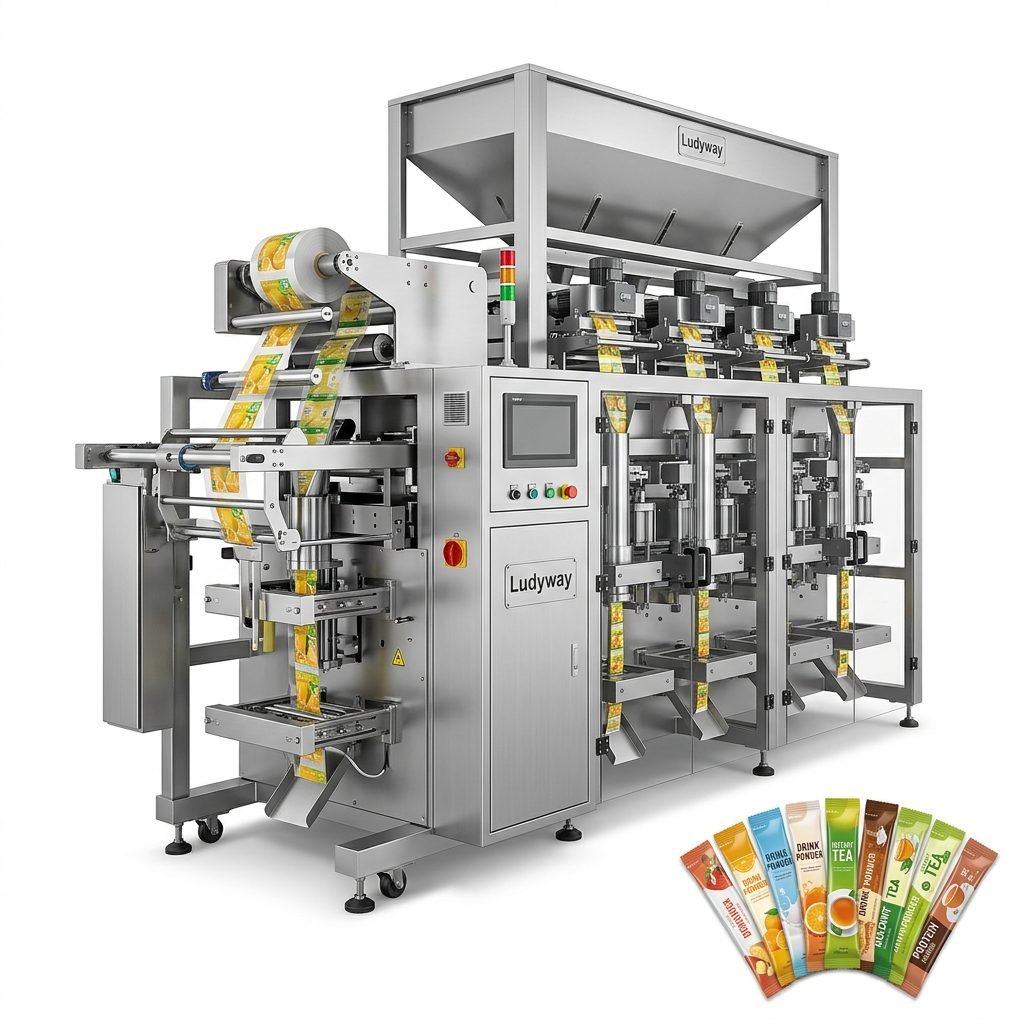
Multi-lane stick pack machine for drink powders and single-dose nutrition products.
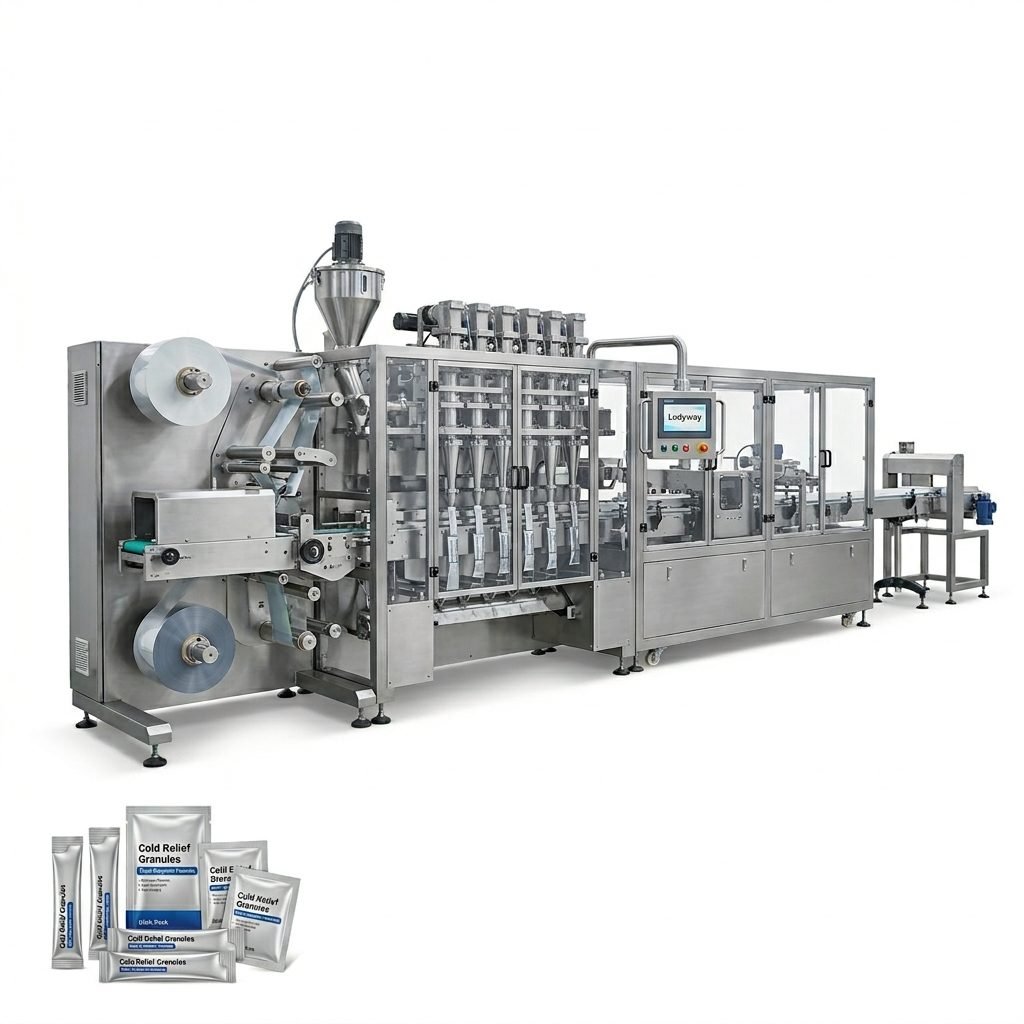
3. Sachet Packaging Machines (3-Side and 4-Side Seal)
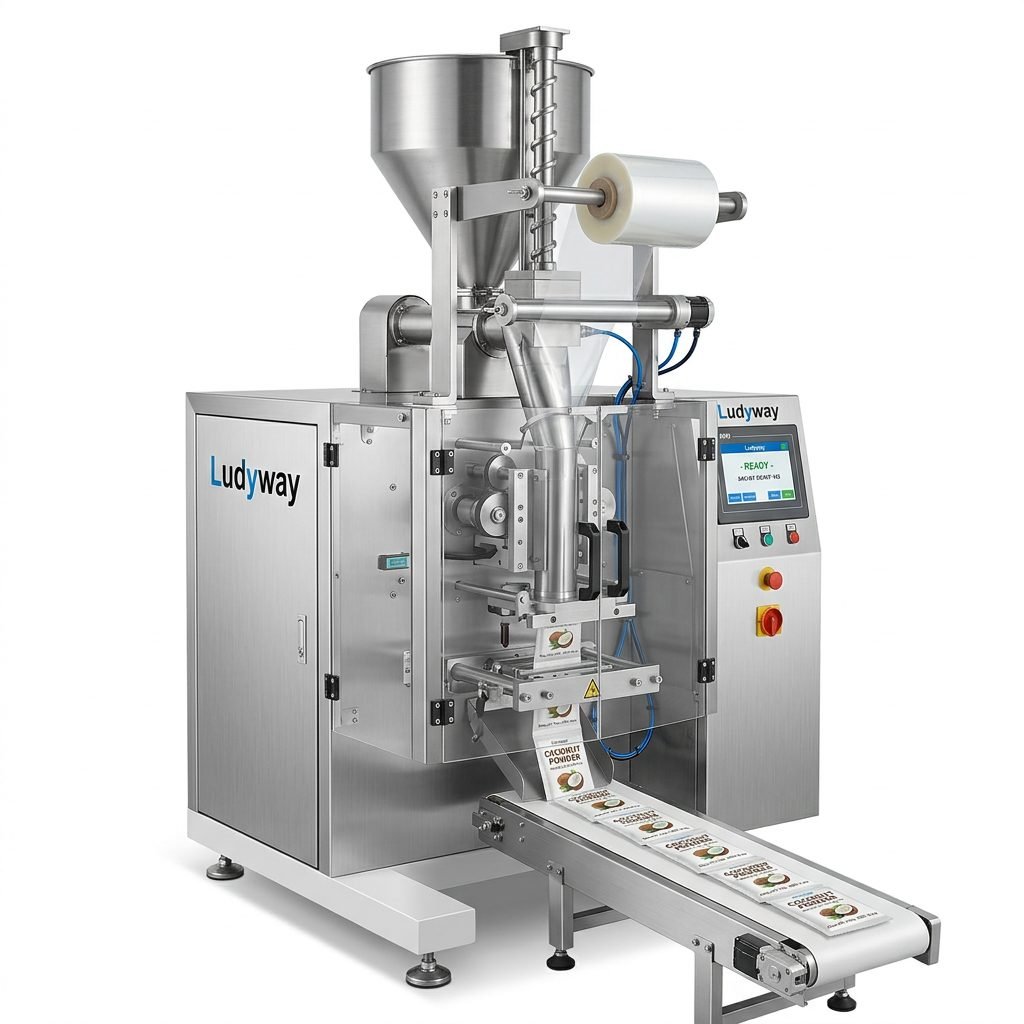
Four-side seal sachet machine for food powders.
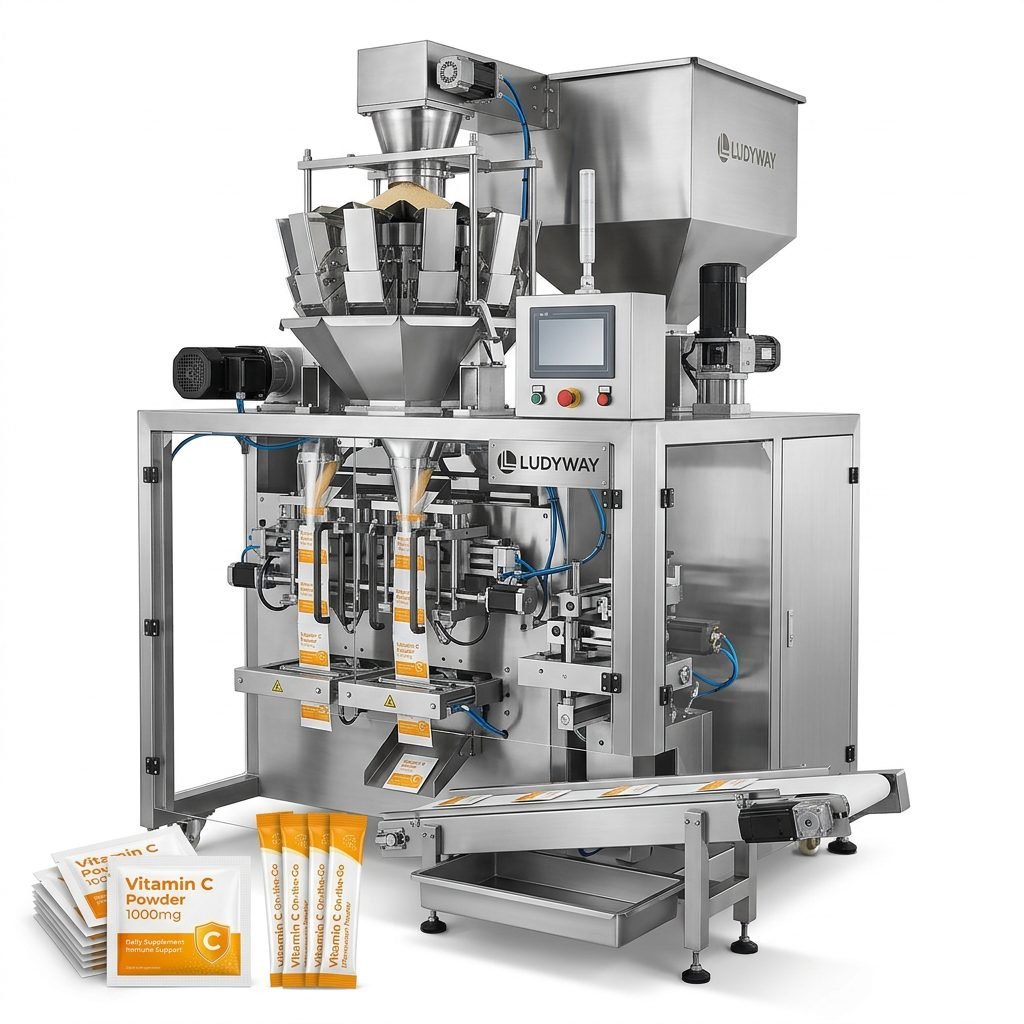
Sachet machines produce flat, rectangular packs sealed on three or four sides from one or two film webs. The four-side seal format gives a wide printable face and a strong hermetic seal, which is why it is standard for ketchup and mayonnaise portions, shampoo samples, wet wipes, pharmaceutical powders, seasoning and desiccants.
Like stick pack machines, sachet machines are commonly built as multi-lane systems with 4 to 16 lanes, giving outputs well above 600 sachets per minute. Laminated films with aluminium or metallised barrier layers are typical, so sealing temperature control and registration accuracy matter.
Specs to check: sachet width and length range, print registration tolerance, liquid splash control on the seal area, tear-notch and easy-open options, and CIP or washdown design for liquid products. A multi-lane sachet packaging machine for granules, powders and liquids shows the standard layout.
4. Horizontal Form Fill Seal (HFFS) and Flow Wrapping Machines
HFFS machines feed the product horizontally on a conveyor while film is wrapped around it from above or below, then fin-sealed lengthwise and cross-sealed between items. Flow wrappers are the simplest HFFS variant and are used for bars, biscuits, chocolate, face mask sheets, bread, medical devices and hardware. Thermoforming HFFS machines go further by heating and forming rigid or flexible film into trays for meat, cheese and sterile medical packs.
Speeds of 150 to 600 packs per minute are common on servo flow wrappers with automatic infeed. The format excels wherever the product is a discrete solid piece rather than a loose dose. Multi-lane infeed systems, such as those used on a face mask sheet horizontal flow wrapper, allow several product streams to feed one wrapping head.
Best for
Bars, confectionery, bakery, wipes and masks, medical disposables, electronic accessories, any item with a stable shape that can be pushed by a lug conveyor.
Specs to check
Maximum product height and width, box-motion versus rotary cross seal, no-product-no-bag sensing, modified atmosphere option, and film splice detection for continuous running.
5. Premade Pouch Packaging Machines
Rotary and linear premade pouch machines pick a pre-formed stand-up pouch, doypack or zipper bag from a magazine, open it, fill it and seal it. They trade the lower material cost of roll stock for premium shelf appeal, retail-ready zippers and spouts, and much faster bag changeovers. Pet food, granola, coffee beans, frozen fruit, liquid soups and baby food all rely heavily on this format.
A standard eight-station rotary machine runs 30 to 60 pouches per minute; duplex versions double that. Buyers should ask for pouch size range, gripper width adjustment method, zipper opening and dust-flap handling, and whether the filler can be swapped between multihead weigher, auger and liquid pump. A premade pouch packaging machine for granules, powder and liquids illustrates the modular filler approach.
6. Liquid Filling, Capping and Sealing Machines
Liquid fillers dose beverages, oils, syrups, shampoos, detergents, serums and oral medicines into bottles, vials, tubes, jars or flexible packs. The filling principle depends on viscosity and accuracy demands: gravity and overflow fillers for thin liquids, piston and servo pump fillers for creams and pastes, peristaltic fillers for sterile pharma, and flow-meter fillers for high-value products where every millilitre counts.
Rotary bottling monoblocks reach 6,000 to 24,000 bottles per hour, while inline fillers with 4 to 12 heads suit cosmetics and household chemicals at lower volumes. Capping, induction sealing, labelling and inkjet coding are normally integrated on the same conveyor.
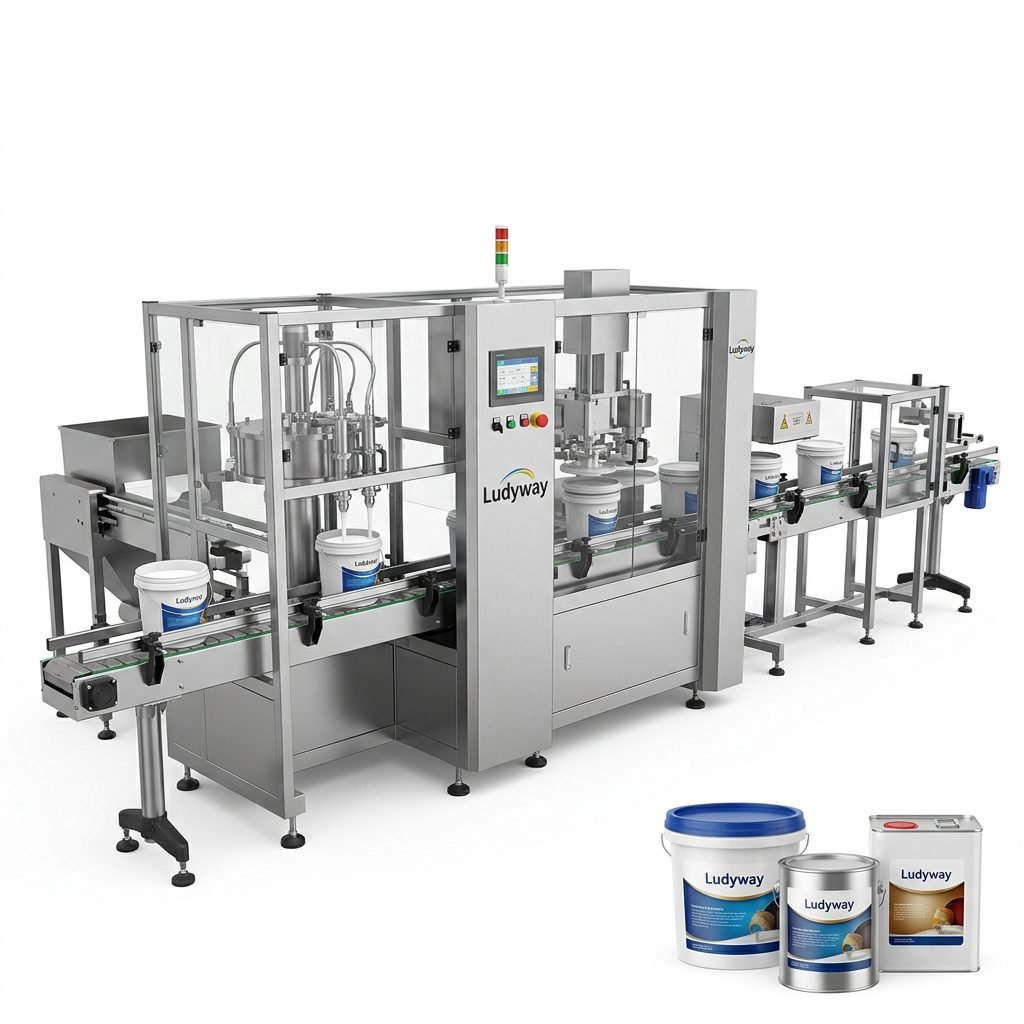
Specs to check: viscosity range, fill volume range and repeatability, number of heads, drip-free nozzles, CIP/SIP capability, explosion-proof rating for solvents, and GMP documentation for pharmaceutical use. For bottles and vials, review a pharmaceutical liquid filling and sealing machine.
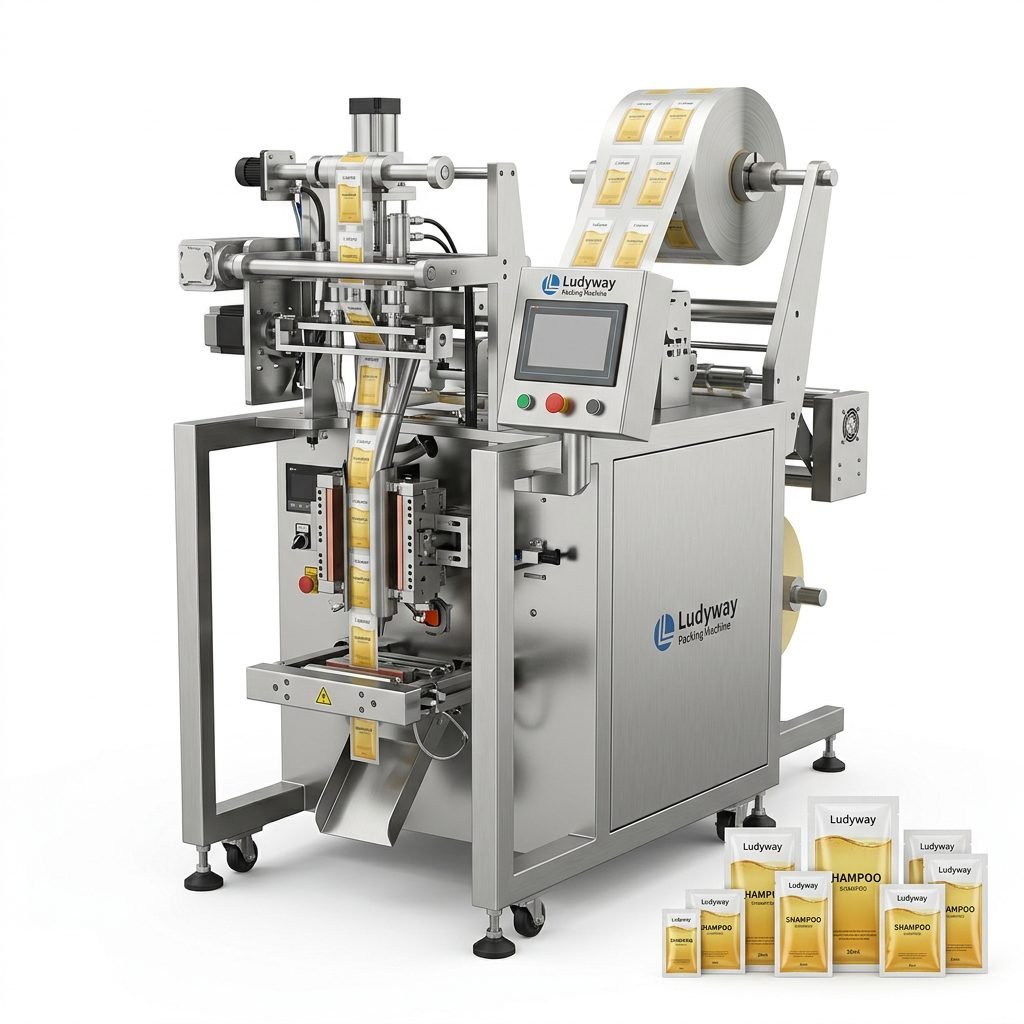
Liquid filling and sealing machine for personal-care sachets.
7. Blister and Strip Packaging Machines
Blister machines thermoform or cold-form cavities in PVC, PVDC or aluminium web, feed tablets, capsules or small devices into the cavities, then heat-seal a lidding foil and punch out finished blister cards. Strip packaging machines seal tablets between two foil webs without forming cavities. Both formats provide unit-dose protection, tamper evidence and clear batch coding, which is why they dominate solid-dose pharmaceuticals, chewing gum, vitamins and small consumer hardware.
Throughput and format
Intermittent-motion machines produce roughly 100 to 300 blisters per minute; continuous-motion rotary machines exceed 600. Forming area, index length and cavity depth define which products fit.
Compliance focus
Ask for cGMP design, 21 CFR Part 11-ready controls, vision inspection of every cavity, serialisation interface and integration with a downstream cartoner. A high-speed pharmaceutical blister packaging machine lists the standard options.
8. Vacuum and Modified Atmosphere Packaging Machines

Industrial vacuum packaging system for freeze-dried and shelf-stable foods.
Vacuum packaging machines evacuate air from the pack before sealing, which removes oxygen and slows oxidation and microbial growth. Chamber machines handle bags placed manually or robotically; belt and thermoforming vacuum machines run continuously. Modified atmosphere packaging (MAP) goes one step further by backflushing with nitrogen or a CO2 mix to preserve colour and texture in fresh meat, cheese, coffee and nuts.
For powders and granules such as milk powder, probiotics, freeze-dried meat and pharmaceutical actives, nitrogen flushing can be integrated directly into VFFS and stick pack machines, with target residual oxygen below 2% in the sealed pack.
Specs to check: pump capacity in cubic metres per hour, ultimate vacuum level, seal bar length, gas flush option, chamber dimensions and hygienic design. See the industrial vacuum packaging machine for food and pharmaceutical granule powder.
9. Shrink Wrapping and Sleeve Labelling Machines
Shrink wrappers enclose a product or a group of products in polyolefin or polyethylene film and pass it through a heat tunnel so the film contracts tightly. L-sealers suit boxed goods, software and cosmetics gift sets; sleeve wrappers bundle multipacks of bottles, cans and cartons for distribution; shrink sleeve labellers apply full-body decorative or tamper-evident sleeves to containers.
Automatic sleeve wrappers deliver 15 to 40 bundles per minute, with high-speed tray-and-film shrink packers for beverages exceeding 100. Energy consumption of the heat tunnel and film gauge are the two biggest operating-cost variables.
Specs to check: maximum product envelope, film width and thickness range, tunnel temperature uniformity, bullseye versus fully closed shrink, and conveyor integration. Reference the high-speed automatic shrink wrapping machine for industrial packaging.
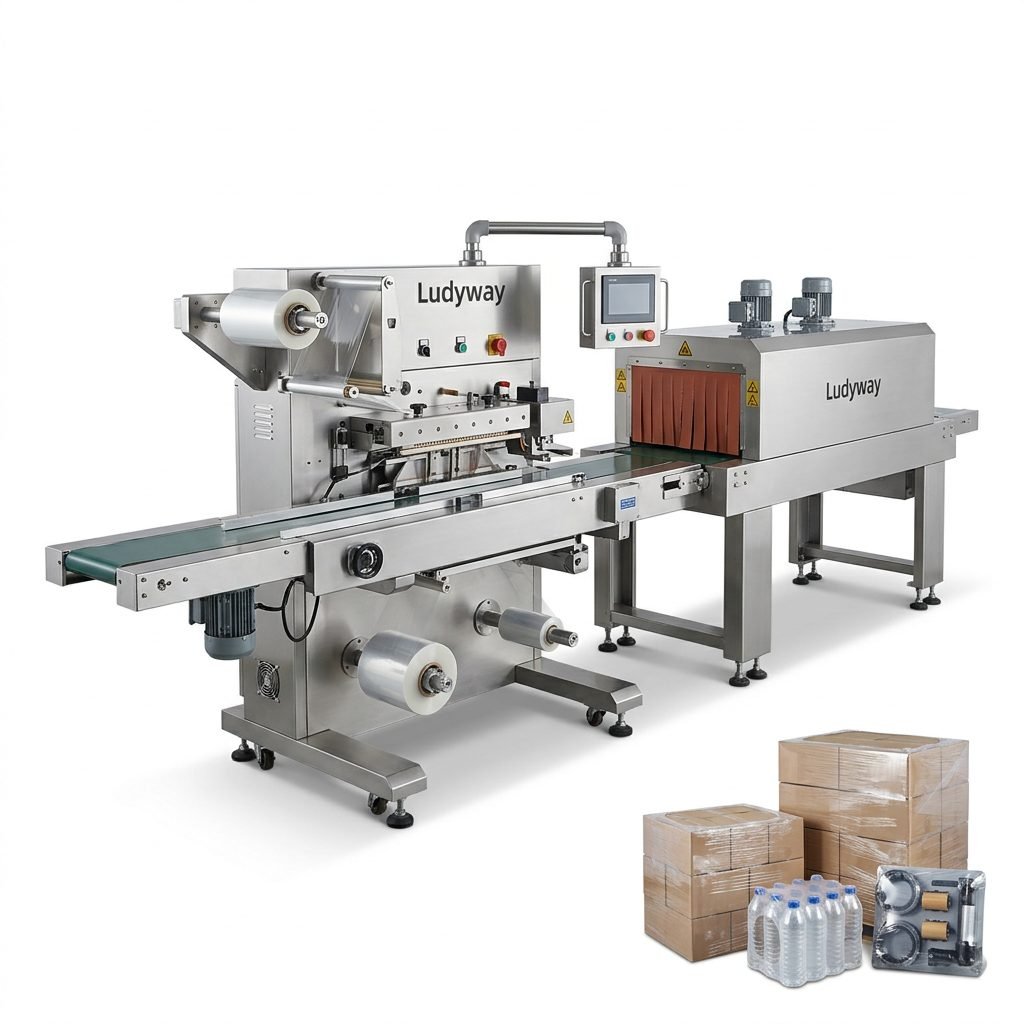
Automatic shrink wrapping machine for bundling and secondary packaging.
10. Cartoning, Case Packing and Palletizing Systems
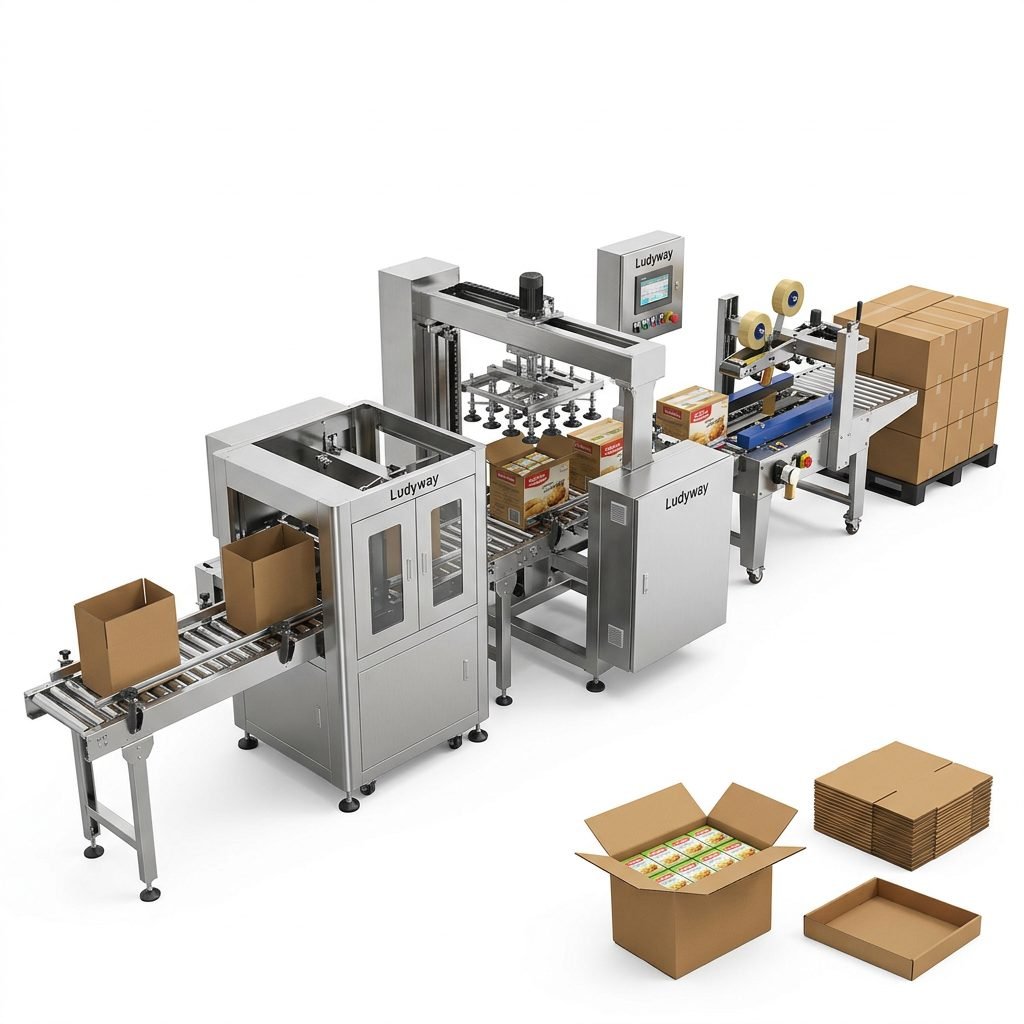
End-of-line case packing system handling cartons and trays.
End-of-line equipment turns thousands of primary packs per hour into shippable loads. Cartoners erect folding cartons and insert counted sachets, sticks, blisters or bottles; case erectors, case packers and case sealers build and close corrugated shippers; robotic or conventional palletizers stack cases in defined patterns and stretch wrappers secure the pallet.
Because these machines run downstream of everything else, their reliability determines the whole line’s OEE. Robotic palletizers with 600 to 1,500 cases per hour capacity and recipe-based pattern changes have become the default for multi-SKU plants.
Specs to check: carton or case size range, counting and collating method, glue versus tuck closure, pallet pattern software, safety guarding to ISO 13849 and integration protocol with upstream machines. Explore a robotic palletizing system for automated warehouses.
Packaging Machine Comparison: Format, Output and Best-Fit Products
The table below summarises the ten machine types side by side. Output figures are indicative for mid-range industrial models; actual throughput depends on product, pack size, film and dosing system.
| Machine Type | Pack Format | Indicative Output | Best-Fit Products | Key Spec to Verify |
|---|---|---|---|---|
| VFFS | Pillow, gusset, quad-seal bags | 30–150 bags/min | Snacks, rice, coffee, pet food, frozen food | Film width and dosing type |
| Multi-lane stick pack | Stick packs 17–50 mm wide | 200–800 sticks/min | Instant coffee, electrolytes, protein, honey, pharma granules | Lane count and dosing accuracy |
| Sachet (3/4-side seal) | Flat sachets | 200–1,000 sachets/min | Condiments, cosmetics samples, wipes, seasoning, ORS | Seal integrity on liquids |
| HFFS / flow wrap | Flow packs, thermoformed trays | 150–600 packs/min | Bars, biscuits, masks, medical devices | Product envelope and cross-seal type |
| Premade pouch | Doypack, zipper, spout pouch | 30–120 pouches/min | Pet food, granola, coffee beans, soups | Pouch size range and filler modularity |
| Liquid filling and capping | Bottles, vials, tubes, jars | 2,000–24,000 units/h | Beverages, oils, shampoo, serums, syrups | Viscosity range and CIP |
| Blister and strip | Blister cards, foil strips | 100–600 blisters/min | Tablets, capsules, gum, small devices | cGMP build and vision inspection |
| Vacuum / MAP | Vacuum bags, MAP trays | 2–20 cycles/min | Meat, cheese, freeze-dried food, milk powder | Pump capacity and residual oxygen |
| Shrink wrap / sleeve | Shrink bundles, sleeves | 15–100 bundles/min | Multipacks, boxed goods, bottles | Tunnel energy use and film gauge |
| Cartoning / case / palletizing | Cartons, cases, pallets | 600–1,500 cases/h | All sectors, end-of-line | Size range and safety compliance |
How to Select the Right Packaging Machine for Your Production Line
Procurement teams that follow a structured evaluation almost always end up with lower lifetime cost than those who buy on headline speed or lowest quote. The five-step sequence below is the one experienced line integrators use.
Step 1 — Characterise the product
Bulk density, particle size, flowability, hygroscopicity, dustiness, viscosity and temperature sensitivity. Send at least 5 kg or 5 L of real product for factory dosing trials before signing.
Step 2 — Fix the pack format and film
Confirm dimensions, fill weight tolerance, barrier requirement and whether the structure must be recyclable. Film choice can change sealing jaw design and machine speed by 20–30%.
Step 3 — Size for real demand
Base capacity on peak monthly volume at 85% OEE and realistic shifts, not on nameplate speed. Multi-lane machines scale output by adding lanes rather than by running faster.
Step 4 — Audit compliance and build quality
CE marking, ISO 9001 manufacturing, FDA-compliant food-contact materials, GMP design for pharma, IP65 washdown where needed, and branded components such as Siemens, Schneider or Omron controls.
Step 5 — Compare total cost of ownership
Include film waste on start-up, changeover time, spare-parts pricing, energy, operator headcount, remote diagnostics and the supplier’s installation, training and warranty terms.
Bonus — Plan the full line
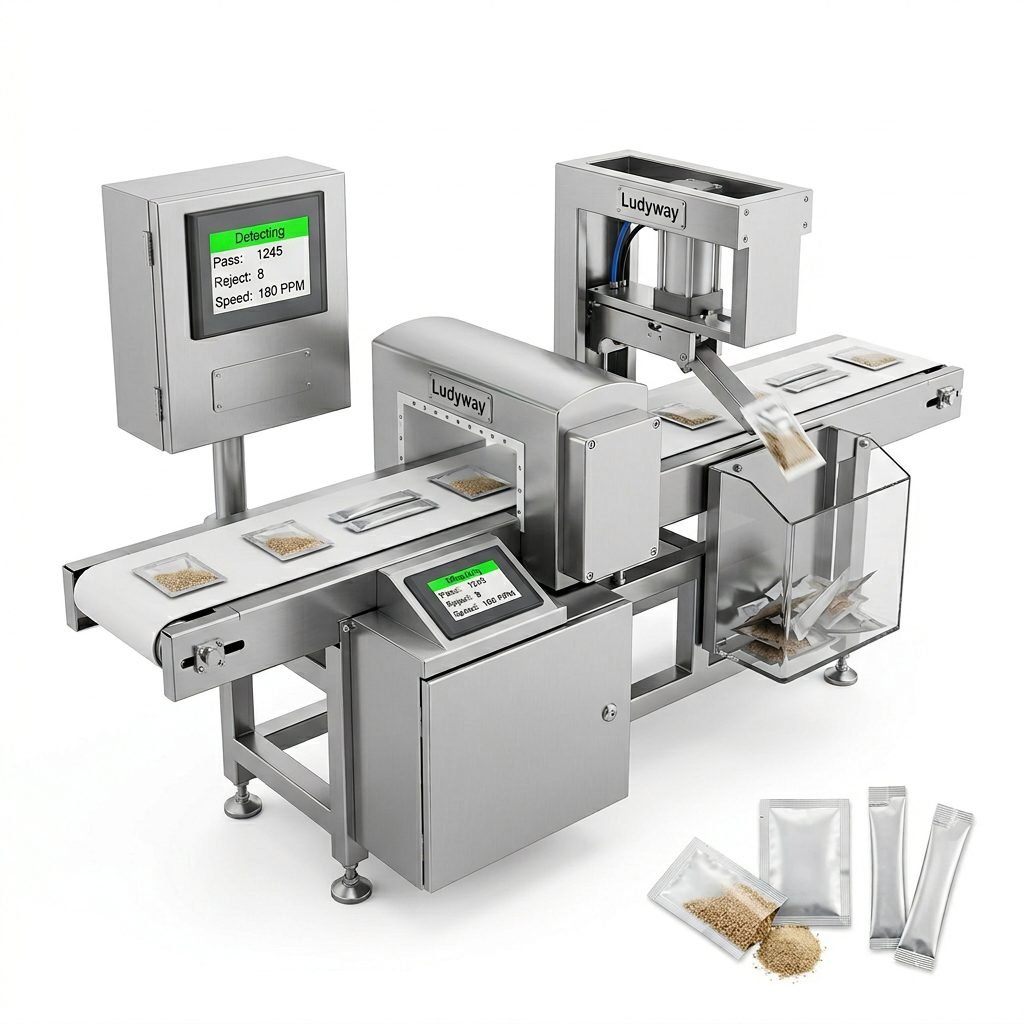
Feeding, checkweighing, metal detection, coding, cartoning and palletizing should be quoted together so interfaces, conveyor heights and PLC communication are the supplier’s responsibility, not yours.
Certifications and Standards Buyers Should Request
For food and nutraceutical lines, product-contact parts must comply with food-contact regulations such as the FDA requirements for food contact substances in the United States or EU Regulation 1935/2004 in Europe, and the machine itself should carry CE marking under the Machinery Directive. Pharmaceutical installations additionally require GMP-compliant surfaces, documented IQ/OQ/PQ validation and, for sterile medical devices, packaging processes validated to ISO 11607.
Flexible-film users should also track material and sustainability guidance published by the Flexible Packaging Association, since brand owners are increasingly specifying mono-material PE or PP structures that need wider sealing windows and modified jaw profiles.
From Single Machines to Turnkey Packaging Lines
Most plants start with one primary packaging machine and add feeding, inspection and end-of-line equipment later. The alternative, increasingly common among exporters and contract packers, is to commission a complete turnkey line from one supplier: product conveying and dosing, multi-lane filling and sealing, checkweighing, metal detection, cartoning, case packing and palletizing, all delivered with a single control architecture and one point of accountability.
A turnkey approach typically shortens commissioning by weeks, removes interface disputes between vendors and makes future expansion simpler because every module already speaks the same protocol. See an example of a custom turnkey packaging line for granule, powder and liquid products.
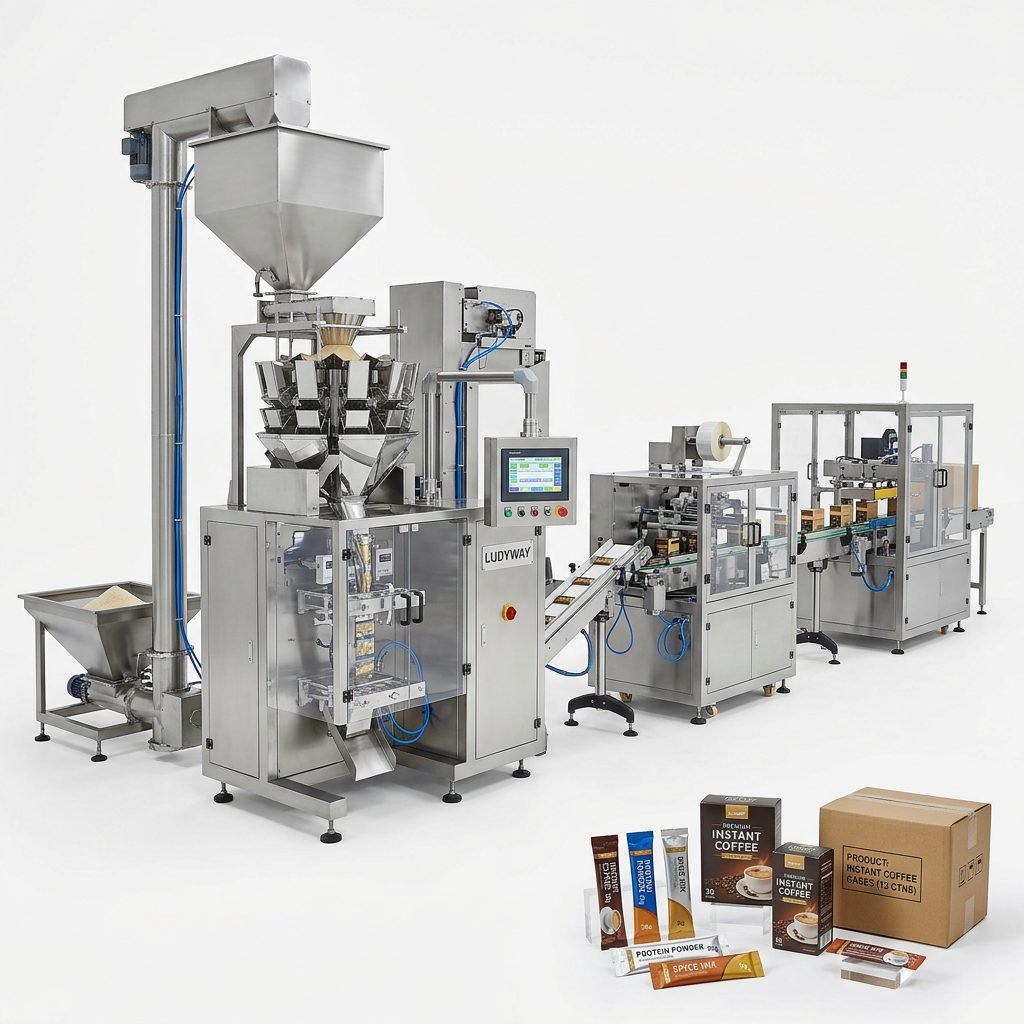
Turnkey instant food packaging line integrating filling, inspection and end-of-line modules.
Why Manufacturers Source Packaging Machines from Ludyway
Ludyway Machinery, founded in 1993 and based in Nanlang Town, Zhongshan, Guangdong, is one of the largest packaging machine manufacturers in China, specialising in multi-lane stick pack, sachet and fully automated packaging systems for granule, powder, liquid and pouch applications in the food, pharmaceutical and health industries. The company operates a 20,000 m² production facility with more than 200 manufacturing equipment units, employs 130+ packaging specialists and offers over 50 intelligent packaging machine models supplied to customers in more than 100 countries and regions.
With over 30 years of engineering experience, Ludyway builds complete turnkey lines as well as individual machines, supports international projects with installation, training and remote diagnostics, and has grown annual revenue beyond RMB 500 million on the strength of its export business. Independent coverage of this growth is available in the report Ludyway Packaging Machinery Global Growth Trend.
30+
Years of industry experience
50+
Intelligent packaging machine models
130+
Professional packaging experts
100+
Countries and regions served
Ludyway Multi-Lane and Automated Packaging Machines
Multi-Lane Stick Pack Machine
Primary Packaging, Granule and Powder
Price on Request
Multi-Lane Sachet Machine
Primary Packaging, Powder and Liquid
Price on Request
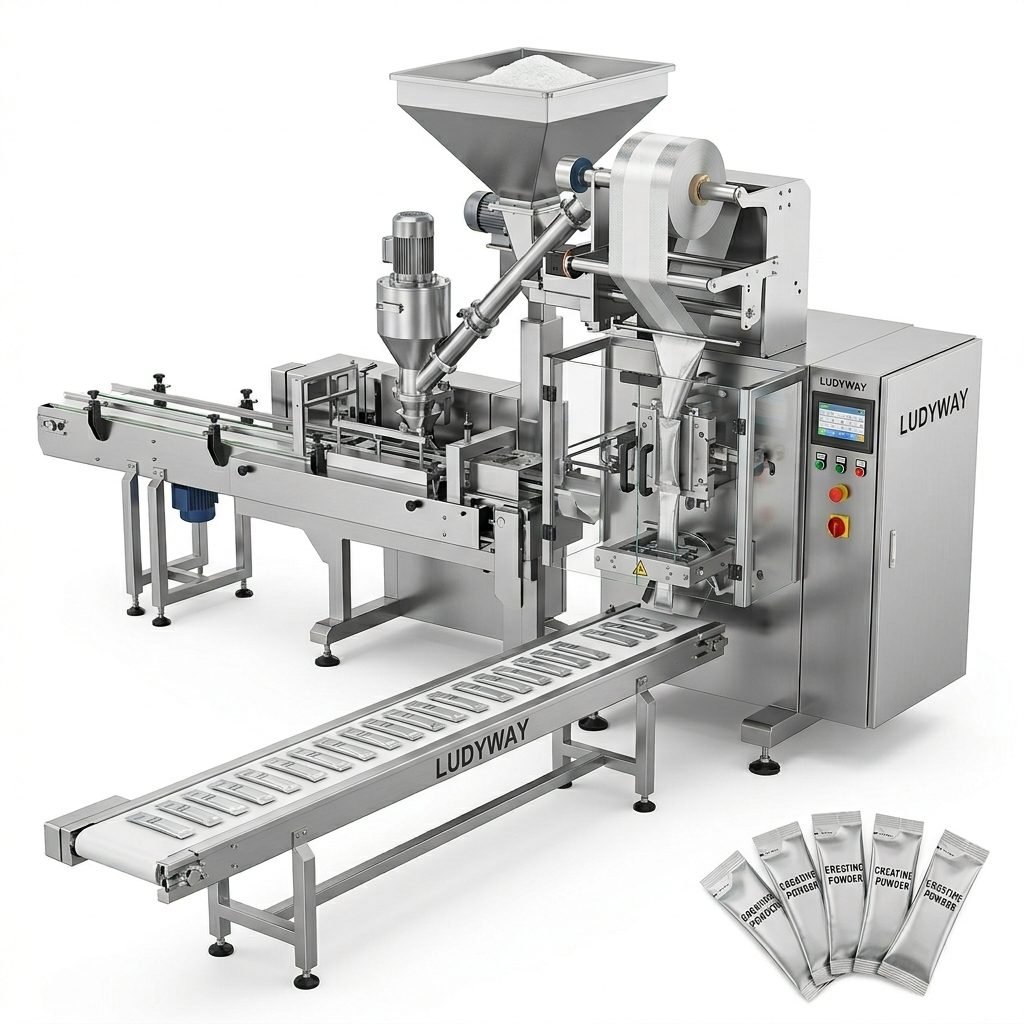
Powder Packaging Line
Turnkey Line, Sports Nutrition
Price on Request
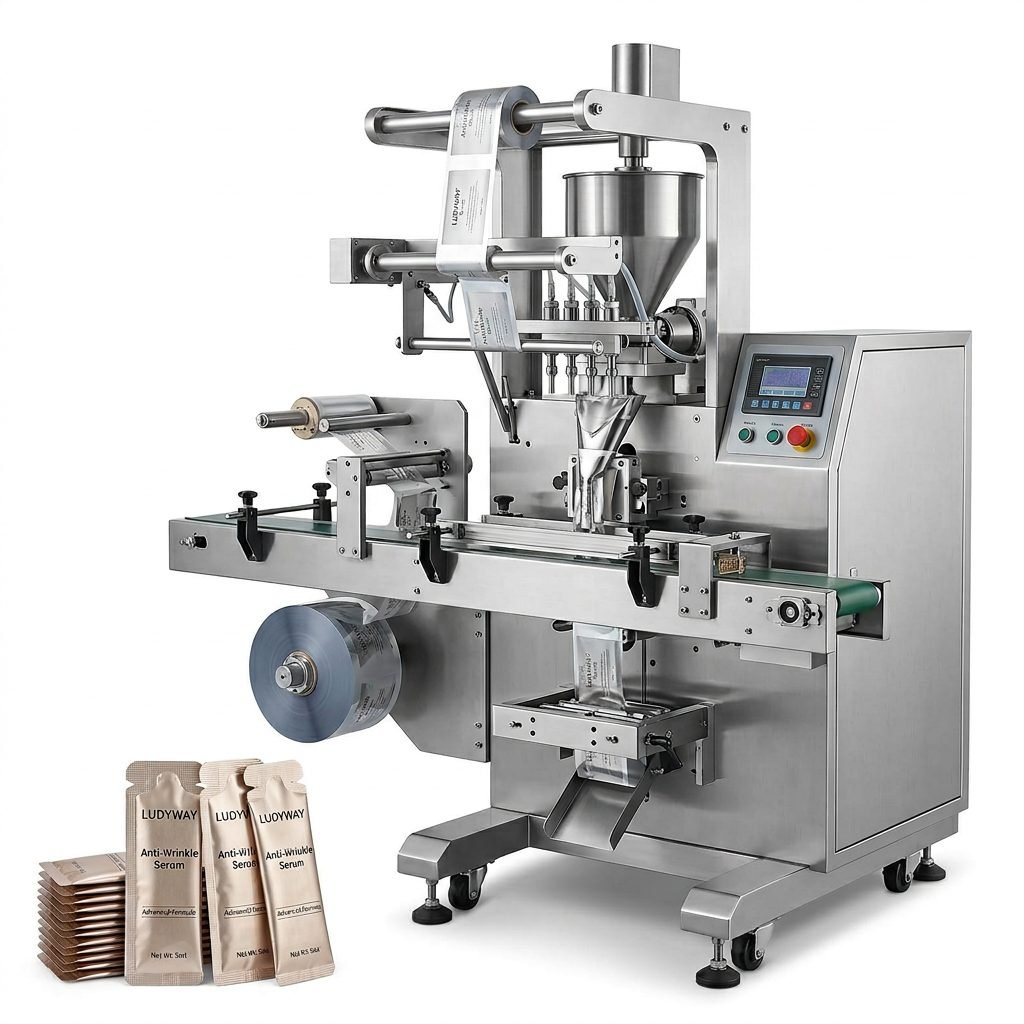
Liquid Sachet Filling Machine
Primary Packaging, Liquid and Gel
Price on Request
Frequently Asked Questions About Packaging Machines
What is the difference between a stick pack machine and a sachet machine?
Both are multi-lane vertical form-fill-seal systems, but a stick pack machine forms long, narrow tubes with a single back seal, while a sachet machine produces flat packs sealed on three or four sides from one or two film webs. Stick packs use less film per dose and pour more easily; four-side sachets offer a larger print area and stronger seals for liquids.
Which packaging machine is best for powders that do not flow well?
Cohesive powders such as cocoa, protein, collagen and spices are best handled by servo-driven auger fillers with agitators, mounted on a VFFS, stick pack or sachet machine. Volumetric cup fillers are only suitable for free-flowing granules like sugar, salt or rice.
What is the typical lead time and minimum order for an industrial packaging machine?
Standard multi-lane machines are usually built to order in 45 to 90 days after technical confirmation, while complete turnkey lines take 90 to 150 days depending on scope. Most manufacturers, including Ludyway, accept single-unit orders; pricing is quoted per configuration after product samples and pack specifications are reviewed.
How should a packaging machine be quoted and compared?
Request quotations on an FOB or CIF basis with a full component list, stated output at your pack size, dosing accuracy guarantee, scope of installation and training, warranty period and a spare-parts price list. Comparing on these line items rather than on total price alone reveals the real cost of ownership.
Can one machine package granules, powders and liquids?
Yes. Many modern multi-lane stick pack and sachet machines are designed with interchangeable dosing modules, so an auger, volumetric cup and piston pump can be fitted to the same frame. Changeover takes under an hour on well-designed systems, which is valuable for contract packers running diverse SKUs.
Request a Quotation, Sample Test or Product Catalogue
If you are specifying a new line or replacing an existing machine, the fastest route to an accurate proposal is to share your product type, target pack size and weight, required output per hour and destination market. Ludyway’s engineering team will recommend the right machine type from the ten covered above, run dosing and sealing trials with your material, and return a configuration with technical drawings, component brands, lead time and after-sales terms.
Email: info@ludyway.com
WhatsApp: +86 131 2959 2456
Factory: Nanlang Town, Zhongshan, Guangdong, China — factory visits and video audits are welcome, and the team exhibits at major international packaging shows including PACK EXPO.